
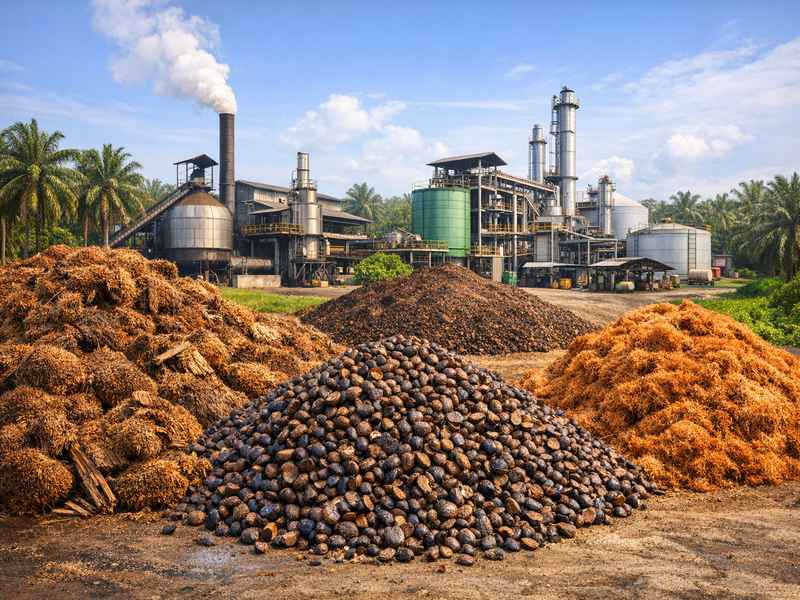
What Are the By-Products of the Palm Oil Production Process?
Palm oil production yields crude palm oil (CPO) and palm kernel oil (PKO), but these are only part of the fruit’s total value. The industry efficiently utilizes nearly every component of the fresh fruit bunch (FFB) as a useful by-product. Understanding these by-products is key to boosting profitability, enhancing sustainability, and reducing environmental impact. This article outlines the main by-products of palm oil processing and their commercial and environmental uses. Overview of Palm Oil Processing Stages To understand by-products, we must first briefly review the palm oil production process: Fresh Fruit Bunch (FFB) reception Sterilization Threshing Digestion and pressing Clarification Kernel recovery Each of these stages generates solid, liquid, or gaseous by-products that can be reused, recycled, or commercialized. Major Solid By-Products Empty Fruit Bunches (EFB) Origin: After sterilization and threshing, palm fruits are separated from the bunch structure. The leftover structure is called the Empty Fruit Bunch (EFB). Quantity: Approximately 20–23% of FFB weight. Characteristics: High fiber content High moisture content (60–65%) Rich in potassium and organic matter Applications: Application Description Mulching Applied in plantations to retain soil moisture Composting Mixed with POME sludge to produce organic fertilizer Biomass fuel Used in boilers after drying Fiberboard production Processed into eco-friendly panels Biochar production Converted into soil-enhancing carbon material EFB represents one of the most valuable biomass streams in the palm oil industry. Palm Mesocarp Fiber Origin: Generated during pressing when oil is extracted from the fruit. Quantity: Roughly 12–15% of FFB weight. Characteristics: Fibrous Moderately dry High calorific value Applications: Application Description Boiler fuel Primary biomass fuel in mills Cogeneration Steam and electricity production Pellets Biofuel export market Most mills use mesocarp fiber as fuel for steam boilers, significantly reducing fossil fuel dependency. Palm Kernel Shells (PKS) Origin: Produced during kernel cracking and separation. Quantity: Around 5–7% of FFB weight. Characteristics: Hard shell High energy density Low moisture content Applications: Application Description Biomass fuel Exported for power generation Activated carbon Processed into filtration media Biochar Used for soil improvement Industrial heating Cement and power industries Palm kernel shells have become a globally traded biomass commodity. Palm Kernel Meal (PKM) Origin: Generated after extracting oil from palm kernels. Characteristics: High protein content Suitable for livestock feed Applications: Application Description Animal feed Used for cattle and poultry Aquaculture feed Fish farming input Organic fertilizer Soil amendment PKM is especially valuable in regions with strong livestock industries Liquid By-Products Palm Oil Mill Effluent (POME) Origin: Produced during sterilization, clarification, and hydrocyclone processes. Quantity: About 0.6–1 cubic meter per ton of FFB processed. Characteristics: High biological oxygen demand (BOD) Rich in organic matter High temperature when discharged Applications After Treatment: Application Description Biogas production Methane capture through anaerobic digestion Organic fertilizer Land application after treatment Irrigation water Controlled reuse POME management is critical for environmental compliance. In modern mills, POME is treated to generate biogas, creating renewable energy while reducing greenhouse gas emissions. Spent Bleaching Earth (SBE) Origin: Generated in the refining stage during oil bleaching. Characteristics: Contains residual oil Clay-based material Applications: Application Description Biodiesel feedstock recovery Extract residual oil Brick manufacturing Mixed into building materials Energy recovery Burned under controlled conditions Proper handling is important due to fire risk from residual oil. Gaseous By-Products Biogas (Methane) Origin: Produced during anaerobic digestion of POME. Composition: Methane (CH₄) Carbon dioxide (CO₂) Applications: Application Description Electricity generation Gas engines for power Steam production Boiler fuel Upgraded biomethane Compressed gas use Biogas capture improves sustainability and reduces the carbon footprint significantly. Boiler Flue Gas When fiber and shells are burned, flue gases are generated. With proper emission control systems (cyclones, scrubbers), particulate matter is minimized. Modern plants incorporate emission treatment systems to comply with environmental standards. Secondary Industrial By-Products Beyond the mill stage, refining and fractionation generate additional streams. Palm Fatty Acid Distillate (PFAD) Origin: Produced during deodorization in the refining process. Characteristics: High free fatty acid content Dark colored Applications: Application Biodiesel production Soap manufacturing Animal feed additives Description Major feedstock Low-cost fatty acid source Under regulation PFAD is increasingly valuable in renewable fuel markets. Glycerol (in Biodiesel Production) When palm oil is converted into biodiesel, glycerol is generated as a by-product. Applications: Pharmaceuticals Cosmetics Food additives Industrial solvents Summary of Major By-Products Below is a consolidated overview: By-Product Type Main Use Empty Fruit Bunch (EFB) Solid Mulch, compost, biomass Mesocarp Fiber Solid Boiler fuel Palm Kernel Shell (PKS) Solid Biomass export Palm Kernel Meal (PKM) Solid Animal feed POME Liquid Biogas, fertilizer Spent Bleaching Earth Solid Oil recovery PFAD Liquid Biodiesel, soap Biogas Gas Renewable energy Environmental and Sustainability Importance Palm oil production generates large biomass volumes, but modern integrated plants aim for near-zero waste. Sustainability Benefits: Reduced landfill waste Renewable energy generation Lower greenhouse gas emissions Circular economy integration Reduced fossil fuel consumption The industry increasingly follows sustainability standards such as RSPO, which require responsible by-product management. Economic Value of By-Products By-products are no longer viewed as waste but as revenue streams. Example Value Contribution: By-Product Revenue Contribution Potential PKS export High PFAD biodiesel High Biogas electricity Medium–High PKM animal feed Medium Compost Low–Medium For integrated complexes, by-products can contribute 10–25% of total revenue depending on market conditions. Challenges in By-Product Management While by-products provide opportunities, they also present challenges: High moisture content in EFB Transportation costs Environmental regulations Market price fluctuations Storage and fire risks (SBE) Proper planning, equipment investment, and market linkage are essential for maximizing benefits. Future Trends in Palm Oil By-Product Utilization The palm oil industry is evolving toward greater resource efficiency. Emerging Technologies: Biochar production from EFB Advanced pelletization systems Carbon credit trading through methane capture Bioplastic development Second-generation biofuel production Digital monitoring systems and sustainability tracking further enhance by-product management efficiency. Palm oil production creates valuable by-products such as biomass (EFB, fiber, shells), effluents (POME), derivatives (PFAD), and biogas. Properly managed, these materials offer strong economic and sustainability benefits rather than waste. Modern integrated complexes apply circular economy principles, converting by-products into energy, fertilizer, feed, and industrial materials. Nowadays, effective use is a competitive advantage