
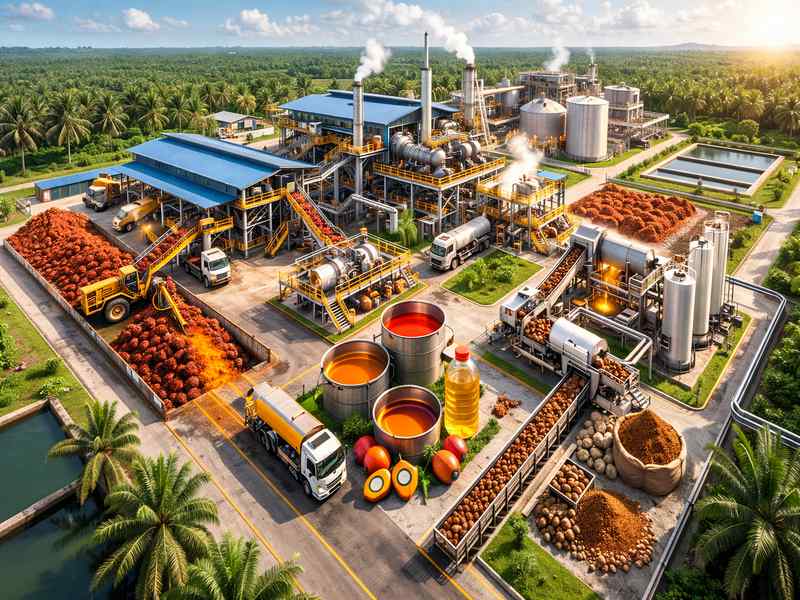
Integrated Palm Oil Complex: Mill + Refinery + Kernel Crushing
Palm oil production has evolved from small stand-alone mills to fully integrated complexes that combine extraction, refining, and kernel processing in one facility. These complexes maximize value from each part of the fruit, improve efficiency, and strengthen global competitiveness. This article explains what an integrated palm oil complex includes—mill, refinery, and kernel crushing plant—along with its benefits, technical and economic considerations, environmental factors, and implementation strategy. An Integrated Palm Oil Complex: What Is It? An Integrated Palm Oil Complex is a facility that brings together three primary production stages under one umbrella: Palm Oil Mill – Extracts crude palm oil (CPO) from fresh fruit bunches (FFB). Palm Oil Refinery – Refines CPO into finished products (e.g., RBD olein, stearin). Palm Kernel Crushing Plant – Processes palm kernels to produce palm kernel oil (PKO) and kernel meal. Together, these units capture value from all major product streams of the palm fruit, reducing reliance on external buyers and improving margin control. Why Integration Matters Traditional palm oil mills produce Crude Palm Oil (CPO) and Palm Kernel (PK). However, both products are often sold raw and at lower margins. An integrated complex refines CPO and crushes PK into value-added products that fetch higher prices and fulfill industry standards for both food and industrial applications. Core Components of the Complex The integrated palm oil complex has three main operational pillars: Palm Oil Mill The mill is the first stage where fresh fruit bunches are processed to extract crude palm oil. Key Processes in the Mill: FFB reception and weighing Sterilization Threshing Digesting Pressing Clarification By-product handling (empty fruit bunches, fibers, shells) The mill must be designed for high efficiency and optimized oil extraction rates (OER), which is crucial for the overall profitability of the complex. Palm Oil Refinery After extraction, CPO requires refining to make it suitable for consumption or industrial use. Refinery operations add significant value by removing impurities, color, odors, and free fatty acids. Typical Refinery Processes: Degumming Neutralization (to reduce free fatty acids) Bleaching Deodorization Fractionation (to separate stearin and olein) An integrated refinery can produce a range of products such as: Refined, Bleached, and Deodorized (RBD) Palm Oil RBD Olein (for cooking oil, salad oil) RBD Stearin (for margarine, soaps, industrial use) Palm Kernel Crushing Plant Palm kernels are recovered during the mill’s threshing and pressing operations. Instead of selling kernels in raw form or to third parties, an integrated complex often includes its own kernel crushing unit. Key Outputs: Palm Kernel Oil (PKO) – High in lauric acid, valuable for food and oleochemical industries. Palm Kernel Meal – Used in animal feed or as raw material for other processes. Benefits of an Integrated Complex Integrating milling, refining, and kernel crushing delivers multiple advantages in efficiency, product quality, profitability, and market competitiveness. Economies of Scale By centralizing operations: Shared utilities (steam, power) Unified waste treatment Reduced logistics cost Lower operating overhead per ton of product This drives down cost per unit and increases throughput. Value Maximization Instead of selling CPO and PK as raw commodities, an integrated complex produces refined oils and processed kernel products that command higher market prices. Product Margin Potential Crude Palm Oil (CPO) Low Refined Palm Oil Medium Fractionated Products (Olein/Stearin) High Palm Kernel Oil (PKO) High Palm Kernel Meal Variable (feed market) Product Quality and Brand Control Producing refined products in-house means tighter control over quality parameters such as: Free fatty acid (FFA) levels Color and odor removal Oxidative stability Compliance with food safety standards (HACCP, ISO) This is especially valuable when targeting export markets with strict regulatory requirements. Supply Chain and Market Flexibility An integrated complex can adjust production based on demand: Increase RBD olein for cooking oil markets Produce more stearin for industrial or cosmetic markets Shift kernel crushing to match market prices This flexibility enhances competitiveness against standalone mills or refineries. Technical and Design Considerations Building an integrated complex requires thoughtful design and technical integration across all production units. Layout Planning Integrated complexes often have layouts that permit seamless product flow with minimal cross-contamination and efficient resource sharing. Typical Design Features: Shared boiler and steam generation for mill and refinery Central wastewater treatment Common laboratory and quality control facilities Consolidated storage tanks for refined products Steam and Energy Integration Steam demand is significant in both milling (sterilization) and refining (deodorization). An integrated complex often uses central steam boilers with the capability to: Burn biomass (fibers, shells) Recover waste heat Co-generate electricity Efficient energy management reduces operational costs and environmental footprint. Waste and By-product Management Palm oil processing generates POME (Palm Oil Mill Effluent), solid biomass, and spent bleaching clay. An integrated complex can: Treat POME through aerobic and anaerobic systems (biogas recovery) Convert biomass to energy or sell as raw material Manage bleaching earth through safe disposal or reuse where possible Economic Feasibility and Investment Costs The transition from standalone operations to fully integrated complexes is capital-intensive, but often justified through increased revenues and lower operating costs per unit. Capital Investment Overview Component Estimated Cost (USD) Mill Equipment $800,000–$4,000,000 Refinery $1,000,000–$5,000,000 Kernel Crushing Plant $500,000–$2,000,000 Utilities (boiler, power) $300,000–$1,000,000 Wastewater/Waste Management $200,000–$800,000 Storage & Tanks $150,000–$600,000 Total (Approximate) $2.95M–$13.4M Actual costs vary by country, capacity, automation level, environmental regulations, and supplier choice. Operational Cost and Revenue Potential Category Monthly Estimate (USD) Labor $25,000–$80,000 Utilities $15,000–$50,000 Maintenance $10,000–$35,000 Logistics & Packaging $20,000–$70,000 Total Operating Cost $70,000–$235,000 Revenue depends on product mix, yield, capacity utilization, and market prices. Refined products and kernels generate higher income compared to selling only crude materials. Break-Even and ROI Integration shortens the return-on-investment (ROI) period because: Refined and fractionated products have higher margins Kernel oil and meal add new revenue streams Shared utilities reduce operating costs Typical break-even timelines range from 3 to 7 years depending on market conditions and efficiency. Environmental and Social Considerations Sustainability plays an important role in the long-term success of integrated complexes. Environmental Compliance Palm processing must comply with: Effluent discharge permits Air emission standards Waste disposal regulations Integrated complexes often implement advanced wastewater treatment and biogas capture systems as part of their environmental strategy. Biogas and Renewable Energy Anaerobic