
Cocoa powder production involves multiple stages that directly affect flavor, color, fat content, and particle size.
Cocoa Beans → Cleaning → Roasting → Winnowing → Grinding → Pressing → Cooling → Milling → Cocoa Powder
Alkalisation can also be used to change flavour and colour. Consistent powder quality depends on controlling the entire process, not just the final milling stage.
Raw Cocoa Beans: Where Powder Quality Begins
Industrial cocoa processing normally starts with fermented and dried cocoa beans. Fermentation occurs before the beans reach most processing factories and plays an important role in developing the flavor precursors that later become recognizable cocoa aromas during roasting.
For a cocoa processor, raw-material consistency matters immediately. Bean origin, fermentation degree, moisture, bean size, mold contamination, foreign material, and storage conditions can all affect downstream processing.
| Raw Bean Factor | Why It Matters |
| Moisture content | Affects roasting and storage stability |
| Bean size | Affects heat transfer and roasting uniformity |
| Fermentation | Strongly influences flavor potential |
| Foreign material | Increases equipment and food-safety risks |
| Mold/insect damage | Can reduce product quality |
| Bean origin | Influences flavor, color, and fat characteristics |
A sophisticated processing line cannot fully compensate for poor beans. The equipment can control the process, but it cannot create flavor precursors that were never properly developed during fermentation.
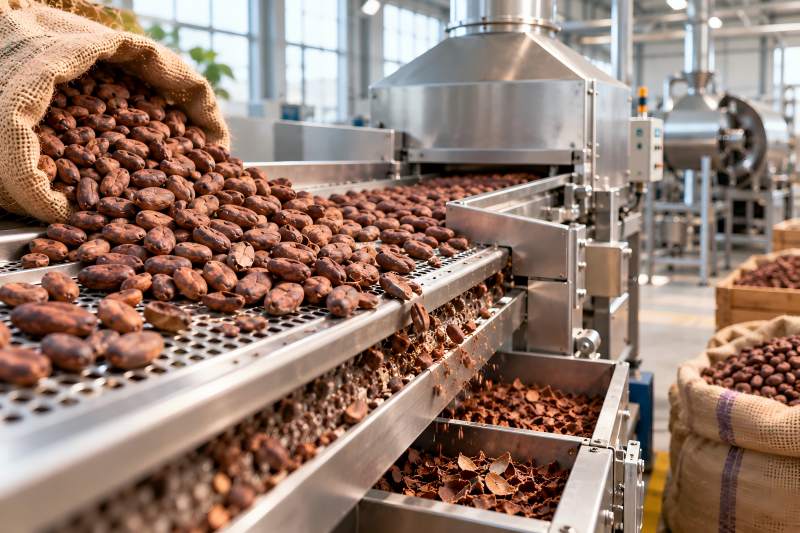
Cleaning and Bean Preparation
Before thermal processing, cocoa beans must be cleaned.
Bulk cocoa beans may contain dust, fibers, stones, metal fragments, broken beans, and other foreign materials. Industrial cleaning systems therefore commonly combine screening, aspiration, and magnetic separation.
The objective is not simply food cleanliness. Hard contaminants such as stones and metal can damage downstream equipment, particularly grinders.
A typical cleaning section may include:
- Vibrating or rotary screening
- Aspiration for light impurities
- Destoning
- Magnetic separation
- Bean grading
- Dust collection
Consistent bean size is also useful because roasting becomes easier to control when the material entering the roaster has relatively uniform physical characteristics.
Roasting Cocoa Beans
Roasting is one of the most crucial processes in the manufacturing of cocoa.
During roasting, heat drives moisture from the beans and promotes chemical reactions responsible for much of the characteristic cocoa aroma and flavor. It also makes subsequent shell separation easier. Industrial processes may roast whole beans or separate the shell first and roast cocoa nibs.
Roasting conditions vary considerably with bean origin, equipment design, and desired flavor profile. Published processing literature describes cocoa roasting broadly around 120–150°C for approximately 15–45 minutes, although actual industrial recipes should be developed around the product rather than treated as universal settings.
| Roasting Variable | Too Low | Too High |
| Temperature | Weak flavor development | Burnt or harsh notes |
| Residence time | Incomplete roast | Excessive flavor loss |
| Bean size variation | Uneven roasting | Local overheating |
| Airflow | Poor moisture removal | Excessive drying |
| Feed consistency | Variable product | Difficult process control |
Reaching the maximum temperature is not the only objective. A successful roast retains batch-to-batch consistency while developing the appropriate flavour.
Winning and Cracking
The beans are split into smaller pieces after receiving the appropriate heat treatment.
The edible inner portion is the cocoa nib, while the outer shell needs to be removed. Winnowing separates these fractions primarily by differences in particle size and density, using controlled airflow together with screening or classification.
This stage is more important than it may appear.
Excessive shell remaining in the nib stream can negatively affect flavor, texture, and overall product quality. At the same time, aggressive aspiration can carry valuable nib particles into the shell stream and reduce yield.
A good winnowing system therefore balances two targets:
low shell content in the nibs and low nib loss in the shell fraction.
That balance depends on proper cracking. If the beans are pulverized instead of cleanly broken, nib and shell particles become similar in size, making air separation much more difficult.
Optional Alkalization
Natural cocoa powder is the term used to designate some cocoa powder that is made without alkalisation.
Other products undergo alkalization, commonly known as Dutch processing. An alkaline solution is used to modify acidity, flavor and especially color. Depending on the process design, alkalization can be performed on cocoa nibs, liquor, or press cake.
| Characteristic | Natural Cocoa | Alkalized Cocoa |
| Alkalization | No | Yes |
| Color | Lighter or reddish brown in general | Brown to Extremely Dark |
| Acidity | Higher | Reduced |
| Flavor | Sharper, more acidic | Generally smoother |
| Process complexity | Lower | Higher |
| Color flexibility | Limited | Greater |
Alkalization should not simply be considered an extra processing step. It is effectively a product-design tool.
Changes in alkali concentration, moisture, reaction temperature, and treatment time can produce noticeably different powder characteristics. For manufacturers supplying several cocoa powder grades, control of this stage becomes particularly important.
Grinding Cocoa Nibs into Cocoa Liquor
The next major transformation happens during grinding.
Cocoa nibs contain a large amount of cocoa butter. Cocoa butter is liberated from the cells as the nib structure disintegrates. Heat generated during grinding helps keep this fat liquid, gradually transforming the solid nibs into a flowing paste known as cocoa liquor or cocoa mass.
Cocoa liquor, despite its name, is alcohol-free.
Therefore, grinding entails more than just reducing particle size. The machine must create a sufficiently fine, homogeneous and pumpable suspension of cocoa solids in cocoa butter.
Depending on the required capacity and fineness, a cocoa processing line may use more than one grinding stage.
| Grinding Objective | Process Importance |
| Break nib structure | Releases cocoa butter |
| Reduce particles | Improves liquor uniformity |
| Maintain suitable temperature | Keeps liquor pumpable |
| Control throughput | Stabilizes downstream pressing |
| Avoid excessive heating | Protects flavor and equipment |
A common mistake is to evaluate a cocoa grinder only by its nominal fineness. In production, capacity at the required fineness and temperature is usually more meaningful.
A grinder capable of producing very fine liquor but only at a severely reduced throughput may become the bottleneck of the entire line.
Cocoa Liquor Conditioning
After grinding, the cocoa liquor must remain sufficiently fluid for pumping, storage, and pressing.
Temperature control becomes important because cocoa butter changes its physical behavior as temperature falls. Poorly controlled liquor temperature can increase viscosity and make transfer between tanks, pumps, and the cocoa press less stable.
The liquor may therefore pass through heated tanks, agitators, filters or additional refining equipment before pressing.
The production route now also divides based on the intended final product. Cocoa liquor can be used directly as an ingredient for chocolate manufacturing, or it can continue to pressing for the production of cocoa butter and cocoa powder.
Hydraulic Pressing: Separating Cocoa Butter
To produce cocoa powder, a substantial portion of the cocoa butter must be removed from the liquor.
Hot cocoa liquor is fed into a hydraulic cocoa press. High pressure forces liquid cocoa butter through filter elements while the solid cocoa material remains inside the press chambers.
The process therefore creates two valuable products:
Cocoa liquor → Cocoa butter + Cocoa press cake
Industrial pressing can operate at very high pressures; ICCO describes cocoa presses operating at pressures up to around 550 bar.
Pressing conditions determine how much fat remains in the cake.
| Pressing Parameter | Main Effect |
| Liquor temperature | Flow and separation behavior |
| Hydraulic pressure | Cocoa butter extraction |
| Pressing time | Residual cake fat |
| Liquor fineness | Pressing consistency |
| Filter condition | Butter flow and cake formation |
| Feed consistency | Batch repeatability |
The press is therefore not simply a butter-removal machine. It is also one of the main control points for defining the composition of the future cocoa powder.
Cocoa Cake Breaking and Cooling
The material remaining after pressing is called cocoa press cake.
It is compact, hard, and still contains some cocoa butter. It cannot normally be sent directly into a fine powder mill in large blocks.
The cake is first discharged from the press and broken into smaller pieces. Depending on the production line, crushers or cake breakers reduce it into manageable fragments.
Cooling is particularly important.
If cake enters the final mill at an unsuitable temperature, residual cocoa butter can soften and contribute to sticking, smearing or poor powder flow. Because of this, controlling temperature is crucial to producing cocoa powder consistently.
The sequence is therefore better understood as:
Pressing → Cake Discharge → Cake Breaking → Cooling → Fine Milling
rather than simply pressing followed by grinding.
Milling Cocoa Cake into Cocoa Powder
The cooled cocoa cake is finally milled into powder.
Industrial cocoa powder systems may use hammer mills, pin mills, impact mills or other pulverizing and classification arrangements depending on the required capacity and particle-size distribution. ICCO notes that hammer and disc mills are among the systems used for cocoa grinding, often together with classification.
An important technical detail is that much of the fundamental particle-size reduction has already occurred when the nibs were converted into cocoa liquor. Final cake milling therefore performs significant deagglomeration and powder formation, rather than creating the entire particle structure from scratch.
This explains why liquor grinding and powder milling should not be treated as completely independent operations.
| Milling Variable | Possible Effect |
| Feed cake size | Influences mill stability |
| Feed temperature | Affects sticking and flow |
| Mill speed | Influences fineness and capacity |
| Airflow | Helps cooling and conveying |
| Classifier setting | Controls oversized particles |
| Residual fat | Influences powder behavior |
Simply increasing mill speed is rarely the best solution to a fineness problem. Feed temperature, cake structure, airflow and classification performance should be evaluated together.
Sieving, Tempering and Packaging
After milling, cocoa powder may be classified or sieved to remove oversized particles and improve consistency.
Powder temperature and cocoa butter crystallization also need attention before packaging. ICCO notes that cocoa powder may undergo controlled cooling or tempering so that residual cocoa butter reaches a more stable crystalline condition, helping maintain powder characteristics during storage.
Finished powder should then be protected from moisture, contamination and undesirable temperature conditions.
A typical finished-product quality program may evaluate:
| Quality Parameter | What It Indicates |
| Moisture | Storage stability |
| Fat content | Powder grade |
| Particle size | Texture and dispersibility |
| Color | Roast/alkalization consistency |
| pH | Natural vs. alkalized characteristics |
| Flavor | Overall process performance |
| Microbiology | Product safety |
| Bulk density | Handling and packaging behavior |
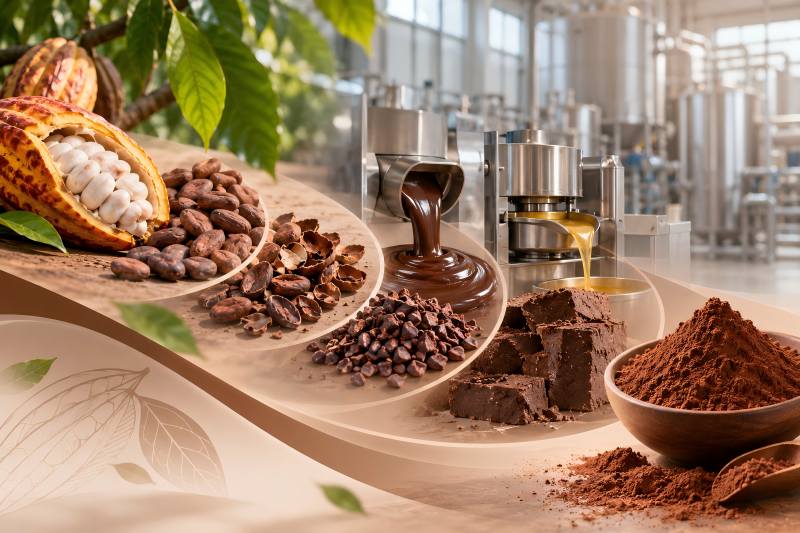
A Typical Cocoa Powder Processing Line
For an industrial plant, the complete process can be organized into several equipment sections.
| Processing Stage | Typical Equipment | Main Purpose |
| Bean preparation | Cleaner, destoner, magnet | Remove impurities |
| Thermal processing | Cocoa roaster | Develop flavor and reduce moisture |
| Shell removal | Cracker & winnower | Separate nibs from shells |
| Alkalization | Alkalizing system | Adjust color, acidity and flavor |
| Nib grinding | Cocoa paste grinder | Produce cocoa liquor |
| Liquor handling | Heated tank & pump | Stabilize and transfer liquor |
| Fat separation | Hydraulic cocoa press | Extract cocoa butter |
| Cake preparation | Cake breaker & cooler | Prepare material for milling |
| Powder production | Cocoa powder mill | Pulverize cocoa cake |
| Classification | Sifter/classifier | Control powder consistency |
| Final handling | Cooling & packing system | Stabilize and package powder |
Producing cocoa powder is a process-control challenge, not a single-machine task.
Each stage—cleaning, roasting, winnowing, grinding, pressing, cooling, and milling—directly affects final powder quality. Therefore, rather of functioning as separate machines, these processes must function as a single, balanced system.
The best cocoa processing line is not the one with the highest individual machine capacities, but the one in which each stage is correctly matched to the required cocoa powder quality and production capacity.