
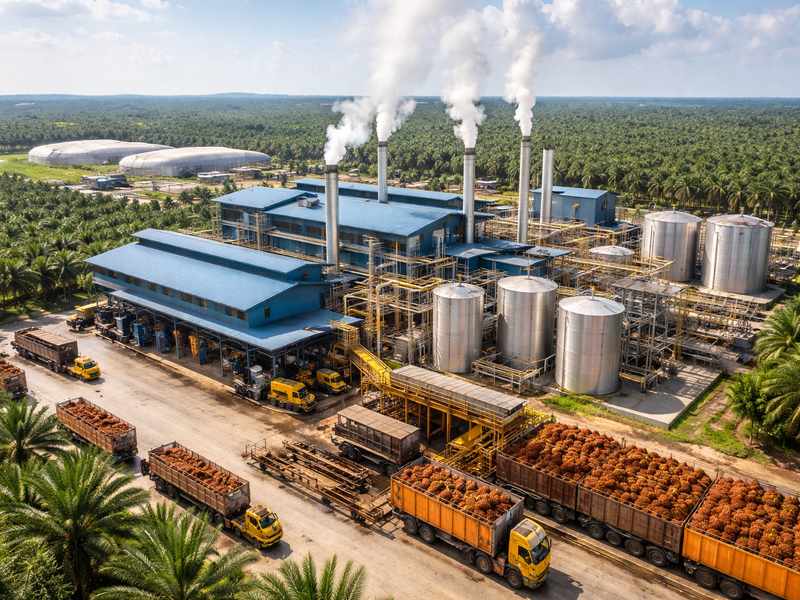
Palm oil mills range from small artisanal units processing a few tons of fresh fruit bunches (FFBs) daily to large industrial plants handling hundreds of tons. As global demand rises, many small mill owners ask whether they can scale up to industrial production. The answer is yes—but it requires careful feasibility analysis across technical, economic, operational, environmental, and social factors.
Understanding Mill Scales
Before exploring the upgrade process, it’s essential to clarify what we mean by “small” versus “industrial” scale mills.
Definitions and Typical Capacities
| Mill Type | Typical Capacity (FFB/day) | Description |
| Small Mill | 5–30 tons | Low investment cost, minimal automation, manual labor heavy |
| Medium Mill | 30–60 tons | Some mechanization, moderate automation |
| Industrial Scale | 60–300+ tons | High automation, advanced machinery, optimized processes |
Small mills often serve local farmers, operating with minimal extraction equipment. Industrial mills are complex facilities with automated conveyors, high-speed presses, wastewater treatment plants, and integrated logistics.
Why Consider Scaling Up?
Upgrading from a small mill to industrial capacity isn’t just a matter of increasing output—it brings strategic opportunities and challenges.
Potential Benefits
- Higher Production Volumes
Larger throughput can dramatically increase revenue.
- Operational Efficiency
Automation and modern machinery reduce waste and labor costs.
- Market Access
Larger volumes make contracts with major buyers more feasible.
- Value-Added Products
Industrial mills can produce derivatives like palm kernel oil, stearin, and olein.
- Improved Adherence to Standards
Export regulations and sustainability certifications are easier for industrial mills to fulfill.
Potential Risks
- High Capital Expenditure
Significant investment in infrastructure, equipment, and land.
- Technical Complexity
Requires skilled management and technical operators.
- Increased Environmental Compliance
Larger mills face stricter regulatory scrutiny.
- Market Risks
Price volatility and competition from established producers.
Technical Feasibility: Equipment and Layout
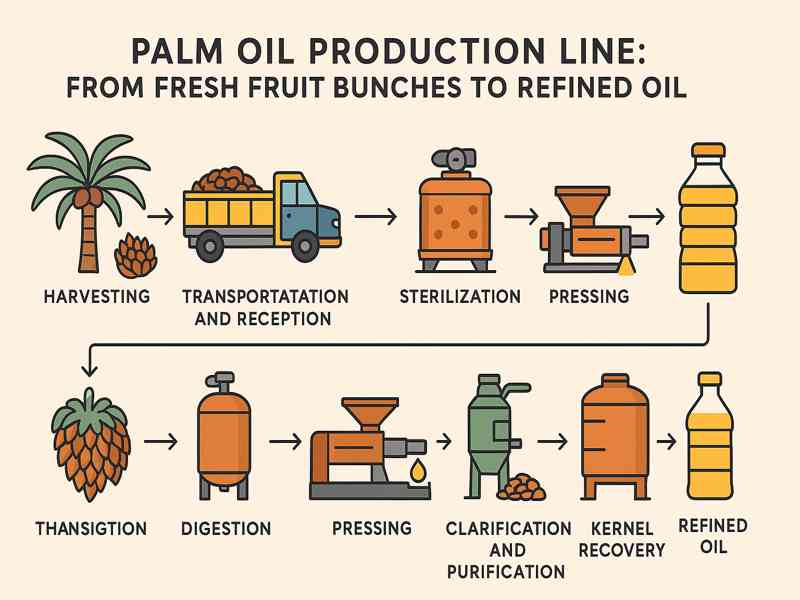
One of the most critical aspects of scaling up is designing and equipping the mill to handle increased capacity.
Current Small Mill Configuration (Typical)
| Component | Typical Technology | Limitations |
| Fruit Reception | Manual unloading | Slow, limited volume |
| Sterilization | Small batch sterilisers | Low throughput |
| Digestion | Traditional digester | Inconsistent fiber breakage |
| Pressing | Manual/low-speed press | Low oil extraction rate |
| Clarification | Gravity settling | Inefficient separation |
| Waste Handling | No or basic ponds | Environmental risk |
Industrial Scale Upgrades
To achieve industrial throughput, each of these areas must be transformed:
| Component | Industrial Alternative | Benefit |
| Fruit Reception | Automated unloading, weighbridge | Faster processing, accurate records |
| Sterilization | Continuous sterilizer | Uniform steam distribution, higher capacity |
| Digestion | High-speed heated digester | Better extraction potential |
| Pressing | Automated high-capacity presses | Higher oil yield, lower labor |
| Clarification | Stack-centrifuges & automated systems | Better quality, reduced waste |
| Wastewater Treatment | Settling tanks + biogas digesters | Regulatory compliance, energy co-benefit |
Key takeaway: Upgrading to industrial scale requires a complete overhaul of processing lines—not just incremental upgrades.
Economic and Financial Feasibility
Industrial scaling is a significant financial undertaking. A proper economic feasibility analysis must consider both capital expenditures (CAPEX) and operational expenditures (OPEX).
Estimated Capital Requirements
| Expense Category | Estimated Cost (USD) | Notes |
| Land acquisition | $200,000–$800,000 | Depends on location |
| Construction & Civil Works | $500,000–$2,000,000 | Buildings, foundations |
| Processing Equipment | $1,000,000–$5,000,000 | Core upgrade cost |
| Utilities (power, water, steam) | $200,000–$1,000,000 | Boilers, generators |
| Wastewater Systems | $100,000–$500,000 | Treatment plants |
| Vehicles & Logistics | $100,000–$600,000 | Trucks, forklifts |
Note: Exact costs vary greatly by country, supplier choice, and environmental requirements.
Operational Cost Breakdown
| Cost Type | Monthly Estimated Range | Description |
| Labor | $5,000–$25,000 | Skilled operational staff |
| Utilities | $10,000–$40,000 | Fuel, electricity, water |
| Maintenance | $5,000–$20,000 | Spare parts, repairs |
| Packaging & Transport | $8,000–$35,000 | Distribution costs |
| Waste Compliance | $2,000–$15,000 | Environmental monitoring |
Revenue and Profit Potential (Illustrative)
A simplified revenue model helps illustrate the financial potential:
| Production Level | Monthly FFB Input | Oil Yield (%) | Palm Oil Produced (tons) | Approx Revenue* |
| Small Mill | 30 tons/day (900/month) | 18% | 162 tons | ~$130,000 |
| Industrial | 150 tons/day (4,500/month) | 20% | 900 tons | ~$720,000 |
(*) Based on average market value of palm oil ≈ $800–$900/ton (varies by market).
Breakeven and ROI Considerations
- Breakeven Period: Typically 4–8 years with strong sales and efficient management.
- Payback Factors: Government incentives, improved yield, premium products (certified sustainable palm oil), and byproducts (biogas, meal).
Environmental and Social Feasibility
Scaling up isn’t just about machines and money. Environmental and social sustainability strongly influence feasibility.
Wastewater and Effluent Management
Industrial mills must meet effluent standards to avoid fines and community disputes.
| Parameter | Small Mill | Industrial Mill | Expectation |
| Effluent Treatment | Basic | Advanced systems | Compliance required |
| Biogas Capture | Rare | Possible | Energy recovery |
| Solid Waste Recycling | Minimal | Composting/Animal feed | Added value |
Key focus: Modern wastewater treatment (e.g., anaerobic digesters) reduces environmental impact and creates renewable energy.
Social Impact
Upgrading can create jobs and improve community livelihoods. However:
- Noise, traffic, and odor can increase tensions.
- CSR programs should be planned: training, healthcare support, and sustainable practices.
- Land rights and permits must be managed carefully.
Regulatory, Permits, and Certification
Industrial operations face stricter licensing requirements:
Common Regulatory Requirements
- Environmental Impact Assessment (EIA)
- Building and safety permits
- Effluent discharge license
- Fire and hazard compliance certificates
Certifications for Sustainability
International purchasers frequently need:
- RSPO (Roundtable on Sustainable Palm Oil)
- ISPO (Indonesian Sustainable Palm Oil)
- MSPO (Malaysian Sustainable Palm Oil)
Obtaining certification enhances price and market access.
For more information on licensing and regulatory requirements for palm oil processing plants, you can continue reading this article: Licensing and Regulatory Requirements for Palm Oil Processing Plants→
Operational and Workforce Feasibility
Automating to industrial levels requires skilled personnel and management systems.
Required Workforce Shift
| Role | Small Mill | Industrial Mill |
| Operators | Manual labor | Skilled technicians |
| Supervisors | Informal | Professional managers |
| Maintenance | Reactive | Predictive & planned |
| Quality Control | Basic | Laboratory & automated QC |
Investment in workforce training is essential.
Risks and Mitigation Strategies
Industrial expansion brings risks—and each needs mitigation.
Market Risks
- Price volatility: Implement forward contracts.
- Export barriers: Diversify markets.
Technical Risks
- Breakdowns: Scheduled maintenance and spare parts inventory.
- Poor yield: Hire consultants for process optimization.
Environmental Risks
- Effluent fines: Real-time monitoring systems.
- Community relations: Ongoing stakeholder engagement.
Practical Steps to Implementation
For mill owners planning expansion:
Phase 1: Feasibility Assessment
- Technical audit of current mill
- Market demand analysis
- Land and zoning review
- Financial modeling
Phase 2: Design & Engineering
- Select process flow design
- Issue RFQs for equipment
- Draft wastewater and waste management plans
Phase 3: Funding and Construction
- Secure financing (loans, investors)
- Begin construction and installation
- Recruit and train workforce
Phase 4: Trial Runs and Commissioning
- Conduct trial processing
- Validate oil yields
- Test environmental systems
Phase 5: Full Operation
- Scale to production targets
- Monitor KPIs (yield, cost per ton)
Is It Feasible?
Yes—a small palm oil mill can be upgraded to industrial scale, but success rests on:
- Solid financial planning
- Comprehensive technical upgrade
- Environmental and social sustainability
- Skilled workforce and management
- Effective risk mitigation
Upgrading is not simply scaling equipment—it demands strategic transformation. With the right approach and investor buy-in, a small mill can transition into a competitive industrial producer, meeting volume demands, improving efficiency, and contributing to economic development.