
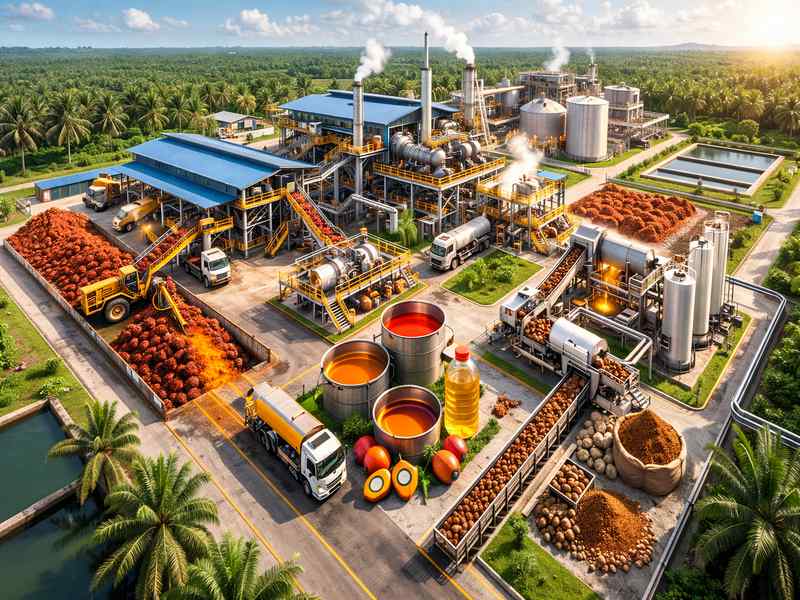
Palm oil production has evolved from small stand-alone mills to fully integrated complexes that combine extraction, refining, and kernel processing in one facility. These complexes maximize value from each part of the fruit, improve efficiency, and strengthen global competitiveness.
This article explains what an integrated palm oil complex includes—mill, refinery, and kernel crushing plant—along with its benefits, technical and economic considerations, environmental factors, and implementation strategy.
An Integrated Palm Oil Complex: What Is It?
An Integrated Palm Oil Complex is a facility that brings together three primary production stages under one umbrella:
- Palm Oil Mill – Extracts crude palm oil (CPO) from fresh fruit bunches (FFB).
- Palm Oil Refinery – Refines CPO into finished products (e.g., RBD olein, stearin).
- Palm Kernel Crushing Plant – Processes palm kernels to produce palm kernel oil (PKO) and kernel meal.
Together, these units capture value from all major product streams of the palm fruit, reducing reliance on external buyers and improving margin control.
Why Integration Matters
Traditional palm oil mills produce Crude Palm Oil (CPO) and Palm Kernel (PK). However, both products are often sold raw and at lower margins. An integrated complex refines CPO and crushes PK into value-added products that fetch higher prices and fulfill industry standards for both food and industrial applications.
Core Components of the Complex
The integrated palm oil complex has three main operational pillars:
Palm Oil Mill
The mill is the first stage where fresh fruit bunches are processed to extract crude palm oil.
Key Processes in the Mill:
- FFB reception and weighing
- Sterilization
- Threshing
- Digesting
- Pressing
- Clarification
- By-product handling (empty fruit bunches, fibers, shells)
The mill must be designed for high efficiency and optimized oil extraction rates (OER), which is crucial for the overall profitability of the complex.
Palm Oil Refinery
After extraction, CPO requires refining to make it suitable for consumption or industrial use. Refinery operations add significant value by removing impurities, color, odors, and free fatty acids.
Typical Refinery Processes:
- Degumming
- Neutralization (to reduce free fatty acids)
- Bleaching
- Deodorization
- Fractionation (to separate stearin and olein)
- An integrated refinery can produce a range of products such as:
- Refined, Bleached, and Deodorized (RBD) Palm Oil
- RBD Olein (for cooking oil, salad oil)
- RBD Stearin (for margarine, soaps, industrial use)
Palm Kernel Crushing Plant
Palm kernels are recovered during the mill’s threshing and pressing operations. Instead of selling kernels in raw form or to third parties, an integrated complex often includes its own kernel crushing unit.
Key Outputs:
- Palm Kernel Oil (PKO) – High in lauric acid, valuable for food and oleochemical industries.
- Palm Kernel Meal – Used in animal feed or as raw material for other processes.
Benefits of an Integrated Complex
Integrating milling, refining, and kernel crushing delivers multiple advantages in efficiency, product quality, profitability, and market competitiveness.
Economies of Scale
By centralizing operations:
- Shared utilities (steam, power)
- Unified waste treatment
- Reduced logistics cost
- Lower operating overhead per ton of product
- This drives down cost per unit and increases throughput.
Value Maximization
Instead of selling CPO and PK as raw commodities, an integrated complex produces refined oils and processed kernel products that command higher market prices.
| Product | Margin Potential |
| Crude Palm Oil (CPO) | Low |
| Refined Palm Oil | Medium |
| Fractionated Products (Olein/Stearin) | High |
| Palm Kernel Oil (PKO) | High |
| Palm Kernel Meal | Variable (feed market) |
Product Quality and Brand Control
Producing refined products in-house means tighter control over quality parameters such as:
- Free fatty acid (FFA) levels
- Color and odor removal
- Oxidative stability
- Compliance with food safety standards (HACCP, ISO)
This is especially valuable when targeting export markets with strict regulatory requirements.
Supply Chain and Market Flexibility
An integrated complex can adjust production based on demand:
- Increase RBD olein for cooking oil markets
- Produce more stearin for industrial or cosmetic markets
- Shift kernel crushing to match market prices
This flexibility enhances competitiveness against standalone mills or refineries.
Technical and Design Considerations
Building an integrated complex requires thoughtful design and technical integration across all production units.
Layout Planning
Integrated complexes often have layouts that permit seamless product flow with minimal cross-contamination and efficient resource sharing.
Typical Design Features:
- Shared boiler and steam generation for mill and refinery
- Central wastewater treatment
- Common laboratory and quality control facilities
- Consolidated storage tanks for refined products
Steam and Energy Integration
Steam demand is significant in both milling (sterilization) and refining (deodorization). An integrated complex often uses central steam boilers with the capability to:
- Burn biomass (fibers, shells)
- Recover waste heat
- Co-generate electricity
Efficient energy management reduces operational costs and environmental footprint.
Waste and By-product Management
Palm oil processing generates POME (Palm Oil Mill Effluent), solid biomass, and spent bleaching clay.
An integrated complex can:
- Treat POME through aerobic and anaerobic systems (biogas recovery)
- Convert biomass to energy or sell as raw material
- Manage bleaching earth through safe disposal or reuse where possible
Economic Feasibility and Investment Costs
The transition from standalone operations to fully integrated complexes is capital-intensive, but often justified through increased revenues and lower operating costs per unit.
Capital Investment Overview
| Component | Estimated Cost (USD) |
| Mill Equipment | $800,000–$4,000,000 |
| Refinery | $1,000,000–$5,000,000 |
| Kernel Crushing Plant | $500,000–$2,000,000 |
| Utilities (boiler, power) | $300,000–$1,000,000 |
| Wastewater/Waste Management | $200,000–$800,000 |
| Storage & Tanks | $150,000–$600,000 |
| Total (Approximate) | $2.95M–$13.4M |
Actual costs vary by country, capacity, automation level, environmental regulations, and supplier choice.
Operational Cost and Revenue Potential
| Category | Monthly Estimate (USD) |
| Labor | $25,000–$80,000 |
| Utilities | $15,000–$50,000 |
| Maintenance | $10,000–$35,000 |
| Logistics & Packaging | $20,000–$70,000 |
| Total Operating Cost | $70,000–$235,000 |
Revenue depends on product mix, yield, capacity utilization, and market prices. Refined products and kernels generate higher income compared to selling only crude materials.
Break-Even and ROI
Integration shortens the return-on-investment (ROI) period because:
- Refined and fractionated products have higher margins
- Kernel oil and meal add new revenue streams
- Shared utilities reduce operating costs
Typical break-even timelines range from 3 to 7 years depending on market conditions and efficiency.
Environmental and Social Considerations
Sustainability plays an important role in the long-term success of integrated complexes.
Environmental Compliance
Palm processing must comply with:
- Effluent discharge permits
- Air emission standards
- Waste disposal regulations
Integrated complexes often implement advanced wastewater treatment and biogas capture systems as part of their environmental strategy.
Biogas and Renewable Energy
Anaerobic treatment of POME produces biogas that can be:
- Burned for steam generation
- Converted to electricity
- Used as auxiliary fuel
This reduces greenhouse gas emissions and provides energy cost savings.
Social Impact and Community Relations
Large integrated facilities impact local communities through:
- Job creation
- Local supplier engagement
- Infrastructure development
However, they must also manage:
- Traffic and noise
- Fertile land use
- Fair labor practices
Corporate Social Responsibility (CSR) initiatives strengthen community relations and brand reputation.
Quality Assurance and Certifications
Integrated complexes are better equipped to support international quality standards, such as:
| Standard | Benefit |
| ISO 9001 | Quality Management |
| ISO 14001 | Environmental Management |
| HACCP | Food Safety |
| RSPO/ISPO/MSPO | Sustainable Palm Oil |
These certifications open doors to premium markets in Europe, the Middle East, and Asia and differentiate products in competitive environments.
Challenges and Risk Mitigation
While integrated complexes offer many advantages, they also come with challenges:
Technical Complexity
Operating multiple units under one facility requires:
- Skilled workforce
- Preventive maintenance
- Integrated control systems
Mitigation: Training, automation, and partnerships with experienced OEMs
Market Risks
- Commodity price volatility
- Export regulation changes
- Competition from established brands
Mitigation: Diversified product mix, long-term contracts, and risk hedging.
Environmental Compliance
- Penalties and shutdown risk if effluent or emissions standards aren’t met.
Mitigation: Real-time monitoring, proper wastewater solutions, and reserve capacity for future regulations.
Logistics and Supply Chain Management
An integrated complex requires efficient logistics for:
- Fresh fruit bunch (FFB) transportation
- Inter-unit transfer of semi-processed materials
- Outbound distribution of refined products and kernels
Centralizing these logistical functions under one management policy improves:
- Turnaround times
- Inventory control
- Cost efficiency
Strategic Implementation Roadmap
For enterprises considering building an integrated complex, the following roadmap can guide planning:
Step 1: Feasibility Study
- Market demand and pricing
- Capacity planning
- Regulatory landscape
Step 2: Site and Design Engineering
- Land acquisition and layout
- Equipment selection
- Process flow design
Step 3: Financing and Budgeting
- Capital sourcing (investors/loans)
- Financial modeling
- Risk mitigation planning
Step 4: Construction and Installation
- Civil works and foundations
- Mechanical and electrical installation
- Control/automation systems
Step 5: Commissioning and Testing
- Trial runs
- Quality verification
- Operator training
Step 6: Full Operations
- Ramp up to capacity
- Performance measurement
- Continuous improvement
A Competitive Strategic Asset
An integrated palm oil complex — combining a mill, refinery, and kernel crushing plant — is no longer a luxury but a strategic necessity for producers seeking higher value and global competitiveness.
By leveraging scale, maximizing product value, and applying environmental and operational best practices, these complexes improve profitability and sustainability. Though they require careful planning and investment, the long-term gains in efficiency, diversification, and market access often outweigh the challenges.