
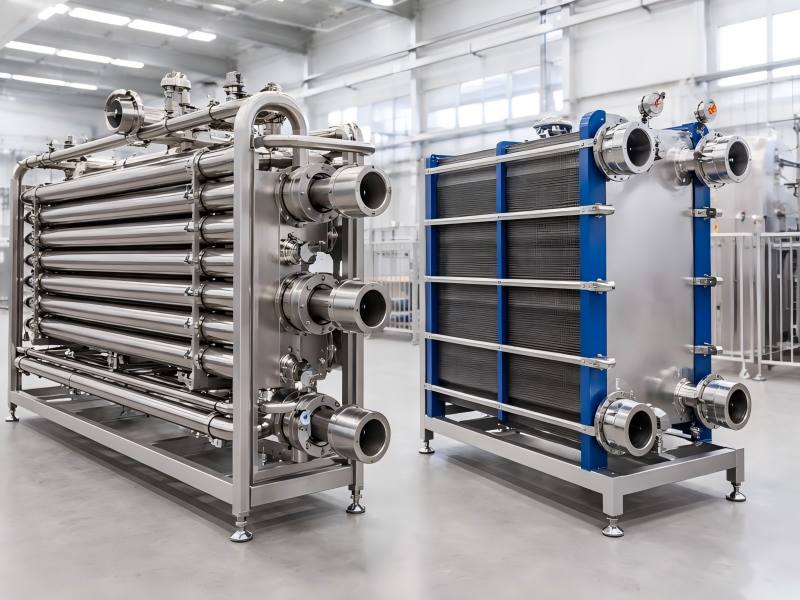
The decision is totally dependent on your application; there is no one “better” alternative.
- For processing tomatoes, particularly paste and puree:
👉 Tubular preheaters are clearly the better choice - For low-viscosity fluids and energy efficiency:
👉 Plate heat exchangers outperform
In practical terms, most industrial tomato processing plants use tubular preheaters because they can handle the high viscosity, fiber content, and continuous processing demands of tomato pulp.
However, advanced production lines may combine both technologies—using plate heat exchangers for preheating clean fluids and tubular systems for pulp handling—to achieve optimal efficiency.
Overview of Both Technologies
What Is a Tomato Tubular Preheater?
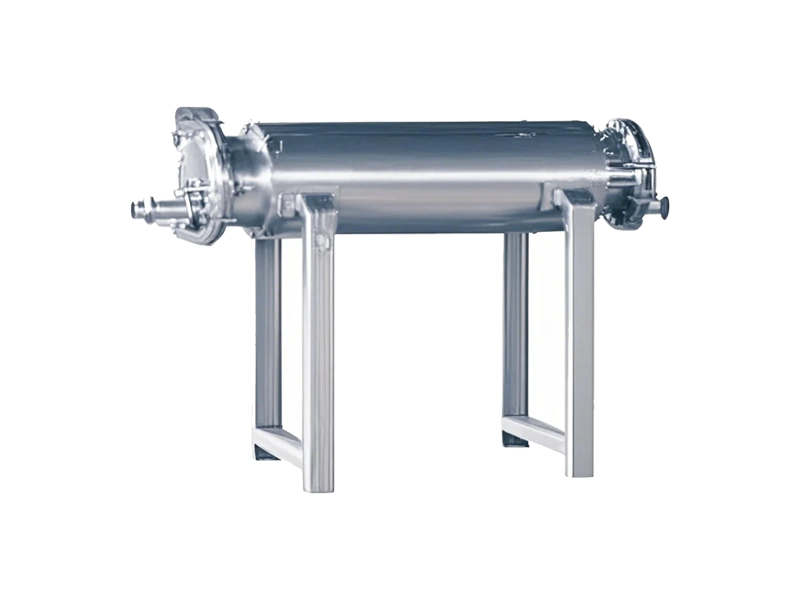
A tomato tubular preheater is a type of tubular heat exchanger specifically designed to handle viscous fluids and products with particles, such as crushed tomato pulp.
- Product flows through tubes
- Steam or hot water flows outside the tubes
- Heat transfers indirectly through the tube walls
Tubular systems are commonly used in hot break and cold break processes and can handle pulp, fibers, and seeds without clogging.
Plate Heat Exchangers: What Are They?
Thin metal plates are used in a plate heat exchanger (PHE) to transfer heat between fluids.
- Fluids flow in alternating channels between plates
- Large surface area ensures rapid heat transfer
- Compact and highly efficient design
Plate heat exchangers are widely used in low-viscosity liquid processing such as milk, beverages, and clear juices.
Core Structural Differences
| Feature | Tubular Preheater | Plate Heat Exchanger |
| Structure | Tube-in-tube or multi-tube | Stacked corrugated plates |
| Flow path | Large-diameter tubes | Narrow plate channels |
| Surface area | Moderate | Very high |
| Design complexity | Simple | More complex (gaskets, plates) |
| Space requirement | Larger | Compact |
Plate heat exchangers achieve higher efficiency mainly because their corrugated plates create a much larger heat transfer area.
Heat Transfer Efficiency Comparison
Plate Heat Exchanger Advantage
The remarkable thermal performance of plate heat exchangers is well-known:
- Up to 5× higher efficiency than tubular designs
- High turbulence improves heat transfer
- Very small temperature difference (approach temperature)
This makes them ideal when:
- Fast heating is required
- Energy efficiency is a priority
Tubular Preheater Performance
Tubular preheaters are less efficient in pure heat transfer terms because:
- Lower surface area
- Requires a higher flow velocity to achieve turbulence
However, they compensate with:
- Better handling of difficult materials
- More stable performance under heavy loads
Heat Transfer Comparison Table
| Parameter | Tubular Preheater | Plate Heat Exchanger |
| Heat transfer coefficient | Medium | Very high |
| Temperature approach | Moderate | Very low |
| Energy efficiency | Good | Excellent |
| Heating speed | Moderate | Fast |
Suitability for Tomato Products
This is where the real difference lies.
Tomato Processing Challenges
Tomato pulp is:
- Viscous
- Contains fibers, seeds, and skins
- Prone to fouling and clogging
Tubular Preheater: Ideal for Tomato Pulp
Tubular systems are specifically designed for such conditions:
- Can handle large particles without blockage
- No narrow gaps → less clogging
- Smooth flow path reduces pressure drop
They are the preferred choice for:
- Tomato paste
- Hot break processing
- High-viscosity products
Plate Heat Exchanger Limitations
Plate heat exchangers face challenges with tomato pulp:
- Narrow channels can clog easily
- Limited tolerance for particles (>0.3 cm)
- Performance drops with high viscosity
They are better suited for:
- Tomato juice (low pulp)
- Clarified liquids
Product Suitability Table
| Product Type | Tubular Preheater | Plate Heat Exchanger |
| Tomato paste | Excellent | Poor |
| Tomato puree | Excellent | Moderate |
| Tomato juice (clear) | Good | Excellent |
| High pulp content | Excellent | Limited |
Fouling and Cleaning
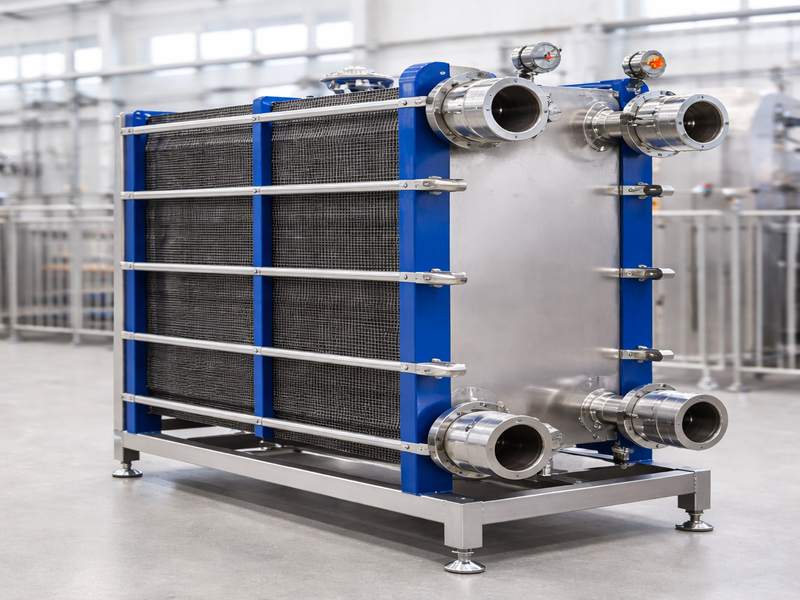
Plate Heat Exchanger
Advantages:
- Easy to disassemble
- Simple cleaning (CIP systems)
- Plates can be replaced individually
However:
- Fouling occurs faster with viscous products
- Frequent cleaning required
Tubular Preheater
Advantages:
- Longer operating time between cleaning cycles
- Less prone to clogging
- Better for continuous production
Disadvantages:
- Harder to clean manually
- Requires strong CIP systems
Cleaning Comparison
| Factor | Tubular Preheater | Plate Heat Exchanger |
| Fouling resistance | High | Medium |
| Cleaning frequency | Low | High |
| Ease of cleaning | Moderate | Easy |
| Downtime | Lower | Higher |
Pressure Drop and Flow Behavior
Plate heat exchangers:
- Narrow channels → higher friction
- Require more pumping power
Tubular preheaters:
- Larger flow passages
- Lower pressure drop
- Better for thick fluids
Flow Comparison
| Parameter | Tubular Preheater | Plate Heat Exchanger |
| Pressure drop | Low | High |
| Flow stability | High | Moderate |
| Pumping energy | Lower | Higher |
Durability and Reliability
Tubular systems are generally more robust:
- Strong mechanical structure
- Can handle thermal stress better
- Less sensitive to pressure variations
Plate heat exchangers:
- Depend on gaskets
- Require periodic maintenance
- More sensitive to wear and leakage
Durability Comparison
| Factor | Tubular Preheater | Plate Heat Exchanger |
| Mechanical strength | High | Moderate |
| Lifespan | Long | Medium |
| Maintenance complexity | Moderate | Low |
| Risk of leakage | Low | Higher (gaskets) |
Cost Analysis
Plate Heat Exchanger
- Lower initial cost
- Lower installation cost
- Energy-efficient → lower operating cost
Tubular Preheater
- Higher capital investment
- Higher installation cost
- Lower maintenance frequency
Cost Comparison Table
| Cost Type | Tubular Preheater | Plate Heat Exchanger |
| Initial cost | High | Low |
| Operating cost | Medium | Low |
| Maintenance cost | Medium | Low |
| Total lifecycle cost | Competitive | Low (for suitable fluids) |
Space and Installation
Plate heat exchangers are extremely compact:
- Smaller footprint
- Easier to install in tight spaces
Tubular preheaters:
- Require more space
- Larger footprint
- More complex piping
When to Choose Each Option
Choose Tubular Preheater If:
- You process tomato paste or thick pulp
- Your product contains fibers or particles
- You need continuous operation with minimal clogging
- You prioritize reliability over compactness
Choose Plate Heat Exchanger If:
- You process low-viscosity liquids
- Your product is clear or filtered
- You need high energy efficiency
- Space is limited
Final Comparison Summary
| Key Factor | Winner |
| Heat transfer efficiency | Plate heat exchanger |
| Handling viscous products | Tubular preheater |
| Fouling resistance | Tubular preheater |
| Ease of cleaning | Plate heat exchanger |
| Durability | Tubular preheater |
| Compact design | Plate heat exchanger |
| Overall for tomato paste | Tubular preheater |