
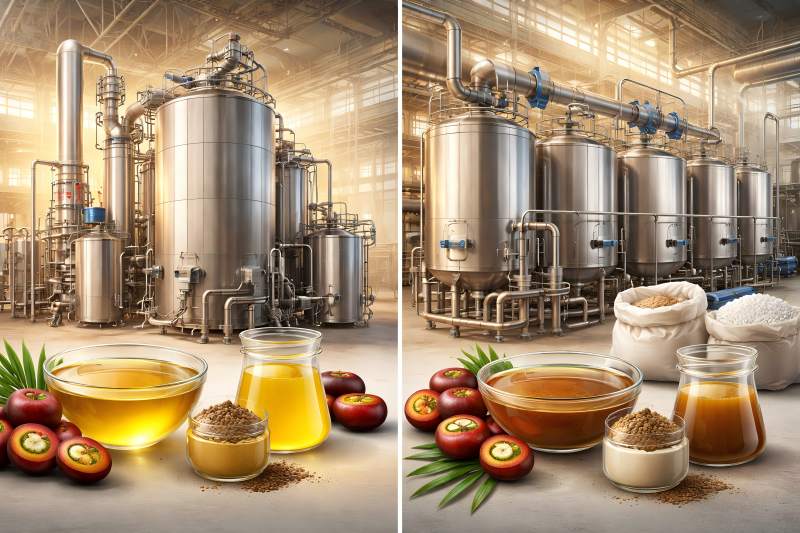
Crude palm oil contains free fatty acids, gums, pigments, metals, moisture, and odor compounds that must be removed during refining while preserving nutrients.
Chemical and physical refining are the primary methods used by the industry. Both produce RBD palm oil but differ in process, equipment, by-products, and cost.
Overview of Palm Oil Refining
Palm oil refining generally consists of four main stages:
- Degumming
- Neutralization or deacidification
- Bleaching
- Deodorization
The removal of free fatty acids (FFA) is the primary distinction between chemical and physical refining.
- An alkali solution is used to neutralize FFA during chemical refining.
- In physical refining, FFA are removed by high-temperature steam distillation during deodorization.
This distinction influences equipment configuration, operating cost, oil yield, and product quality.
Chemical Refining Process
Process Description
Chemical refining removes free fatty acids through an alkali neutralization step. The usual process flow consists of:
- Degumming is the process of removing phospholipids using acid or water.
- Neutralization – Caustic soda (NaOH) reacts with FFA to form soapstock.
- Washing and Drying – Removes residual soap and moisture.
- Bleaching: Adsorbent clay eliminates trace metals and colors.
- Deodorization—Variable chemicals are eliminated by steam distillation.
The reaction in the neutralization stage can be summarized as:
FFA + NaOH → Soap + Water
The soapstock must then be separated via centrifugation.
Key Characteristics
- Operates at lower deodorization temperatures compared to physical refining.
- Generates soapstock as a by-product.
- Requires wastewater treatment due to the washing steps.
- Better suited for oils that include a lot of phosphatides.
Physical Refining Process
Process Description
Physical refining eliminates the neutralization step. Instead of using alkali, it relies on steam distillation to remove FFA at high temperature and vacuum.
The typical process flow includes:
- Acid Degumming (or dry degumming) – Ensures minimal residual phosphorus.
- Bleaching – Removes pigments and trace impurities.
- High-Temperature Deodorization – Steam distillation removes FFA and odor compounds.
- Palm fatty acid distillate (PFAD) is the result of distilling the free fatty acids.
Key Characteristics
- No alkali neutralization.
- No soapstock generation.
- Higher deodorization temperature.
- Produces PFAD as a valuable by-product.
- Reduced production of wastewater.
Fundamental Distinctions Between Chemical and Physical Refining
Process Flow Comparison
| Parameter | Chemical Refining | Physical Refining |
| FFA Removal Method | Alkali neutralization | Steam distillation |
| Neutralization Step | Required | Not required |
| Washing Stage | Required | Not required |
| Deodorization Temperature | Moderate | High |
| By-product | Soapstock | PFAD |
| Wastewater Generation | Higher | Lower |
Free Fatty Acid Removal Mechanism
When refining chemicals:
- Soap is made chemically from FFA.
- Entrainment in soapstock causes oil losses.
- Additional separation equipment is needed.
In physical refining:
- High temperatures and vacuums cause FFA to evaporate.
- Distillation separates fatty acids from triglycerides.
- Higher energy demand but better oil yield.
Yield and Losses of Oil
| Aspect | Chemical Refining | Physical Refining |
| Neutral Oil Loss | Higher (due to soapstock) | Lower |
| Overall Yield | Slightly lower | Higher |
| By-product Value | Moderate (acid oil) | Higher (PFAD) |
| Processing Efficiency | Moderate | High |
Physical refining generally provides better oil recovery, especially for palm oil, which naturally has low phosphatide content.
Equipment and Investment Differences
Chemical Refining Equipment
- Neutralization tanks
- Caustic dosing system
- Washing centrifuges
- Soapstock handling system
- Wastewater treatment unit
Physical Refining Equipment
- Advanced degumming unit
- High-vacuum deodorizer
- Efficient heat recovery system
- Fatty acid distillate condenser
Because physical refining operates at higher temperatures and vacuum levels, it requires more robust stainless steel construction and vacuum systems.
Operational Conditions Comparison
| Operating Parameter | Chemical Refining | Physical Refining |
| Temperature (Deodorization) | 220–240°C | 240–270°C |
| Vacuum Level | Moderate | High (2–4 mbar) |
| Chemical Usage | High (NaOH) | Low |
| Steam Consumption | Moderate | Higher |
| Effluent Volume | Higher | Lower |
Physical refining typically requires greater thermal energy but fewer chemicals and less water.
Environmental Considerations
Chemical refining generates:
- Soapstock
- High wastewater load
- Chemical sludge
- Higher effluent treatment costs
Physical refining:
- Minimizes wastewater
- Avoids alkali discharge
- Produces PFAD, which can be used in biodiesel, soap, and oleochemical production
- More environmentally sustainable
In modern palm oil mills that prioritize sustainability and environmental compliance, physical refining is often preferred.
Suitability for Different Oil Types
| Oil Type | Preferred Method |
| Palm Oil | Physical Refining |
| Soybean Oil | Chemical Refining |
| Rapeseed Oil | Chemical Refining |
| Coconut Oil | Physical Refining |
Palm oil has:
- Low phosphatide content
- High free fatty acid levels
- Stable triglyceride structure
These characteristics make it ideal for physical refining.
Quality and Nutritional Impact
Both methods aim to produce high-quality RBD palm oil. However:
Chemical refining:
- Milder deodorization
- Slightly better retention of some minor nutrients
- More stable color control
Physical refining:
- Some heat-sensitive chemicals may be reduced by higher temperatures.
- Better removal of odor and FFA
- Lower residual phosphorus
Modern physical refining systems use optimized temperature profiles to preserve tocopherols while ensuring FFA removal.
Cost Comparison
Capital Expenditure (CAPEX)
| Cost Element | Chemical Refining | Physical Refining |
| Equipment Cost | Moderate | Higher |
| Installation Complexity | Moderate | High |
| Utility Infrastructure | Moderate | High |
Physical refining generally requires more sophisticated vacuum and heat recovery systems.
Operating Cost (OPEX)
| Cost Category | Chemical Refining | Physical Refining |
| Chemicals | High | Low |
| Steam | Moderate | High |
| Water | High | Low |
| Waste Treatment | High | Low |
| Oil Loss | Higher | Lower |
Over time, physical refining may offer better profitability due to higher oil yield and lower chemical cost.
By-Product Utilization
Chemical Refining:
- Produces soapstock
- Soapstock can be acidulated to produce acid oil
- Lower market value
Physical Refining:
- Produces PFAD (Palm Fatty Acid Distillate)
- Valuable feedstock for biodiesel
- Used in soap and oleochemical industries
- Higher commercial value
The market demand for PFAD significantly enhances the economics of physical refining.
Process Control Complexity
Chemical refining:
- Easier to control
- Less sensitive to phosphorus level
- More forgiving with variable crude oil quality
Physical refining:
- Requires strict control of degumming
- Residual phosphorus must be below 5 ppm
- Highly dependent on crude oil pretreatment
Therefore, feedstock quality plays a critical role in selecting the refining method.
Why Physical Refining Dominates in the Palm Oil Industry
Most modern palm oil refineries adopt physical refining because:
- Palm oil has naturally low phosphatide levels
- Higher oil yield improves profit margin
- Lower wastewater generation meets environmental regulations
- PFAD has strong downstream demand
- Reduced chemical dependency lowers operational complexity
However, chemical refining remains relevant in certain regions and applications where crude oil quality fluctuates significantly.
Concluding Comparative Analysis
| Aspect | Chemical Refining | Physical Refining |
| FFA Removal | Neutralization | Steam Distillation |
| Oil Yield | Lower | Higher |
| Environmental Impact | Higher | Lower |
| Chemical Usage | High | Minimal |
| By-product Value | Moderate | High |
| Process Complexity | Moderate | Higher |
| Suitability for Palm Oil | Acceptable | Ideal |
The key difference between physical and chemical refining in palm oil processing is how free fatty acids are removed. Chemical refining uses alkali neutralization, producing soapstock and wastewater, while physical refining applies high-temperature steam distillation to generate palm fatty acid distillate.
Physical refining is now preferred due to higher oil yield, lower environmental impact, and better economic returns. However, chemical refining remains suitable for variable crude oil quality and requires lower initial investment.
The best method depends on crude oil characteristics, plant capacity, regulations, energy costs, and market strategy. For most modern operations, physical refining offers greater long-term efficiency and sustainability.