
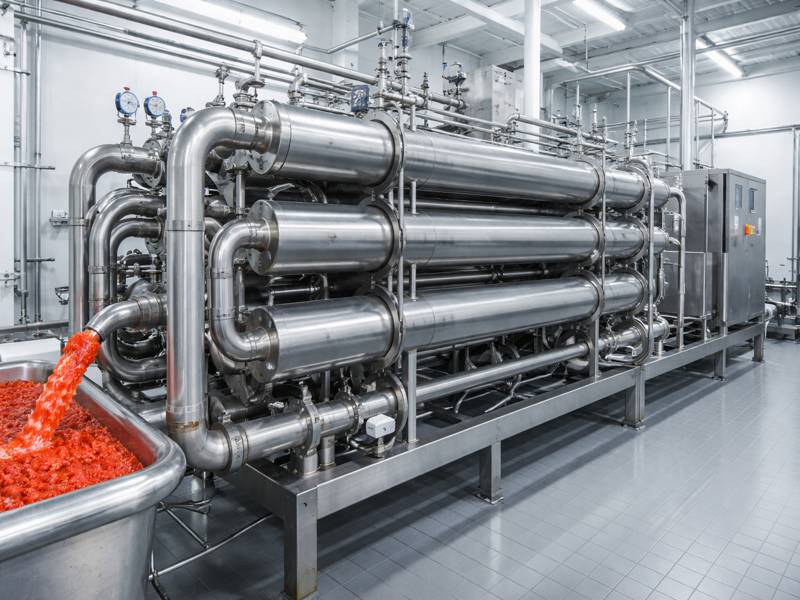
A tomato tubular preheater is a type of heat exchange equipment used in food processing to raise the temperature of tomato pulp or slurry before further processing. It is specifically designed for fluid or semi-fluid materials such as crushed tomatoes.
Its primary purpose is to:
- Preheat the tomato pulp using steam or hot water
- Soften the tomato tissue
- Inactivate enzymes
- Improve processing efficiency
In industrial tomato production lines, the tubular preheater is typically installed after crushing and before pulping or refining.
Why Preheating Is Important in Tomato Processing
Before understanding how the machine works, it’s essential to understand why preheating is necessary.
Key Functions of Preheating
| Function | Description |
| Enzyme inactivation | Prevents pectin breakdown, preserving viscosity |
| Tissue softening | Makes tomatoes easier to pulp and extract |
| Yield improvement | Enhances pulp extraction efficiency |
| Microbial reduction | Reduces microbial load before sterilization |
| Process consistency | Stabilizes downstream processing conditions |
Preheating significantly affects the final product’s:
- Texture
- Color
- Viscosity
- Flavor
For example, tubular preheaters are used in both cold break (55–75°C) and hot break (85–100°C) processes, depending on the desired product consistency.
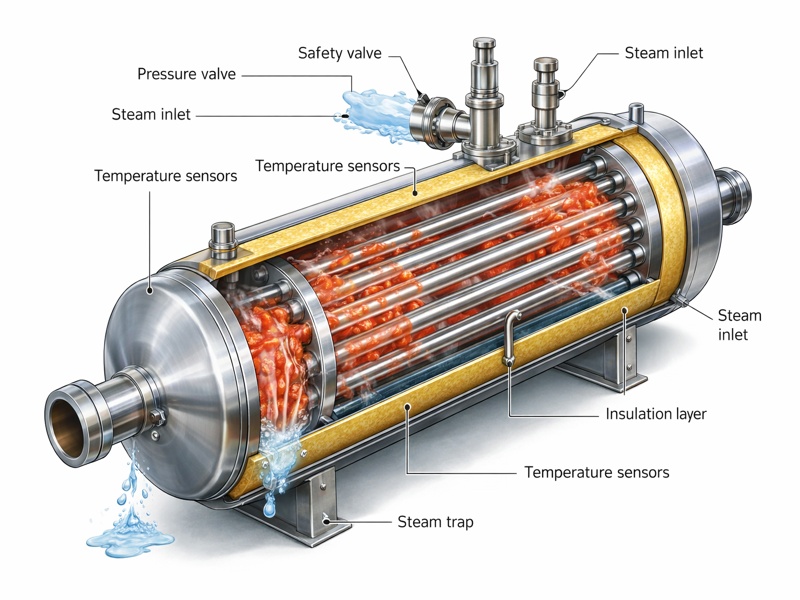
Structure of a Tomato Tubular Preheater
A tubular preheater is essentially a tube-in-tube heat exchanger system designed for continuous processing.
Main Components
| Component | Function |
| Inner tubes | Carry tomato pulp |
| Outer shell | Holds heating medium (steam or hot water) |
| Steam inlet system | Supplies heat energy |
| Valves (pressure, safety) | Control pressure and safety |
| Steam trap | Removes condensed water |
| Temperature sensors | Monitor the heating process |
| Insulation layer | Reduces heat loss |
In many designs, the system consists of multiple stainless steel tubes arranged in parallel, allowing the material to flow back and forth to maximize heat transfer.
How Does a Tomato Tubular Preheater Work?
Indirect heat exchange, in which the heating medium and tomato pulp do not mix, is the foundation of the operation.
Step-by-Step Working Process
Step 1: Feeding the Tomato Pulp
After washing and crushing, tomatoes are converted into a slurry or mash. This material is pumped into the inner tubes of the preheater.
Step 2: Introduction of Heating Medium
Steam or hot water flows through the outer shell surrounding the tubes.
Step 3: Heat Exchange
- Heat transfers from the steam to the tomato pulp through the tube walls
- The pulp temperature rises rapidly and uniformly
Step 4: Temperature Control
Operators adjust:
- Steam pressure
- Flow rate
- Residence time
This ensures precise temperature control for different processes.
Step 5: Discharge
Once the target temperature is reached (e.g., 60–90°C), the preheated pulp exits the system and moves to the next stage, such as pulping or refining.
Simplified Flow Diagram
| Stage | Description |
| Input | Crushed tomato pulp |
| Heating | Steam heats pulp via tubes |
| Control | Temperature regulated |
| Output | Preheated tomato pulp |
Types of Tomato Preheating Processes
Tomato tubular preheaters are widely used in two major processing methods:
Cold Break Process
| Parameter | Value |
| Temperature | 55–75°C |
| Purpose | Preserve flavor and color |
| Result | Lower viscosity |
| Application | Tomato juice, ketchup |
Hot Break Process
| Parameter | Value |
| Temperature | 85–100°C |
| Purpose | Inactivate enzymes quickly |
| Result | Higher viscosity |
| Application | Tomato paste, pizza sauce |
These temperature ranges are achieved through controlled heating inside tubular preheaters.
Role in the Tomato Processing Line
The tubular preheater is a critical intermediate step in the tomato processing workflow.
Typical Processing Line
| Stage | Equipment |
| Washing | Tomato washing machine |
| Sorting | Inspection conveyor |
| Crushing | Tomato crusher |
| Preheating | Tubular preheater |
| Pulping | Pulper/finisher |
| Concentration | Evaporator |
| Sterilization | Tubular sterilizer |
| Packaging | Filling machine |
Preheating helps improve pulping efficiency and can increase pulp yield to around 90% in optimized systems.
Key Advantages of Tubular Preheaters
High Thermal Efficiency
Tubular systems can achieve high heat transfer efficiency, often recycling heat energy within the system.
Gentle Heating
The temperature difference between the heating medium and the product is controlled, preventing overheating and preserving product quality.
Continuous Operation
Unlike batch systems, tubular preheaters support continuous production, which is ideal for industrial-scale plants.
Hygienic Design
- Made of food-grade stainless steel (SUS304/316)
- Easy to clean (CIP systems)
- Meets food safety standards
Precise Temperature Control
Allows exact adjustment for cold break or hot break processes.
Technical Parameters (Example)
An example of a tomato tubular preheater’s usual specification range is shown below:
| Parameter | Range |
| Capacity | 2–30 tons/hour |
| Heating medium | Steam / hot water |
| Temperature range | 55–95°C |
| Steam pressure | 0.08–0.3 MPa |
| Material | Stainless steel (SUS304/316) |
| Heat exchange type | Tube-in-tube |
These parameters can vary depending on plant size and production requirements.
Design Variations
Different designs exist depending on the application:
Tube-in-Tube Design
- Most common
- Simple structure
- Easy maintenance
Multi-Tube Bundle Design
- Higher capacity
- Increased heat transfer area
Wavy Tube Design
- Improves turbulence
- Enhances heat transfer efficiency
Comparison with Other Preheaters
| Feature | Tubular Preheater | Plate Heat Exchanger | Steam Injection |
| Heating method | Indirect | Indirect | Direct |
| Hygiene | High | High | Moderate |
| Temperature control | Precise | Precise | Less precise |
| Maintenance | Moderate | High | Low |
| Product dilution | No | No | Yes |
| Suitable for viscous fluids | Excellent | Limited | Good |
Tubular preheaters are particularly preferred for viscous products like tomato pulp.
Operational Considerations
To ensure optimal performance, operators should monitor:
- Steam pressure levels
- Flow rates of pulp and heating medium
- Temperature consistency
- Cleaning cycles (CIP)
- Valve and sensor functionality
Improper control can lead to:
- Overheating (loss of flavor)
- Underheating (poor enzyme control)
- Fouling inside tubes
Maintenance and Cleaning
Long-term performance requires routine maintenance.
Important Maintenance Activities
| Task | Frequency |
| Tube cleaning (CIP) | Daily/weekly |
| Valve inspection | Monthly |
| Steam trap check | Monthly |
| Sensor calibration | Quarterly |
| Full system inspection | Annually |
Tubes’ smooth inside surface guarantees effective cleaning and reduces fouling.
Future Trends in Tubular Preheaters
With increasing automation and energy efficiency requirements, modern tubular preheaters are evolving:
- Integration with PLC control systems
- Smart temperature monitoring
- Energy recovery systems
- Fully automated cleaning systems
- Improved heat transfer materials
These innovations help reduce energy consumption and improve product consistency.
A tomato tubular preheater is a key heat exchanger in tomato processing, heating pulp via indirect steam to inactivate enzymes, soften tissue, and improve yield. Its controlled tubular heat transfer ensures efficiency in both cold and hot break processes, directly affecting texture, viscosity, and product quality—making it essential for consistent, high-quality production.