
When selecting cocoa powder, buyers usually focus on fat content, color, pH, flavor and whether the powder is natural or alkalized. Particle size is sometimes treated as a secondary specification, but in actual production it can influence mouthfeel, dispersion, dust generation, mixing behavior and downstream processing.
Cocoa powder may be described as 100 mesh, 200 mesh or 300 mesh, but these numbers are often misunderstood. A higher mesh number means a finer sieve opening—not necessarily that every cocoa particle has exactly that diameter.
As a practical approximation:
| Mesh | Approx. Sieve Opening | Relative Fineness |
| 100 mesh | ~150 µm | Coarser |
| 200 mesh | ~75 µm | Fine |
| 300 mesh | ~50 µm | Very fine |
Commercial cocoa specifications frequently use 200 mesh as a fineness reference. Examples include products specifying more than 98–99% passing a 75 µm/200-mesh sieve, while published cocoa-processing literature also references 200 mesh as an accepted cocoa-powder specification.
However, choosing between 100, 200 and 300 mesh should not be reduced to “finer is better.” The correct fineness depends on the final product and how the powder must behave during processing.
What Does Cocoa Powder’s Mesh Mean?
The number of apertures per linear inch on a screen is referred to as mesh. The apertures get smaller as the mesh number rises.
This gives a useful rule:
Higher mesh number → smaller sieve opening → finer classified powder
But mesh should not be confused with the actual average particle size.
For example, if a specification states:
99% passes 200 mesh
it means at least 99% of the tested material passes through the specified sieve. It does not mean all particles are 75 µm in diameter.
This distinction matters considerably with cocoa.
Cocoa powder contains irregular particles and agglomerates. Depending on the analytical method, its measured particle-size distribution can be much finer than the nominal sieve opening. One published patent describing conventional cocoa powder reports more than 99.5% passing a 200-mesh/75 µm screen while giving a typical mean particle size around 7–12 µm.
So when purchasing cocoa powder or specifying a milling system, asking only for “200 mesh” does not provide a complete particle-size specification.
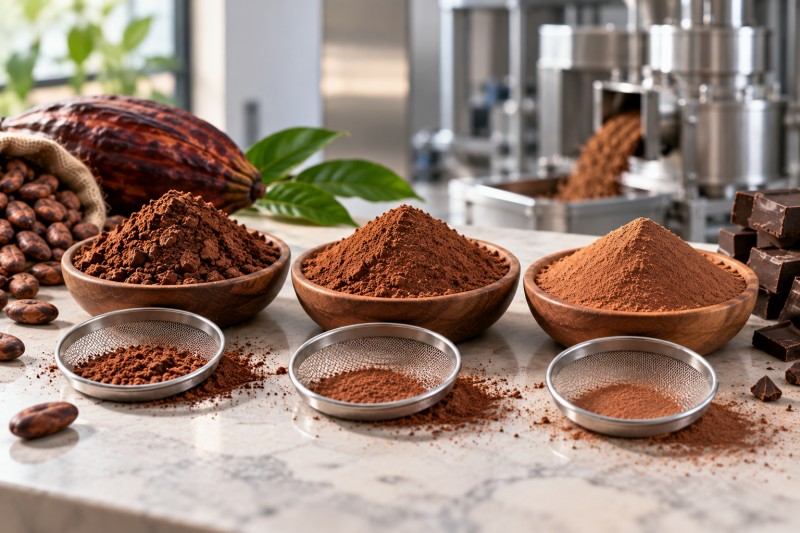
100 Mesh Cocoa Powder
A 100-mesh screen has an opening of roughly 150 µm.
For cocoa processing, this should generally be considered a relatively coarse classification compared with a 200-mesh finished powder specification.
| Parameter | 100 Mesh Cocoa Powder |
| Approx. sieve opening | ~150 µm |
| Relative fineness | Coarse |
| Milling requirement | Lower |
| Powder handling | Generally easier |
| Dust tendency | Relatively lower |
| Risk of detectable coarse particles | Higher |
| Typical role | Intermediate/coarser powder or less demanding applications |
A 100-mesh product may be suitable where extremely smooth texture is unnecessary or where cocoa powder will undergo additional processing.
It can also be useful as an intermediate product before secondary fine grinding.
The major advantage is processing simplicity. Producing a coarser powder normally places less demand on the final milling and classification stage. Throughput can potentially be higher, and heat generation may be easier to manage.
The trade-off is texture.
If coarse particles or agglomerates remain, they may become noticeable in applications where the consumer expects a very smooth product.
For this reason, 100 mesh should not automatically be considered a finished specification for every food application.
200 Mesh Cocoa Powder
A 200-mesh screen has an opening of approximately 75 µm.
This is an important reference point in commercial cocoa processing. One commercial specification, for example, reports 98.41% below 75 µm through a 200-mesh sieve, while another cocoa specification lists more than 99% at 200 mesh.
Published technical work has also described cocoa powder passing 200 mesh as an accepted market specification.
| Parameter | 200 Mesh Cocoa Powder |
| Approx. sieve opening | ~75 µm |
| Relative fineness | Fine |
| Milling difficulty | Moderate |
| Mouthfeel | Generally smooth |
| Dispersion potential | Good when properly formulated |
| Dust tendency | Moderate |
| Commercial relevance | High |
For many industrial applications, 200 mesh provides a practical balance between fineness and production efficiency.
It is fine enough to control obvious coarse particles while avoiding some of the additional processing difficulty associated with pushing the complete powder stream toward much finer classifications.
That makes it a sensible starting specification for cocoa powder used in products such as bakery mixes, confectionery ingredients, beverage premixes and general food manufacturing—although the final requirement should always come from the customer’s product specification.
300 Mesh Cocoa Powder
A 300-mesh screen corresponds approximately to an opening around 50 µm, depending on the sieve standard being referenced.
This represents substantially finer screening than 100 or 200 mesh.
| Parameter | 300 Mesh Cocoa Powder |
| Approx. sieve opening | ~50 µm |
| Relative fineness | Very fine |
| Milling demand | High |
| Classification difficulty | Higher |
| Potential texture | Very smooth |
| Dust tendency | Higher |
| Agglomeration tendency | Potentially higher |
| Energy requirement | Generally higher |
A very fine cocoa powder can be useful when manufacturers need tighter control over coarse particles or are developing applications where smoothness is especially important.
But 300 mesh comes with an engineering cost.
As particle size decreases, grinding becomes progressively more demanding. More energy is required; the mill generates more heat, classifier load increases, and the fine powder becomes more difficult to separate efficiently.
Fine particles can also increase dust and make powder handling more challenging.
So specifying 300 mesh simply because it sounds like a higher-quality product is not necessarily good process design.
Direct Comparison: 100 vs 200 vs 300 Mesh
The differences become clearer when viewed from the production side.
| Characteristic | 100 Mesh | 200 Mesh | 300 Mesh |
| Approx. opening | 150 µm | 75 µm | ~50 µm |
| Fineness | Coarse | Fine | Very fine |
| Grinding difficulty | Low | Medium | High |
| Energy consumption | Lower | Moderate | Higher |
| Mill throughput | Higher | Moderate | Potentially lower |
| Heat generation | Lower | Moderate | Higher |
| Dust control demand | Lower | Medium | Higher |
| Classification difficulty | Low | Medium | High |
| Smoothness potential | Moderate | High | Very high |
| Typical production practicality | High | Very high | Application-dependent |
These values describe general processing tendencies rather than fixed performance guarantees.
Actual results depend on the mill, classifier, cocoa cake properties, residual fat, feed temperature and particle-size distribution.
Why More Energy Is Needed to Grind Finer Cocoa Powder
Reducing cocoa cake from relatively large fragments into powder is easy compared with repeatedly breaking already-small particles into even smaller particles.
This is a basic aspect of size reduction.
As the target size decreases, the amount of newly created surface area rises substantially. At the same time, the probability that energy actually produces useful fracture rather than heat becomes less favorable.
Suppose a powder mill can comfortably produce a 200-mesh product at its rated capacity.
Asking the same machine to produce a much higher percentage passing 300 mesh may require:
- Lower feed rate
- Higher rotor speed
- Additional grinding stages
- More classification
- Recycling of oversized particles
- Greater cooling capacity
- More electrical power
The machine may still technically produce 300-mesh powder, but its effective production capacity may fall.
Temperature Becomes More Important as Powder Gets Finer
Cocoa powder is not a simple mineral powder.
It contains residual cocoa butter.
Conventional cocoa powders can contain around 10–12% fat, while other grades contain more. A technical reference describing standard cocoa powders likewise notes conventional powders containing about 10–12% fat after pressing and milling.
That fat changes the behavior of the material inside a grinding system.
Grinding converts mechanical energy into heat. If the cocoa cake or powder becomes too warm, residual fat can soften and contribute to:
smearing → sticking → screen blockage → unstable grinding → reduced capacity
This can become increasingly troublesome during fine grinding.
A mill capable of producing 300 mesh with a cold, stable feed may perform very differently when cake temperature rises during continuous operation.
Cooling is therefore not an optional detail in fine cocoa grinding.
Particle Size and Mouthfeel
One reason manufacturers demand fine cocoa powder is texture.
Large particles are more likely to produce a rough or gritty sensory impression. Technical literature on cocoa products therefore emphasizes controlling particle-size distribution to minimize coarse particles and avoid gritty mouthfeel.
But this does not mean that moving from 200 mesh to 300 mesh automatically produces a proportionally better product.
Human sensory perception is influenced by the entire particle-size distribution, not simply the largest sieve through which the powder passes.
Consider two powders:
| Powder | 200 Mesh Passing | Particle Distribution |
| Powder A | 99.5% | Narrow and consistent |
| Powder B | 99.5% | Broad distribution with more ultrafines |
Both satisfy the same nominal mesh requirement, but they may behave differently during mixing, conveying and consumption.
This is why laser particle-size analysis can provide more useful information than mesh alone when tight product control is required.
Does Finer Cocoa Powder Dissolve Better?
This needs careful wording.
Cocoa powder does not truly dissolve in water like sugar. Much of the material forms a dispersion or suspension.
Reducing particle size increases surface area and can improve how quickly particles interact with the surrounding liquid, but wettability is influenced by more than size.
Important factors include:
- Fat content
- Alkalization
- Lecithination
- Surface characteristics
- Agglomeration
- Mixing intensity
- Liquid temperature
- Formulation
A 300-mesh powder therefore does not automatically create an instant cocoa beverage.
Very fine powder can actually be difficult to wet because particles may float, form lumps or trap air.
For beverage applications, wettability and dispersibility must be engineered separately from fineness.
Mesh Size and Powder Handling
Finer is also not always easier to transport.
As cocoa powder becomes finer, its surface area increases and its bulk behavior can change.
Very fine powders may become more cohesive, dusty, and susceptible to agglomeration.
| Handling Factor | 100 Mesh | 200 Mesh | 300 Mesh |
| Dust generation | Lower | Medium | Higher |
| Flowability | Generally easier | Good if controlled | More sensitive |
| Agglomeration risk | Lower | Medium | Higher |
| Dust collection demand | Lower | Medium | Higher |
| Packaging cleanliness | Easier | Moderate | More demanding |
Plant designers therefore need to consider the whole system.
A 300-mesh mill connected to poorly designed screw conveyors, open transfer points and inadequate dust collection will not create a good production line.
Why the Cocoa Cake Matters
The same mill can produce different results when the feed material changes.
Important cake properties include:
Residual fat content. More fat can make grinding more sensitive to temperature.
Cake temperature. Warm cake may soften during grinding.
Initial cake size. Large irregular pieces create unstable feed conditions.
Moisture. Excess moisture can increase sticking and agglomeration.
Previous liquor grinding. Cocoa particle structure has already been strongly influenced before pressing.
The last point is often overlooked.
Research and patent literature indicate that much of cocoa’s fundamental particle-size distribution can already be established during liquor grinding and remain through subsequent butter separation.
The final powder mill is therefore not responsible for creating every microscopic cocoa particle from scratch. It also breaks press cake structure and agglomerates and controls the final coarse fraction.
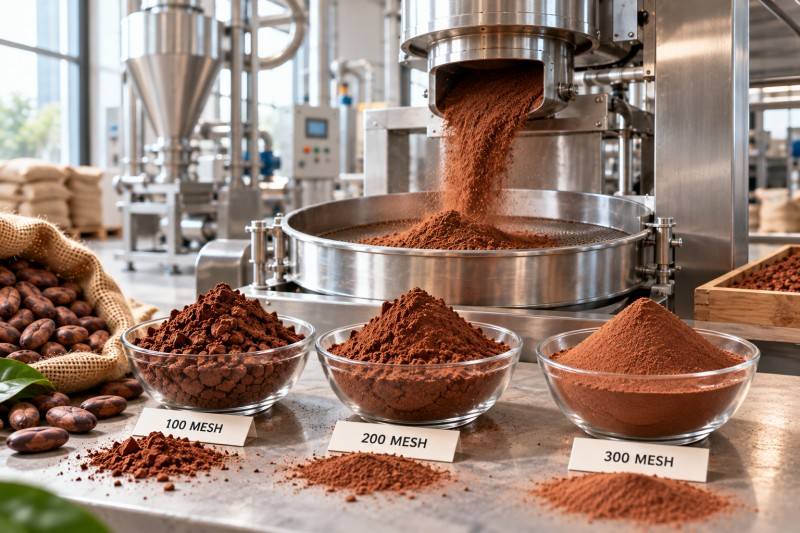
Choosing the Right Cocoa Powder Fineness
For most buyers, the selection can be approached practically.
Choose around 100 mesh when:
The application can tolerate a relatively coarse powder, the material will undergo further processing, or maximizing grinding throughput is more important than achieving a very fine finished powder.
Choose around 200 mesh when:
You need a fine commercial cocoa powder with a good balance between texture, processability and production cost. This is a particularly relevant benchmark because 200-mesh fineness appears frequently in commercial cocoa specifications.
Choose around 300 mesh when:
The final application genuinely requires tighter control of coarse particles or very fine powder characteristics, and the additional milling, classification, cooling and dust-control requirements can be justified.
Do Not Specify Cocoa Powder by Mesh Alone
A purchasing specification reading only:
“Cocoa Powder — 200 Mesh”
is incomplete.
A better specification might include:
| Parameter | Example Specification |
| Type | Natural / alkalized |
| Fat content | 10–12% |
| Moisture | ≤5% |
| pH | Application-specific |
| Fineness | ≥99% through 200 mesh |
| Sieve opening | 75 µm |
| Particle distribution | D10 / D50 / D90 if required |
| Color | Customer standard |
| Microbiology | Customer/market standard |
| Packaging | 20–25 kg bag |
For example, one current commercial cocoa powder specification reports 12% fat, 3.91% moisture, pH 7.11 and 98.41% passing a 75 µm/200-mesh sieve.
Adding the percentage passing the sieve is especially important.
What Should a Cocoa Powder Milling Line Control?
For manufacturers producing multiple cocoa powder grades, a flexible milling system is more useful than simply purchasing the highest-speed grinder available.
The system should control:
Feed size → Feed rate → Product temperature → Grinding intensity → Airflow → Classification → Oversize recycling
A practical line may include:
Cocoa Cake Breaker → Cooling → Fine Grinder → Air Classifier/Sifter → Dust Collection → Finished Powder Bin → Packaging
For finer products, an air-classification or controlled recycling system may become increasingly valuable.
Oversized material can be returned to the mill instead of forcing the entire product stream through excessively aggressive grinding conditions.
That can improve both energy efficiency and product consistency.
100, 200, and 300 mesh cocoa powders mainly differ in particle fineness and processing requirements. 100 mesh is coarser and easier to produce, 200 mesh offers a practical balance of fineness and efficiency, while 300 mesh requires more energy, cooling, and process control.
The goal is not maximum fineness, but the particle size required by the application at reasonable cost and stable capacity.