
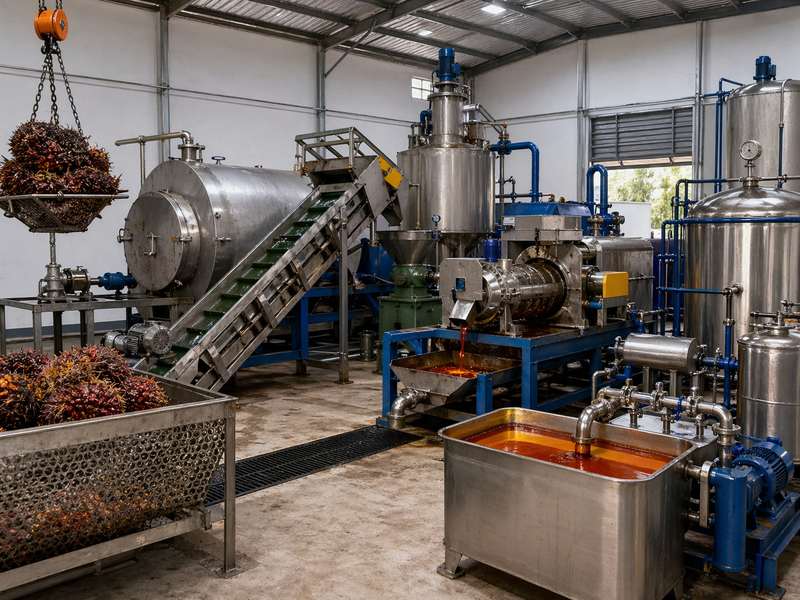
What Equipment Configuration Is Suitable for a Start-Up Palm Oil Processing Plant?
Starting a palm oil processing business requires matching equipment with raw material supply, budget, output goals, and future growth. For start-ups, a 0.5T palm oil processing line is a practical entry-level choice, covering key processes while keeping investment, space, and operation costs manageable. Why a Small Palm Oil Processing Line Is Suitable for Start-Up Investors A start-up palm oil plant usually needs to solve several practical issues at the same time: Limited initial budget Uncertain fresh fruit supply Small or regional market demand Limited technical workforce Need for faster project launch Need for lower operating risk Because of these factors, many investors prefer a small but complete palm oil processing line instead of a large and highly automated project. The main reasons a start-up plant should begin with a compact configuration are Lower equipment investment Lower installation cost Smaller workshop requirement Easier operator training Simpler maintenance Lower energy consumption More flexible production scheduling Easier capacity expansion later Start-up plant priorities Priority Why It Matters Cost control Reduces financial pressure in the early stage Process completeness Ensures the line can actually produce usable oil Stable extraction Helps avoid production loss Basic purification Improves oil quality and marketability Expansion potential Supports future growth without redesigning everything For many small investors, the best configuration is not the largest one. It is the one that can create a workable and profitable production model from the start. 0.5T Palm Oil Equipment Configuration Reference Table Below is a typical reference list for a start-up-scale palm oil processing plant. No. Equipment Name Model Parameters Quantity 1 Sterilizer SFG-1400 1 2 Hoisting Cage CD-1.0/6 1 3 Thresher YS-140 1 4 Conveyor 200 1 5 Digester DS-600 1 6 Palm Fruit Press Machine YS-0.5 1 7 Sieve VB-400 1 8 Crude Oil Tank 0.1 1 9 Clarification Tank 2.5 1 10 Clean Oil Tank 0.5 1 11 Oil Pump 1.5 1 12 Vacuum System GZ-600 1 What This Configuration Covers Instead of looking at each machine separately, it is more useful to understand what this configuration achieves as a system. This Start-up Configuration Typically Covers: Fruit pretreatment Fruit separation Fruit conveying Pulp digestion Oil pressing Primary impurity removal Oil clarification Moisture reduction Finished oil storage Configuration value by process stage Process Section Purpose Included in This Line Pretreatment Prepare palm fruit for extraction Yes Fruit separation Remove bunch material Yes Oil extraction Press crude oil from fruit pulp Yes Oil cleaning Remove coarse solids and settle impurities Yes Dehydration Improve storage quality Yes Storage Hold clarified oil before sale or transfer Yes This is why a 0.5T line is often suitable for start-up investors. It is not just a press machine with a few accessories. It is a basic but complete production system. Why Complete Configuration Matters More Than Buying Only Core Machines Some first-time buyers focus mainly on the pressing machine and assume the rest can be simplified. In reality, an incomplete configuration often creates more operational problems. Risks of under-configured palm oil plants Poor fruit pretreatment Lower extraction efficiency Higher impurity content in oil Unstable oil quality More manual handling Higher labor dependence Difficult workflow coordination Lower commercial value of the final oil Comparison: incomplete setup vs complete start-up line Item Incomplete Setup Complete Start-Up Line Process flow Often disconnected More continuous Oil quality Less stable More controllable Labor demand Higher Lower Efficiency More interruptions Better coordination Future expansion Harder Easier For a business that wants to build a sustainable palm oil processing operation, a small complete line is usually more economical in the long run than a partial setup. Suggested Technical and Business Data for a Start-Up Plant Below are practical planning indicators often used when evaluating a small palm oil project. Item Typical Start-Up Reference Plant type Small-capacity palm oil processing line Capacity level 0.5T configuration Automation level Basic/semi-automatic Workshop requirement Compact Labor requirement Small team Investment approach Core equipment first Expansion path Add capacity and automation later Typical start-up business goals Start local production quickly Reduce upfront capital pressure Build product quality consistency Test fruit supply stability Develop local or regional oil sales Prepare for future plant scaling ROI Analysis for a Start-Up Palm Oil Processing Plant ROI is one of the most crucial aspects of project planning for startup investors. A palm oil processing line may look technically suitable, but if the project cannot generate a reasonable return, the investment decision becomes much riskier. That is why a start-up palm oil plant should always be evaluated not only by equipment list, but also by capital input, operating cost, production value, and payback potential. What A Palm Oil Processing Project’s Return on Investment Is ROI, or return on investment, shows how effectively your project turns capital into profit. To put it simply, it helps respond to inquiries like: How much should I invest? How much oil can this line produce? What are my monthly and yearly operating costs? How much profit can I expect? How much time will it take to recoup the investment? Simple ROI Calculation Formula Meaning ROI = Annual Net Profit / Total Investment × 100% Measures annual return rate Payback Period = Total Investment / Annual Net Profit Estimates years needed to recover cost Main Costs in a Start-Up Palm Oil Plant A small palm oil project does not only include equipment purchase. Investors should calculate total capital more carefully. Main investment categories Equipment cost Transportation cost Installation and commissioning Workshop preparation Electrical connection Piping and supporting materials Initial labor and training Working capital Raw material purchase Packaging and storage Sample investment structure Cost Item Typical Share of Initial Budget Equipment system 40–55% Installation and workshop 15–25% Utilities and supporting materials 5–10% Initial raw materials 10–20% Labor and working capital 10–15% This kind of structure helps investors avoid underestimating the real project budget. Sample ROI Reference for a Small Palm Oil Processing Plant Below is a reference-style example for a start-up palm oil processing project. These numbers are not fixed market quotations, but a useful framework for evaluating investment logic. Assumptions for ROI illustration Small