
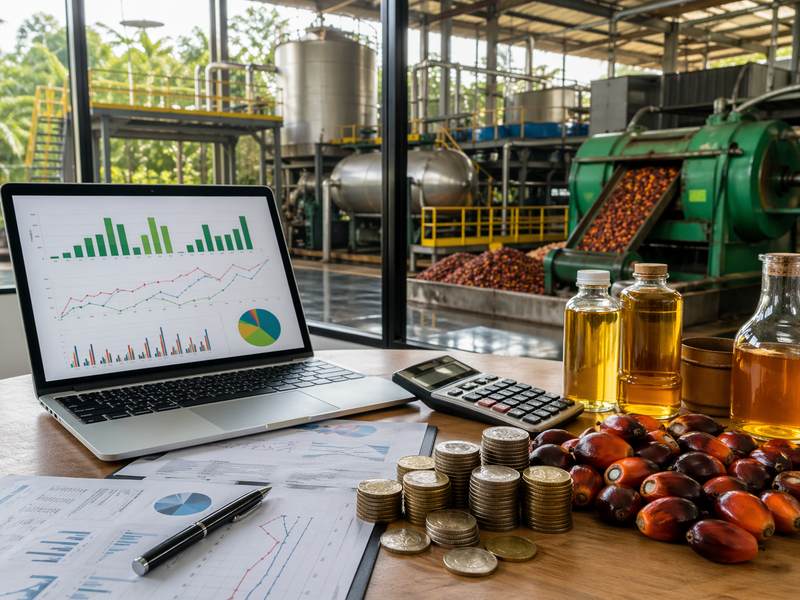
ROI Analysis for a Start-Up Palm Oil Processing Plant
For many start-up investors, equipment choice is only part of the decision. The key question is whether the palm oil plant can deliver a reasonable return after operation, so ROI analysis is essential in project planning. A small palm oil processing line is attractive because it requires lower investment and offers a more manageable path to profitability. Investors can start production sooner, control costs, and test local supply and market demand before expanding. For a start-up palm oil processing plant, ROI depends on several factors working together, including: Initial equipment investment Workshop and installation cost Fresh fruit supply cost Extraction efficiency Labor and utility expenses Finished oil selling price Monthly operating days Equipment stability and downtime A suitable start-up configuration should therefore be evaluated not only as a machine list, but as a profit-generating production system. What Should Be Included in ROI Evaluation? When calculating ROI for a small palm oil processing plant, investors should not focus only on the machine purchase price. A more practical evaluation should include both initial capital investment and ongoing operating costs. Main ROI evaluation categories equipment purchase freight and transportation installation and commissioning workshop construction or preparation electrical and piping support labor cost raw material cost energy and utility consumption maintenance and spare parts packaging, storage, and transport monthly and annual sales revenue ROI planning framework Category What It Includes Initial investment Equipment, shipping, installation, workshop, utilities Operating cost Raw materials, labor, electricity, maintenance, packaging Revenue Palm oil sales, possible by-product sales Profitability Gross profit, net profit, annual return Recovery speed Payback period based on total investment Basic ROI Formula for a Palm Oil Processing Project A start-up project does not need a very complicated financial model at the early stage, but it should at least calculate the basic return formulas below. Common ROI formulas Formula Explanation ROI = Annual Net Profit ÷ Total Investment × 100% Measures annual return on total invested capital Payback Period = Total Investment ÷ Annual Net Profit Estimates how long it takes to recover investment Gross Profit = Sales Revenue – Operating Cost Shows direct profit before additional expenses Net Profit = Gross Profit – Other Annual Expenses Shows actual retained profit Simple calculation logic Total Investment= equipment + installation + workshop + utility setup + working capital Monthly Revenue = monthly oil output × selling price Monthly Operating Cost= raw materials + labor + utilities + maintenance + transport Monthly Profit = monthly revenue – monthly operating cost Annual Net Profit= monthly profit × 12 – annual extra expenses Initial Investment Structure for a Start-Up Palm Oil Plant For a small-capacity project, the investment is usually more than just the processing line itself. Below is a practical reference structure. Typical initial investment items Palm oil processing equipment Installation and commissioning Workshop preparation Electrical wiring and utility connection Tanks, pipes, and supporting materials First batch of raw material purchase Labor setup and trial production budget Spare parts and contingency fund Reference Investment Structure Cost Item Typical Share of Total Investment Equipment system 40%–55% Installation and workshop setup 15%–25% Utility and support system 5%–10% Initial raw materials 10%–20% Labor and working capital 10%–15% Example Start-up Investment Range Item Reference Value Equipment purchase USD 20,000–35,000 Installation and commissioning USD 3,000–6,000 Workshop and utility preparation USD 8,000–15,000 Initial working capital USD 5,000–10,000 Total estimated investment USD 36,000–66,000 This kind of range is useful for early planning because it helps investors understand that project feasibility depends on the whole system cost, not just the machine quotation. Monthly Operating Cost Analysis Once the plant begins production, monthly cost control becomes the core factor affecting ROI. Main Monthly Operating Costs Fresh palm fruit purchase Labor wages Electricity and fuel Routine maintenance Spare parts replacement Packaging and storage Local transportation Management and miscellaneous costs Monthly Cost Structure Cost Item Typical Cost Characteristic Raw material Usually, the highest operating cost Labor Depends on team size and local wage level Electricity/fuel Affected by the local energy price Maintenance Lower if machines are stable and serviced on time Packaging/storage Depends on the product handling model Logistics Depends on market distance and transport frequency Start-up Plant Operating Priorities keep raw material supply stable reduce unnecessary downtime maintain compact labor arrangement avoid excessive oil loss during processing keep utilities and maintenance under control Revenue Estimation for a Small Palm Oil Processing Plant Revenue is mainly influenced by three variables: How much fruit is processed How much oil is extracted How much the oil can be sold for For start-up investors, it is useful to estimate revenue in scenarios rather than relying on only one optimistic number. Revenue Calculation Logic Step Calculation Basis 1 Estimate monthly fruit processing volume 2 Estimate the actual oil extraction rate 3 Estimate monthly oil output 4 Multiply output by selling price 5 Compare revenue with total monthly operating cost Revenue-related factors Fruit quality Fruit freshness Extraction stability Clarification quality Moisture content in the final oil Local crude palm oil market price Monthly effective production days Profit Example: Conservative, Standard, and Better-Performance Scenarios Below is a simplified reference model for a start-up palm oil processing plant. The purpose is not to provide a fixed market promise, but to help investors understand how different operating conditions affect profit and payback. Scenario Comparison Item Conservative Scenario Standard Scenario Better-Performance Scenario Total investment USD 45,000 USD 50,000 USD 55,000 Annual revenue USD 72,000 USD 95,000 USD 125,000 Annual operating cost USD 58,000 USD 65,000 USD 80,000 Annual net profit USD 14,000 USD 30,000 USD 45,000 ROI 31.1% 60.0% 81.8% Payback period 3.2 years 1.7 years 1.2 years This table shows a very important point: The success of a start-up palm oil plant is not decided only by lower investment, but by the balance between cost control, extraction performance, and market sales. Sample Monthly Profit Model A monthly profit model helps investors evaluate whether the project can support daily cash flow. Example Monthly Profit Table Item Example Value Monthly sales revenue USD 7,900 Monthly raw material cost USD 3,800 Monthly