
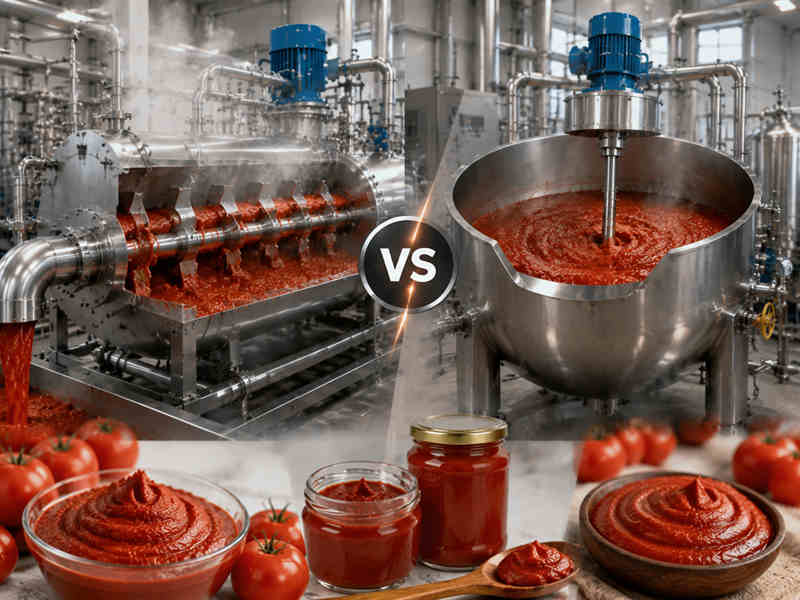
Scraped Vacuum Evaporator vs. Steam-Jacketed Kettle: Which Handles Thick Fruit Puree Better?
Fruit evaporation cannot be simplified to thermal treatment. Increased pulp viscosity creates challenges for flow control, heat transfer and product homogeneity. Steam-heated kettles and vacuum scraped evaporators adopt different mechanisms. Viscosity adaption and quality demands ought to take precedence over production throughput in equipment selection. Why Thick Fruit Puree Requires Different Evaporation Equipment Noticeable variations occur to fruit puree in the concentration process. The raw material features good fluidity initially. Water loss boosts sugar content and thickness, while natural fibres add mixing resistance. Such characteristics bring forward various processing demands: High viscosity control Constant material motion is essential for dense puree to achieve uniform heating. Stagnation against heating surfaces causes partial overheating and damages natural colour and taste. Stable heat transfer As the material thickens, even heat distribution throughout the bulk becomes harder to achieve. Machinery needs to continuously agitate and refresh the layer contacting heating zones. Gentle concentration Temperature regulation is essential for most fruit goods, as excessive thermal exposure deteriorates their inherent colour, fragrance and texture. Such demands render the choice of evaporation equipment particularly critical for fruit concentrates. Scraped Vacuum Evaporator: Designed for High-Viscosity Fruit Materials The scraped vacuum evaporator is equipped with rotary scrapers inside the evaporation vessel. Scrapers continuously strip thickened material from heated surfaces to facilitate consistent circulation beyond passive flow or ordinary agitation. Vacuum lowers the boiling point for low-temperature dehydration and lessens material fouling on heating walls. VORTECH’s bespoke evaporators can be tailored to diverse fruit raw materials, throughput demands and on-site processing circumstances. Key processing characteristics include: Scraped heat transfer surface for high-viscosity materials Vacuum concentration for controlled evaporation temperature Continuous product movement during concentration Customized structure according to puree characteristics Suitable for fruit concentrates, sauces, and viscous food materials Steam-Jacketed Kettle: Traditional Batch Heating Solution Steam-jacketed kettles are popular in food manufacturing thanks to simple construction and flexible operation. Internal agitators deliver acceptable temperature uniformity for materials with low to medium viscosity. Yet thick fruit puree creates operational difficulties. Higher viscosity raises mixing load and makes wall-side heat transfer heavily reliant on agitator efficiency. Steam-jacketed kettles are still suitable for: Small batch fruit processing Sauce preparation Filling production Products requiring cooking rather than intensive concentration Scraped Vacuum Evaporator vs. Steam-Jacketed Kettle Factor Scraped Vacuum Evaporator Steam-Jacketed Kettle Suitable Material Thick fruit puree, concentrate, high-solid products Medium viscosity puree and sauces Heating Method Vacuum evaporation with scraping Steam jacket heating Material Movement Continuous scraping and circulation Agitator-based mixing Temperature Control Lower evaporation temperature Depends on heating control Processing Mode Continuous or semi-continuous Mainly batch production Heat Transfer Performance During Fruit Puree Concentration Thermal transfer greatly influences evaporation performance. In traditional kettles, heat passes through the container wall. Viscous puree forms boundary layers and hinders heat exchange. Scraped vacuum evaporators eliminate such barriers by continuously clearing material attached to heating zones. The scraping function delivers various benefits: Reduced product buildup The scraper prevents thick material from staying on the heated wall for extended periods. Improved temperature uniformity Persistent material motion facilitates uniform thermal distribution across the fruit puree. Better viscosity adaptation As the material becomes more concentrated, machinery maintains product flow instead of counting on passive circulation alone. Effect on Fruit Color and Texture Stability Processing circumstances exert a vital influence on fruit puree quality. Items including strawberry puree, mango concentrate and tomato paste need regulated evaporation to retain visual characteristics and mouthfeel. Vacuum concentration enables evaporation at lower temperatures, protecting thermally sensitive substances. In addition, scrapers prevent partial overheating arising from thick material buildup adjacent to heating walls. From a production perspective, stable evaporation conditions help manufacturers achieve: More consistent product color Better texture uniformity Reduced variation between batches More predictable final concentration Custom Configuration for Different Fruit Processing Requirements Processing behaviours differ among fruit varieties. High-solids tomato paste needs stable concentration treatment. Tropical puree is rich in fibre, whereas berry puree relies on accurate temperature management to retain its original appearance. Accordingly, evaporators should adopt customised design rather than off-the-shelf configurations. VORTECH provides Custom evaporation solutions according to: Custom Item Processing Purpose Scraper Structure Matches different viscosity levels Heating Area Design Supports required evaporation capacity Material Contact Parts Meets food processing requirements Discharge Configuration Fits different final product thickness Customization allows the equipment to better match the complete production line, from fruit preparation to final packaging. Integration With Complete Fruit Processing Lines Concentration via evaporation is just a single step of fruit manufacturing. Raw fruits are generally washed, graded, crushed and pumped before entering the evaporation unit. Well-functioning upstream facilities deliver feed materials with uniform properties to the evaporator. For example: Fruit Washing → Sorting → Crushing → Pump Transfer → Vacuum Evaporation → Filling VORTECH’s fruit processing equipment solutions can be integrated according to production requirements, including fruit washing and sorting equipment, crushing and transferring systems, and customized evaporation solutions. Suitable Applications of Scraped Vacuum Evaporator Tomato Paste Production High solid levels mean tomato paste requires efficient concentration performance. Precise temperature regulation during evaporation maintains consistent visual and textural properties. Scraped vacuum evaporators effectively remove water whilst ensuring the product flows smoothly. Mango and Tropical Fruit Puree Mango and other tropical fruit purees contain natural pulp and fibrous substances. Continuous scraping optimises material handling and ensures stable fluidity during the concentration process. Berry Concentrate Berry produce is vulnerable to harsh processing conditions. Vacuum evaporation delivers controllable low-temperature concentration, properly retaining each product’s natural features in the evaporation workflow. Fruit Filling and Jam Production Viscosity regulation plays a key role in producing thick fillings and jams. Scraped evaporators facilitate homogeneous material distribution and keep steady, uniform concentration in ongoing production operations. For dense fruit puree production, choosing between scraped vacuum evaporators and steam-jacketed kettles is determined by material viscosity, output scale and quality standards. Steam-jacketed kettles work well for basic batch heating. In contrast, scraped vacuum evaporators perform better for high-viscosity puree needing stable concentration, even heat distribution and precise evaporation control. Customised evaporation setups allow fruit producers to achieve consistent output, cut process fluctuations and create robust concentration procedures