
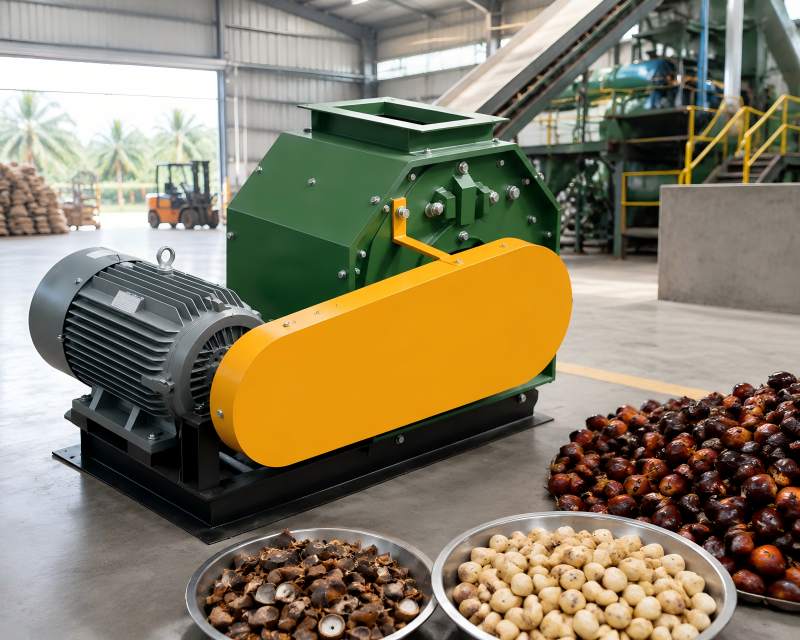
What Is a Palm Nut Crusher and How Does It Work in Palm Oil Processing?
Palm oil processing goes beyond crude palm oil extraction. The remaining palm nuts contain valuable kernels that can be processed into palm kernel oil, widely used in food, cosmetics, detergents, and chemical industries. However, palm nuts have a hard shell that must be cracked before further processing. A Palm Nut Crusher plays a key role by breaking the shell while protecting the kernel. Proper crushing balance improves kernel recovery, separation efficiency, oil yield, and overall processing costs. The Role of Palm Nut Crushing in Palm Oil Processing Palm nuts are generated after the extraction of crude palm oil from palm fruits. These nuts consist mainly of two parts: The outer shell, which provides mechanical protection The inner kernel, which contains valuable oil The general palm kernel oil production process includes drying, nut cracking, shell separation, kernel preparation, and oil extraction. The crushing stage is positioned between raw nut preparation and kernel recovery because the shell must be opened before the kernel can be separated and processed. A typical workflow can be summarized as follows: Processing Stage Main Purpose Key Equipment Palm Nut Drying Reduce moisture and improve cracking performance Dryer or natural drying system Nut Crushing Break shell structure and expose kernel Palm Nut Crusher Shell-Kernel Separation Remove shell fragments Separator, air classifier, hydrocyclone Kernel Processing Prepare kernels for oil extraction Grinder, cooker, oil press The crushing stage may appear simple, but it determines how efficiently the entire production line operates. Why Traditional Palm Nut Breaking Methods Are No Longer Suitable In small rural operations, palm nuts were traditionally cracked manually using stones or simple tools. While this method requires little investment, it creates several limitations: Low processing capacity High labor demand Uneven cracking results Higher kernel damage rate Difficult quality control For commercial palm oil production, these limitations become major obstacles. When processing volume increases, manual cracking cannot provide stable output or consistent kernel quality. Modern palm nut crushers replace this unstable process with mechanical impact and controlled crushing force. The goal is not to pulverize the nut but to create cracks along the shell structure so that the kernel can be separated efficiently. From an engineering standpoint, speed is just one aspect of the increase. Reducing variety is another aspect of it. A processing plant with consistent cracking performance can better control separation efficiency, reduce waste, and maintain stable production output. How Does a Palm Nut Crusher Work? Although different manufacturers may use different designs, most palm nut crushers operate based on mechanical impact, friction, and compression principles. The basic working process includes four steps. Feeding and Material Distribution Dried palm nuts enter the crusher through a feeding system. Before crushing, the machine distributes nuts evenly into the crushing chamber. Uniform feeding is important because uneven loading can create two problems: Some nuts remain uncracked Other nuts receive excessive impact and damage the kernel Industrial machines often use adjustable feeding mechanisms to maintain stable material flow. Mechanical Shell Cracking Inside the crushing chamber, rotating components generate impact force against the palm nuts. Depending on the equipment design, the crushing mechanism may include: Rotating hammers Impact bars Crushing plates Adjustable crushing gaps The shell breaks when the applied force exceeds its mechanical strength. However, the kernel inside should remain relatively intact. This is the key difference between a palm nut crusher and a general crushing machine. Equipment Type Main Objective Result General Crusher Reduce material size Small particles Palm Nut Crusher Crack shell while protecting kernel Broken shell + recoverable kernel A general crusher focuses on particle reduction, while a palm nut crusher focuses on selective separation. Separation Preparation After crushing, the output becomes a mixture of: Whole or broken kernels Shell fragments Small nut particles This mixture then moves to separation equipment. The efficiency of separation depends heavily on crushing quality. If shell fragments are too large, kernels may remain trapped. If kernels are excessively broken, separation becomes more difficult and oil quality may be affected. In many processing systems, shell and kernel separation relies on differences in density. Lighter shell materials can be removed through air separation, while heavier kernels are collected for further processing. Adjustable Crushing Control One of the most important features of industrial palm nut crushers is adjustable crushing intensity. Palm nuts are natural agricultural materials, meaning their characteristics change depending on: Palm variety Harvest conditions Storage time Moisture content A machine that performs well under one condition may require adjustment under another. For this reason, professional processing plants usually focus on flexibility rather than maximum crushing force. Key Factors Affecting Palm Nut Crusher Performance Choosing a crusher is not only about capacity. Several technical factors influence overall production efficiency. Factor Influence on Processing Nut Moisture Affects shell brittleness and cracking efficiency Crushing Gap Controls cracking intensity and kernel damage Rotor Speed Determines impact force and processing stability Feeding Uniformity Influences consistent crushing results Maintenance Condition Affects long-term output and energy consumption Among these factors, moisture control is often underestimated. If palm nuts contain excessive moisture, the shell becomes less brittle and requires more energy to break. If the nuts are too dry, the kernel may become fragile and more easily damaged. Therefore, crushing performance should be considered together with raw material preparation. Typical Technical Parameters of Palm Nut Crushers Different factories require different machine sizes depending on production capacity. Application Scale Typical Capacity Range Suitable Users Small Scale 100–500 kg/h Small palm kernel processors Medium Scale 500 kg/h–2 tons/h Regional oil mills Large Scale Several tons/h Industrial palm oil plants Small processing facilities usually select compact crushers with lower investment costs, while large palm oil plants often integrate high-capacity crushing systems with automatic feeding and separation equipment. How Palm Nut Crushing Affects Oil Production Efficiency Many operators focus heavily on the oil press itself, but the preparation stage often determines the final extraction performance. Poor crushing can create several hidden losses. Lower Kernel Recovery If shells are not properly opened, valuable kernels remain trapped and cannot enter the extraction process. Increased Equipment Wear Large