
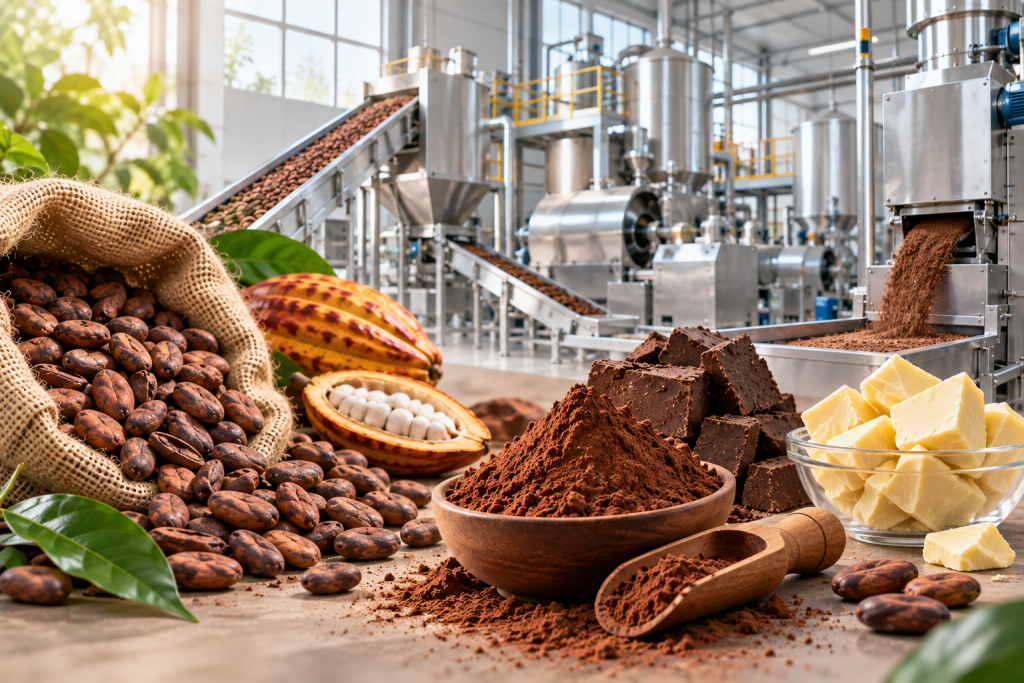
How Much Does It Cost to Set Up a Cocoa Processing Plant?
A cocoa processing plant can cost from a few hundred thousand to tens of millions of dollars, depending on capacity, final products, and automation. A realistic budget should cover not only machinery but also buildings, utilities, installation, storage, laboratory facilities, working capital, and raw materials. Typical Cocoa Processing Plant Investment For early-stage budgeting, the following ranges can be used as indicative planning estimates, not supplier quotations. Plant Scale Cocoa Bean Input Indicative Total Project Investment* Pilot / very small 100–300 kg/day $100,000–$400,000 Small commercial 0.5–1 ton/hour $500,000–$2 million Medium industrial 1–3 tons/hour $2–8 million Large industrial 3–5 tons/hour $8–20+ million Fully integrated large plant 5+ tons/hour $20 million to $100+ million *Planning ranges vary substantially with country, automation, equipment origin, building scope, utilities, product specifications and whether the project is greenfield or uses an existing factory. Historical industrial projects show how quickly costs increase at scale. A World Bank reference case for a 30,000-ton-per-year cocoa processing plant in Ghana reported a total investment of about $20.47 million in 1979 dollars, of which nearly $11.9 million was processing machinery. The report explicitly warns that the figures were specific to that location and period. A later SuperPro Designer study modeled a much more complex 15,700-ton/year facility producing several cocoa and chocolate products. Its estimated equipment purchase cost was about $16 million, while direct fixed capital reached approximately $96.7 million and total capital investment approached $109 million. This illustrates an important point: equipment price and complete installed plant cost are very different numbers. Start With the Product You Want to Make The required process determines the investment. A manufacturer producing only roasted nibs or cocoa liquor requires fewer processing stages. Producing cocoa powder requires additional pressing, cake breaking, cooling, milling and classification equipment. A typical cocoa powder line follows: Cocoa Beans → Cleaning → Roasting → Cracking → Winnowing → Nibs → Grinding → Cocoa Liquor → Pressing → Cocoa Cake → Cooling → Milling → Cocoa Powder Cocoa butter is simultaneously recovered during pressing. If alkalized cocoa powder is required, additional alkalization, drying, and process-control equipment may also be necessary. Final Product Main Processing Requirements Relative Investment Roasted cocoa nibs Cleaning, roasting, winnowing Low Cocoa liquor Above + grinding Low–Medium Cocoa butter Above + pressing Medium–High Cocoa powder Pressing + cake breaking + milling High Alkalized cocoa powder Alkalization + additional controls High Multiple cocoa products Complete integrated system Very High This distinction should be established before requesting machinery quotations. Main Cocoa Processing Equipment Costs Equipment is normally one of the largest visible parts of the initial budget. A cocoa powder factory may require bean receiving equipment, cleaners, destoners, roasters, crackers, winnowers, nib grinders, liquor tanks, cocoa presses, cake breakers, powder mills, classifiers, conveyors, dust collectors and packaging machines. The Indian CFTRI model project, for example, lists graders, destoners, roasters, sifters, air classifiers, pulverizers, dryers, granulators, butter presses and nib grinders among the principal equipment needed to convert cocoa beans into cocoa mass, butter and powder. For preliminary budgeting, equipment expenditure might be divided roughly as follows: Equipment Section Share of Process Equipment Budget Bean cleaning & handling 5–10% Roasting 10–20% Cracking & winnowing 5–10% Nib/liquor grinding 10–15% Liquor storage & transfer 5–10% Cocoa butter pressing 20–35% Cake breaking & powder milling 10–20% Conveying, dust collection & auxiliaries 5–15% These percentages are more useful for conceptual budgeting than assigning universal dollar prices to individual machines. A cocoa press, for example, can change dramatically in cost depending on pressure, number of pots, cycle time, automation and required residual fat content. Why Capacity Has Such a Large Effect Suppose a factory wants to process 2 tons of cocoa beans per hour. At 16 operating hours per day and 300 operating days per year: 2 × 16 × 300 = 9,600 tons of cocoa beans/year At 80% practical utilization: 9,600 × 80% = 7,680 tons/year That number should drive equipment selection. Buying every machine with exactly 2 t/h nominal capacity, however, is usually poor engineering. Roasting residence time, press cycles, cleaning downtime, and product changeovers create differences between nominal and practical capacity. Buffer tanks and intermediate storage are therefore required to prevent one machine from stopping the entire line. A better design might specify approximately: Section Example Design Capacity Bean receiving 2.5–3.0 t/h Cleaning 2.5 t/h Roasting 2.0–2.5 t/h Winnowing 2.0–2.5 t/h Nib grinding 2.0 t/h equivalent Liquor storage Sized around press cycles Pressing Based on required cake fat Powder milling Based on actual cake output The lowest-capacity operation ultimately determines plant throughput. Equipment Is Not the Total Plant Cost This is where many project budgets become unrealistic. A supplier may quote $1 million for a processing line, but that does not mean the factory can begin production for $1 million. The SuperPro cocoa-processing example demonstrates the difference particularly well. Equipment purchases were estimated at about $15.98 million, yet installation, piping, instrumentation, electrical systems, buildings, auxiliary facilities, engineering and construction pushed the fixed-capital requirement far higher. A conceptual greenfield budget might look like this: Cost Category Typical Share of Total Project Budget Processing equipment 30–45% Building & civil works 10–20% Installation & piping 10–15% Electrical & automation 5–10% Utilities 5–10% Engineering/project management 5–10% Laboratory, warehouse & support 3–8% Contingency 5–15% These percentages overlap depending on how suppliers define their scope, so they should not simply be added without checking quotation boundaries. Building and Factory Infrastructure Cocoa processing needs more than an empty warehouse. The facility may require separate areas for raw beans, roasting, grinding, pressing, powder production, cocoa butter handling, packaging and finished-product storage. Dust control deserves particular attention around cleaning, cake breaking and powder milling. The building may also require: Food-grade floors and drainage Ventilation Raw-material warehouse Finished-product warehouse Maintenance area Laboratory Employee hygiene facilities Boiler or thermal utility room Electrical room Dust collection Fire-protection systems Using an existing suitable building can reduce capital expenditure considerably compared with constructing a greenfield factory. Utilities Are Often Underestimated Cocoa processing involves substantial heating, cooling, and electrical loads. Roasting requires thermal energy. Grinding generates heat. Liquor and