
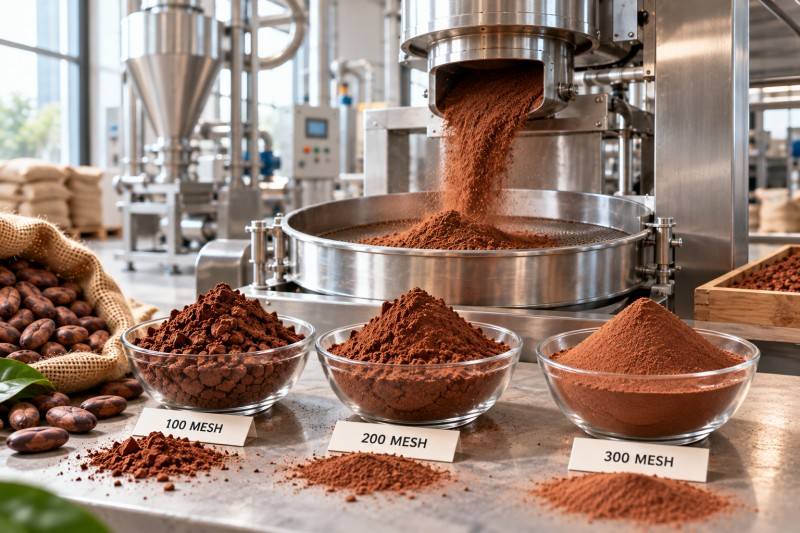
100 Mesh vs 200 Mesh vs 300 Mesh Cocoa Powder: What Is the Difference?
When selecting cocoa powder, buyers usually focus on fat content, color, pH, flavor and whether the powder is natural or alkalized. Particle size is sometimes treated as a secondary specification, but in actual production it can influence mouthfeel, dispersion, dust generation, mixing behavior and downstream processing. Cocoa powder may be described as 100 mesh, 200 mesh or 300 mesh, but these numbers are often misunderstood. A higher mesh number means a finer sieve opening—not necessarily that every cocoa particle has exactly that diameter. As a practical approximation: Mesh Approx. Sieve Opening Relative Fineness 100 mesh ~150 µm Coarser 200 mesh ~75 µm Fine 300 mesh ~50 µm Very fine Commercial cocoa specifications frequently use 200 mesh as a fineness reference. Examples include products specifying more than 98–99% passing a 75 µm/200-mesh sieve, while published cocoa-processing literature also references 200 mesh as an accepted cocoa-powder specification. However, choosing between 100, 200 and 300 mesh should not be reduced to “finer is better.” The correct fineness depends on the final product and how the powder must behave during processing. What Does Cocoa Powder’s Mesh Mean? The number of apertures per linear inch on a screen is referred to as mesh. The apertures get smaller as the mesh number rises. This gives a useful rule: Higher mesh number → smaller sieve opening → finer classified powder But mesh should not be confused with the actual average particle size. For example, if a specification states: 99% passes 200 mesh it means at least 99% of the tested material passes through the specified sieve. It does not mean all particles are 75 µm in diameter. This distinction matters considerably with cocoa. Cocoa powder contains irregular particles and agglomerates. Depending on the analytical method, its measured particle-size distribution can be much finer than the nominal sieve opening. One published patent describing conventional cocoa powder reports more than 99.5% passing a 200-mesh/75 µm screen while giving a typical mean particle size around 7–12 µm. So when purchasing cocoa powder or specifying a milling system, asking only for “200 mesh” does not provide a complete particle-size specification. 100 Mesh Cocoa Powder A 100-mesh screen has an opening of roughly 150 µm. For cocoa processing, this should generally be considered a relatively coarse classification compared with a 200-mesh finished powder specification. Parameter 100 Mesh Cocoa Powder Approx. sieve opening ~150 µm Relative fineness Coarse Milling requirement Lower Powder handling Generally easier Dust tendency Relatively lower Risk of detectable coarse particles Higher Typical role Intermediate/coarser powder or less demanding applications A 100-mesh product may be suitable where extremely smooth texture is unnecessary or where cocoa powder will undergo additional processing. It can also be useful as an intermediate product before secondary fine grinding. The major advantage is processing simplicity. Producing a coarser powder normally places less demand on the final milling and classification stage. Throughput can potentially be higher, and heat generation may be easier to manage. The trade-off is texture. If coarse particles or agglomerates remain, they may become noticeable in applications where the consumer expects a very smooth product. For this reason, 100 mesh should not automatically be considered a finished specification for every food application. 200 Mesh Cocoa Powder A 200-mesh screen has an opening of approximately 75 µm. This is an important reference point in commercial cocoa processing. One commercial specification, for example, reports 98.41% below 75 µm through a 200-mesh sieve, while another cocoa specification lists more than 99% at 200 mesh. Published technical work has also described cocoa powder passing 200 mesh as an accepted market specification. Parameter 200 Mesh Cocoa Powder Approx. sieve opening ~75 µm Relative fineness Fine Milling difficulty Moderate Mouthfeel Generally smooth Dispersion potential Good when properly formulated Dust tendency Moderate Commercial relevance High For many industrial applications, 200 mesh provides a practical balance between fineness and production efficiency. It is fine enough to control obvious coarse particles while avoiding some of the additional processing difficulty associated with pushing the complete powder stream toward much finer classifications. That makes it a sensible starting specification for cocoa powder used in products such as bakery mixes, confectionery ingredients, beverage premixes and general food manufacturing—although the final requirement should always come from the customer’s product specification. 300 Mesh Cocoa Powder A 300-mesh screen corresponds approximately to an opening around 50 µm, depending on the sieve standard being referenced. This represents substantially finer screening than 100 or 200 mesh. Parameter 300 Mesh Cocoa Powder Approx. sieve opening ~50 µm Relative fineness Very fine Milling demand High Classification difficulty Higher Potential texture Very smooth Dust tendency Higher Agglomeration tendency Potentially higher Energy requirement Generally higher A very fine cocoa powder can be useful when manufacturers need tighter control over coarse particles or are developing applications where smoothness is especially important. But 300 mesh comes with an engineering cost. As particle size decreases, grinding becomes progressively more demanding. More energy is required; the mill generates more heat, classifier load increases, and the fine powder becomes more difficult to separate efficiently. Fine particles can also increase dust and make powder handling more challenging. So specifying 300 mesh simply because it sounds like a higher-quality product is not necessarily good process design. Direct Comparison: 100 vs 200 vs 300 Mesh The differences become clearer when viewed from the production side. Characteristic 100 Mesh 200 Mesh 300 Mesh Approx. opening 150 µm 75 µm ~50 µm Fineness Coarse Fine Very fine Grinding difficulty Low Medium High Energy consumption Lower Moderate Higher Mill throughput Higher Moderate Potentially lower Heat generation Lower Moderate Higher Dust control demand Lower Medium Higher Classification difficulty Low Medium High Smoothness potential Moderate High Very high Typical production practicality High Very high Application-dependent These values describe general processing tendencies rather than fixed performance guarantees. Actual results depend on the mill, classifier, cocoa cake properties, residual fat, feed temperature and particle-size distribution. Why More Energy Is Needed to Grind Finer Cocoa Powder Reducing cocoa cake from relatively large fragments into powder is easy compared with repeatedly breaking already-small