
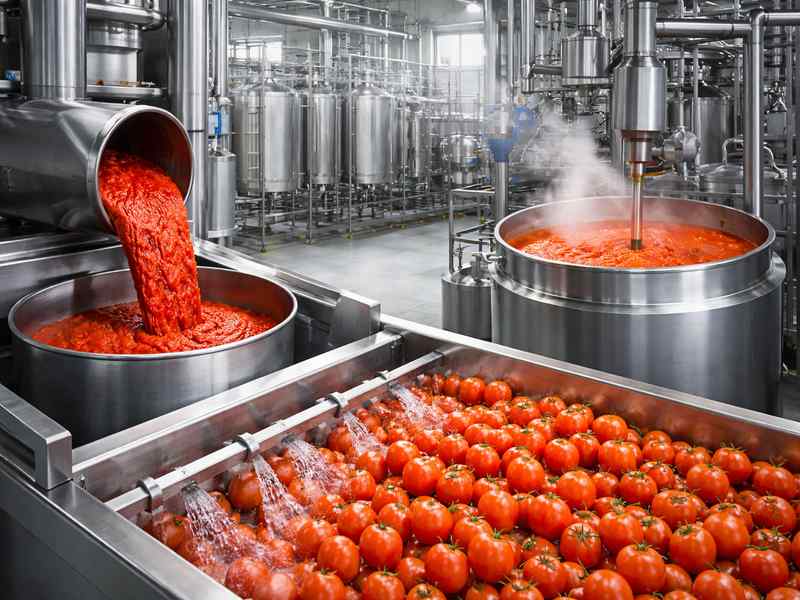
Tomato paste and tomato sauce may use the same raw tomatoes, but they are processed for different final products. Tomato paste lines remove far more water to produce a thick concentrate with high soluble solids, while tomato sauce lines make a smoother, lower-concentration product that often includes seasonings such as salt, sugar, vinegar, or spices.
For processors, this difference goes beyond formulation. It influences equipment selection, evaporation demand, filling methods, packaging style, utility use, and target market. A bulk aseptic tomato paste line supports a very different business model from a bottled tomato sauce line, so understanding the difference helps buyers plan the right machinery and investment.
Table of Quick Comparisons
| Item | Tomato Paste Processing Line | Tomato Sauce Processing Line |
| Main product goal | High-concentration tomato concentrate | Ready-to-use or seasoned tomato product |
| Typical solids focus | Paste at or above 24% tomato soluble solids | Sauce commonly around lower solids, often based on puree plus seasonings |
| Flavor profile | Strong, concentrated tomato flavor | More balanced, seasoned, often sweeter or tangier |
| Core process emphasis | Evaporation and concentration | Formulation, mixing, cooking, homogenizing, filling |
| Ingredient system | Mostly tomato; optional salt, water, spices in some standards | Tomato base plus salt, spices, vinegar, sugar, peppers, onion, garlic, flavorings |
| Typical packaging | Aseptic drums, cans, sachets, jars | Bottles, pouches, jars, retail packs |
| Main customers | Food factories, re-packers, industrial users | Retail brands, foodservice, direct-consumption markets |
The table above summarizes the biggest operational difference: paste lines are concentration-focused, while sauce lines are formulation-focused. Paste is often an intermediate industrial product, whereas sauce is much closer to the final consumer product.
Product Definition Comes First
The most practical way to separate the two lines is to look at the final product target.
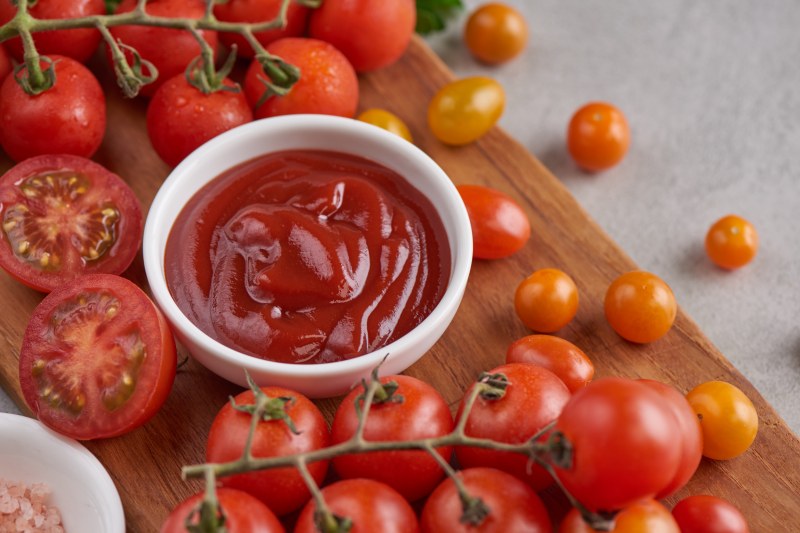
Under Codex and U.S. tomato concentrate rules, tomato paste is a concentrated tomato product made from sound, mature tomatoes, typically with skins and seeds largely removed, and it must contain at least 24% natural or tomato-soluble solids. Tomato puree falls below that, generally from about 7% or 8% up to less than 24%, depending on the standard.
Tomato sauce is different. Although there isn’t a specific U.S. standard of identity for tomato sauce, according to FDA advice, it is generally considered to be a spiced tomato product that can be created by adding spices to tomato puree and contains at least 8.37% salt-free tomato solids. In practice, that means sauce is not simply “less concentrated paste.” It is a formulated product with taste, texture, and seasoning adjusted for direct use.
Raw Material Requirements Are Similar, but the Processing Objective Is Not
Both lines usually begin with ripe red processing tomatoes that are washed, sorted, crushed or pulped, and screened to remove skins and seeds. Quality raw material matters in both cases because poor fruit affects color, flavor, yield, and microbiological stability. The FAO tomato processing guide notes that the sugar content or Brix of raw tomatoes influences processing ratio, and higher solids in tomatoes improve paste efficiency.
However, the objective diverges after pulping:
- In a tomato paste line, the processor wants to maximize concentration efficiency and preserve color and flavor during evaporation.
- In a tomato sauce line, the processor wants a stable, palatable, seasoned product with the right viscosity and filling behavior.
That difference changes the machinery priority. Paste plants invest heavily in evaporators and aseptic systems. Sauce plants place more emphasis on formulation tanks, ingredient dosing, mixing, homogenization, and consumer packaging equipment.
Core Process Flow: Paste Line
A typical tomato paste process includes washing, sorting, trimming, blanching or hot-break treatment, pulping and straining, concentration to the target solids level, hot filling or aseptic filling, sterilization where applicable, cooling, and storage. A training manual from the Indian Institute of Food Processing Technology lists puree/paste flow steps, including washing, sorting, blanching at 90°C for 3 to 5 minutes, pulping and straining, cooking to the desired consistency, judging endpoint total soluble solids, hot filling at 82°C to 88°C, sterilization, cooling, and storage.
The FAO agribusiness handbook describes industrial paste manufacture in similar terms: tomatoes are crushed, heated around 95°C in a hot-break step to control pectinase, sieved to remove seeds and skin, then concentrated in evaporators under vacuum so water can boil at a lower temperature, helping protect quality. It also notes that consumer paste may be packed in tins or jars, while industrial paste is often packed aseptically in large bags inside drums.
Typical Paste Line Equipment
| Process stage | Common equipment |
| Receiving and washing | Flume system, bubble washer, spray washer |
| Sorting | Inspection conveyor, roller sorter |
| Crushing and pulping | Crusher, pulper, refiner |
| Enzyme control / hot break | Tubular heater, heat exchanger |
| Concentration | Single-effect or multi-effect evaporator, vacuum evaporator |
| Sterilization | Tubular sterilizer, aseptic sterilizer |
| Filling | Aseptic drum filler, can filler, jar filler |
| Secondary packing | Case packer, palletizer |
Core Process Flow: Sauce Line
A tomato sauce line may begin with fresh tomatoes, puree, or tomato paste as the base. In many factories, sauce is produced by diluting or reformulating tomato paste, then adding salt, sugar, spices, vinegar, onion, garlic, pepper, or other ingredients. FDA guidance specifically describes tomato sauce as a spiced tomato product and says it may be made by adding spices to tomato puree. The FAO handbook also describes ketchup, a sauce-type product, as being made from concentrated tomato juice or paste with vinegar, salt, spices, and other ingredients, followed by boiling, sieving, bottling, and pasteurization.
So, while a sauce line may include tomato extraction equipment if starting from fresh fruit, many commercial sauce lines are really formulation lines built around a paste or puree base. That makes them more flexible for flavor development and faster product changeover.
Typical Sauce Line Equipment
| Process stage | Common equipment |
| Base preparation | Paste dissolver, puree tank, mixing tank |
| Ingredient dosing | Powder feeder, liquid dosing unit, weighing system |
| Cooking and blending | Steam-jacketed kettle, inline mixer |
| Texture control | Colloid mill, homogenizer, finisher |
| Deaeration | Vacuum deaerator |
| Thermal treatment | Pasteurizer, sterilizer |
| Filling and capping | Bottle filler, pouch filler, jar filler, capper |
| Labeling and packing | Labeler, shrink wrapper, cartoner |
The Biggest Technical Difference: Concentration vs Formulation
This is the heart of the comparison.
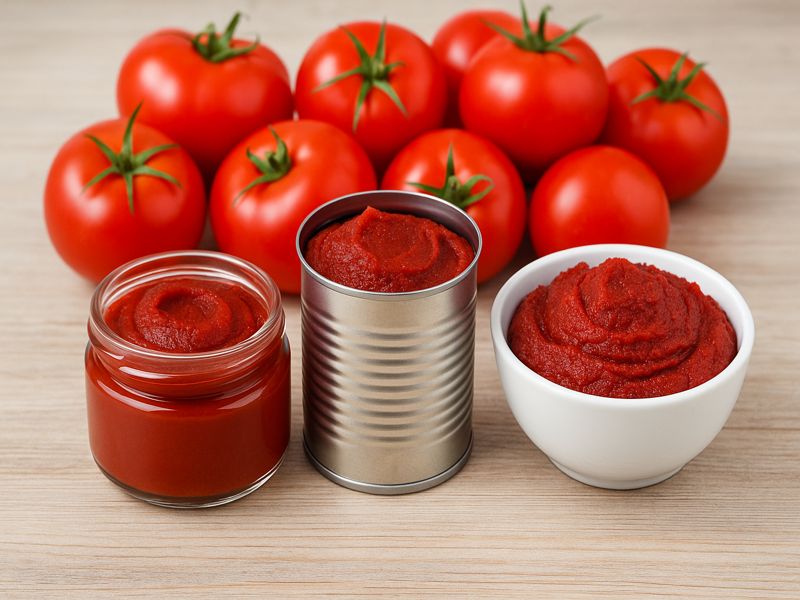
A tomato paste line spends much more energy on water removal. The process must drive the tomato pulp to a high Brix level. The processing manual notes common paste levels such as double concentrate around 26–28° Brix and triple concentrate around 36–38° Brix, while the FAO handbook states that about 5 to 7 kg of tomatoes are needed for 1 kg of paste, depending on raw material solids.
A tomato sauce line usually works at a much lower concentration. Its challenge is not maximum evaporation, but achieving consistent taste, mouthfeel, flowability, and shelf stability after ingredients are blended. This means the line often needs better recipe control, more precise ingredient metering, and stronger mixing capability than a pure paste line.
Key Technical Difference Table
| Technical point | Paste line | Sauce line |
| Main engineering challenge | Remove water efficiently | Blend ingredients consistently |
| Energy demand focus | Evaporation steam load | Mixing, cooking, pasteurization |
| Viscosity development | Comes mainly from concentration | Comes from formulation plus concentration |
| Recipe complexity | Low to moderate | Moderate to high |
| Product changeover | Usually less frequent | Often more frequent |
| Utility sensitivity | Steam and vacuum critical | Steam, dosing accuracy, and filling control critical |
Ingredient Handling Is Much More Important in Sauce Production
Tomato paste can be relatively simple from a formulation standpoint. Codex allows certain optional ingredients in processed tomato concentrates such as salt, spices, aromatic herbs, lemon juice, and water, but the essential character remains concentrated tomato.
In contrast, tomato sauce is usually made using a recipe. FDA guidance and related tomato sauce references describe it as a spiced product, and sauce-style products commonly include seasonings and acidulants. This means a sauce line may need:
- dry powder feeding systems for salt, starch, or spice blends,
- liquid dosing for vinegar or oil,
- high-shear mixing for smooth dispersion,
- filtration or fine sieving for texture uniformity,
- stronger CIP design because seasonings can leave more residue.
That is why many sauce lines look more like cooking and blending systems than evaporation plants.
Packaging Strategy Is Also Different
Packaging often reveals the commercial purpose of the line.
Industrial tomato paste is frequently packed aseptically in large bags within drums for later reprocessing, though consumer formats such as cans and jars are also common. FAO describes industrial paste packaging in 25 to 250-liter aseptic bags in drums, while consumer paste is packed in tins or glass jars.
Tomato sauce is more often filled into retail bottles, jars, squeeze packs, or pouches. Since it is closer to final consumption, the packaging line tends to include bottle unscrambling, filling, capping, labeling, coding, and secondary packing equipment. USDA tomato sauce grade materials also indicate that tomato sauce may be preserved by canning, refrigeration, or freezing, and when held at ambient temperature, it must be heat processed to prevent spoilage.
Which Line Is More Suitable for Your Factory?
Your market model will determine the best option.
Choose a Tomato Paste Processing Line if:
| Best fit scenario | Why |
| You provide industrial purchasers with | Paste is frequently utilized as a remanufacturing basic material. |
| You want a bulk export business | Aseptic drum paste is common in international trade |
| You have a high tomato harvest volume | Concentration helps preserve seasonal raw material |
| You want a standardized semi-finished product | Paste is easier to store and transport than fresh pulp |
Choose a Tomato Sauce Processing Line if:
| Best fit scenario | Why |
| You sell consumer products | Sauce is retail-ready |
| You need multiple flavors | Sauce lines support flexible formulation |
| You want stronger brand differentiation | Recipe, texture, and seasoning create market identity |
| You plan foodservice supply | Sauce packaging suits restaurants and catering channels |