
Palm oil products serve many markets, from bulk industrial supply to retail packaging. Because they differ in viscosity, shelf life, application, and customer needs, packaging must be tailored rather than standardized.
Custom packaging helps protect product quality, improve transport efficiency, enhance brand image, and suit different sales channels. Whether for crude palm oil, refined oil, palm olein, palm kernel oil, shortening, margarine, or other palm-based products, the right packaging affects storage, handling, and market performance.
Why Custom Packaging Matters for Palm Oil Products
Palm oil products are sold in many different forms and for many different purposes. Some are exported in bulk to food processors, while others are packed in small retail containers for supermarkets. Some are intended for industrial frying operations, while others are used in cosmetics, bakery production, or household cooking.
Custom packaging matters because it helps producers align the package with the product’s actual use conditions.
Key reasons custom packaging is important:
Product protection
- Helps prevent contamination during storage and transportation.
- Reduces exposure to moisture, dust, oxygen, and external odors.
- Supports longer shelf stability for finished palm oil products.
Market adaptability
- Allows brands to offer different pack sizes for different customers.
- Supports retail, wholesale, foodservice, and industrial applications.
- Makes it easier to enter local and export markets.
Operational efficiency
- Improves filling, sealing, palletizing, and shipping performance.
- Reduces leakage and handling damage during logistics.
- Supports automated packaging line integration.
Brand value
- Enhances shelf appeal through attractive container design.
- Creates a stronger identity through customized labels and printing.
- Helps brands stand out in competitive edible oil markets.
Main Palm Oil Products That Require Custom Packaging
Palm oil is not sold in only one standard form. Different palm oil derivatives require different packaging structures depending on temperature sensitivity, end use, and handling conditions.
Common palm oil product categories:
Crude palm oil (CPO)
- Usually handled in bulk for further refining.
- Requires industrial-scale storage and transportation solutions.
Refined palm oil
- Often packed for food manufacturing and foodservice applications.
- May be sold in medium or large containers.
Palm olein
- Commonly used as cooking oil.
- Frequently packed in retail bottles, jerry cans, or pouches.
Palm kernel oil
- Used in food, soap, cosmetics, and chemical industries.
- May require packaging suited for both food-grade and industrial uses.
Shortening and margarine
- Need packaging that supports semi-solid or solid fat handling.
- Often packed in tubs, cartons, lined boxes, or pails.
Palm-based specialty products
- Include bakery fats, confectionery fats, or customized blends.
- Often require tailored packaging dimensions and barrier performance.
Common Custom Packaging Types for Palm Oil Products
Choosing the correct packaging format depends on product volume, customer type, storage conditions, and distribution channel.
Common Packaging Types for Palm Oil Products
| Packaging Type | Typical Capacity | Common Applications | Main Advantages |
| PET Bottle | 250 ml to 5 L | Retail cooking oil | Lightweight, transparent, consumer-friendly |
| HDPE Bottle/Jerry Can | 1 L to 25 L | Household, commercial, foodservice | Strong, durable, leak-resistant |
| Stand-Up Pouch | 500 ml to 5 L | Retail and flexible packaging markets | Lightweight, lower material use, attractive display |
| Tin Can | 1 L to 20 L | Premium edible oils, export markets | Good protection, strong appearance |
| Plastic Pail/Bucket | 5 kg to 25 kg | Shortening, margarine, bakery fats | Easy handling for semi-solid products |
| Drum | 180 kg to 220 kg | Industrial palm oil supply | Suitable for bulk distribution |
| IBC Tank | 500 L to 1,000 L | Bulk liquid transport | Efficient storage and shipping |
| Flexitank | 10,000 L to 24,000 L | Large-volume export logistics | High transport efficiency for bulk liquids |
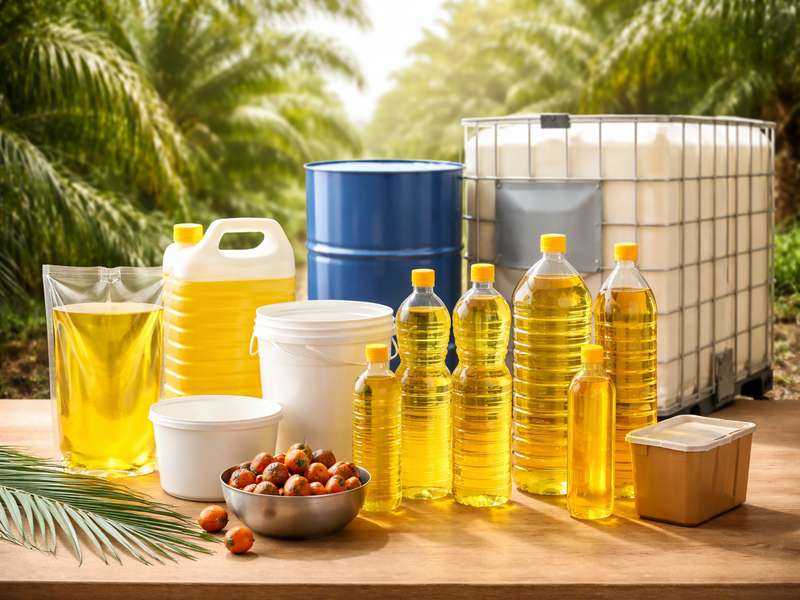
Typical packaging options include:
Retail bottles
- Suitable for cooking oil brands sold in supermarkets.
- Common materials include PET and HDPE.
- Available in custom shapes, neck sizes, and cap types.
Jerry cans
- Popular for medium-volume sales.
- Often used for foodservice and commercial kitchens.
- Easy to stack, carry, and pour.
Flexible pouches
- Increasingly used for cost-sensitive and convenience markets.
- It can reduce packaging weight and transport cost.
- Suitable for refill packaging concepts.
Metal tins
- Often used for premium or export-oriented edible oil products.
- Offer a more traditional and sturdy image.
- Can offer strong defense against outside pressure.
Buckets and pails
- Used for shortening, margarine, and semi-solid palm products.
- Easy for industrial users to scoop and portion.
- Can be produced with tamper-evident lids.
Bulk containers
- Include drums, IBCs, and flexitanks.
- Ideal for industrial supply chains and international shipping.
- Reduce manual handling and improve transport efficiency.
How to Match Packaging with Different Market Segments
A good custom packaging solution begins with understanding who will use the product and how it will be sold.
Retail consumer packaging
Retail packaging must balance function and shelf appeal.
Important features:
- Easy pouring and resealing
- Attractive bottle design
- Clear label area for branding
- Consumer-friendly sizes such as 1 L, 2 L, 3 L, and 5 L
Suitable packaging:
- PET bottles
- HDPE bottles
- Stand-up pouches
- Printed shrink sleeves or pressure-sensitive labels
Foodservice and commercial packaging
Restaurants, catering businesses, and food processing users often need larger pack sizes with better handling durability.
Important features:
- Strong handles for carrying
- Easy dispensing
- Stackable design
- Reliable sealing during repeated handling
Suitable packaging:
- 10 L to 25 L jerry cans
- Medium pails
- Large tins
Packaging for export and industry
Safety, economy, and bulk handling system compatibility are top priorities for industrial clients.
Important features:
- High structural strength
- Good transport utilization
- Pallet efficiency
- Compatibility with pumps, valves, or decanting systems
Suitable packaging:
- Steel drums
- Plastic drums
- IBC tanks
- Flexitanks
Packaging Material Selection for Palm Oil Products
Different materials provide different benefits in terms of weight, strength, appearance, and chemical compatibility.
Packaging Material Comparison for Palm Oil Products
| Material | Common Use | Advantages | Limitations |
| PET | Retail bottles | Clear appearance, lightweight, cost-effective | Less suitable for very high heat conditions |
| HDPE | Bottles, jerry cans | Strong, impact-resistant, opaque protection | Less premium visual effect |
| PP | Caps, tubs, pails | Good rigidity, useful for semi-solid products | Limited transparency |
| Metal Tinplate | Tins, cans | Durable, premium look, good protection | Heavier, higher material cost |
| Steel | Drums | High strength for bulk logistics | Heavier and more expensive to transport |
| Multi-layer Film | Pouches | Flexible, lightweight, printable | Requires correct sealing and puncture control |
Material selection should consider:
Product state
- Liquid palm olein may work well in bottles or pouches.
- Semi-solid fats may require tubs, pails, or lined boxes.
Temperature conditions
- Packaging must perform well during hot climate transport and storage.
- Better resistance to deformation is necessary in some markets.
Barrier needs
- For longer shelf life, packaging may need better protection against light and air.
- Opaque materials may be preferred in certain situations.
Brand positioning
- Premium products often use packaging with a stronger visual impact.
- Value-market products may focus more on cost and practicality.
Custom Design Elements in Palm Oil Packaging
Custom packaging is not only about the container itself. It also includes branding, functionality, and supply chain performance.
Important customization options:
Bottle and container shape
- Unique shapes improve shelf recognition.
- Ergonomic designs improve grip and pouring comfort.
- Square or rectangular profiles may improve carton efficiency.
Cap and closure systems
- Screw caps for easy resealing
- Tamper-evident caps for safety assurance
- Pour spouts for convenient dispensing
Labeling and printing
- Shrink sleeve labels for full-body branding
- In-mold labels for pails and tubs
- Direct container printing for simplified decoration
Handle design
- Integrated handles for larger bottle or jerry can sizes
- Reinforced grip zones for safer carrying
- Better ergonomics for foodservice packaging
Secondary packaging
- Corrugated cartons for bottle protection
- Shrink-wrapped trays for retail distribution
- Pallet wrap solutions for export stability
Key Performance Factors in Palm Oil Packaging Design
Palm oil packaging must do more than look good. It must perform reliably across filling, warehousing, shipping, and end use.
Essential performance factors:
Leak prevention
- Strong sealing is critical during long-distance transport.
- Closure matching must be accurate.
- Container neck finish and cap quality matter greatly.
Stacking strength
- Packaging should resist deformation during storage.
- This is especially important for warehouse and export loading.
- A load-bearing structure affects pallet safety.
Filling line compatibility
- The package must suit the filling method.
- Bottle dimensions should work with conveyors and guide rails.
- Stable base design helps reduce line stoppages.
Transportation efficiency
- Good packaging design improves container loading efficiency.
- Uniform dimensions reduce wasted shipping space.
- Lighter packaging may lower transport cost.
Convenience for users
- Packaging that is simple to open, pour, store, and reseal is preferred by end users.
- Functional convenience can influence repeat purchases.
- Package weight and handle position also affect usability.
Packaging Solutions for Different Palm Oil Product Formats
Not all palm oil products behave the same way in packaging systems.
Recommended Packaging by Palm Oil Product Format
| Product Type | Physical Form | Recommended Packaging | Notes |
| Palm Olein | Liquid | PET bottles, HDPE bottles, jerry cans | Suitable for household and foodservice |
| Refined Palm Oil | Liquid | Bottles, tins, drums, IBCs | Depends on market channel |
| Palm Kernel Oil | Liquid/Semi-liquid | Bottles, drums, pails | Varies by industrial or cosmetic use |
| Shortening | Semi-solid | Pails, lined cartons, tubs | Needs easy scooping and stable sealing |
| Margarine | Semi-solid | Tubs, cartons, buckets | Requires hygienic food-grade packaging |
| Specialty Fats | Semi-solid/Solid | Pails, customized containers | Often packed according to customer processing needs |
Packaging design should reflect:
- Product viscosity
- Storage temperature
- Portion size requirements
- Customer handling habits
- Distribution distance
Sustainability Trends in Palm Oil Packaging
Sustainability is becoming more important in edible oil packaging. Buyers, distributors, and end users increasingly expect environmentally responsible packaging options.
Sustainable packaging strategies include:
Lightweight packaging
- Uses less raw material.
- Reduces shipping weight.
- Can lower carbon footprint across logistics.
Recyclable materials
- PET and HDPE are widely recyclable in many markets.
- Simple material structures improve recyclability.
- Clear recycling guidance can support brand responsibility.
Refill packaging concepts
- Flexible refill pouches reduce rigid plastic consumption.
- Can complement primary reusable containers.
- Attractive for cost-sensitive and eco-conscious consumers.
Optimized carton design
- Reduces unnecessary empty space.
- Improves pallet efficiency.
- Cuts packaging waste in secondary transport.
Sustainable packaging must still protect the palm oil product effectively. A balance between environmental goals and packaging reliability is essential.
How Manufacturers Choose the Right Custom Packaging Partner
Custom packaging development is not only about buying containers. It requires cooperation between palm oil producers and packaging suppliers.
What to look for in a packaging partner:
Food-grade manufacturing capability
- Materials must meet relevant food-contact requirements.
- Clean production conditions are important.
Customization experience
- The supplier should support custom molds, sizes, closures, and decoration.
- Design support is valuable during new product development.
Production consistency
- Stable dimensions help reduce filling line issues.
- Reliable quality improves sealing and transportation performance.
Scalability
- Both trial runs and full production volumes should be managed by the provider.
- This is important for growing palm oil brands.
Logistics support
- Timely delivery of packaging materials supports continuous production.
- Strong export packaging experience is helpful for overseas markets.
Typical Obstacles in Packaging Projects for Palm Oil
Although there are many benefits to custom packaging, proper planning is also necessary.
Common challenges include:
Mismatch between the package and the filling line
A custom bottle may look attractive, but run poorly on existing equipment.
Weak sealing performance
Poor cap compatibility can lead to leakage complaints.
Insufficient transport strength
Thin or poorly designed containers may deform during shipping.
Overdesigned packaging
Excessive customization can increase cost without adding enough value.
To reduce these risks, packaging should be tested under actual filling, storage, and transport conditions before large-scale rollout.
Custom palm oil packaging protects quality, supports logistics, strengthens branding, and fits different customer needs. From retail bottles to bulk containers, packaging should match the product, market, and handling requirements.
The right packaging does more than hold palm oil. It improves efficiency, reduces damage, and adds business value.