
Africa is a key palm oil investment region, supported by strong local demand, oil palm resources, and reliance on imported edible oils.
For investors, a palm oil mill can turn FFB into higher-value products such as cooking oil, soap, cosmetics, margarine, animal feed, and bio-based materials.
The main goal is to build the right mill size with a stable FFB supply, suitable equipment, good oil recovery, and controllable operating costs.
Why Set Up a Palm Oil Mill Plant in Africa?
Africa has several palm oil production centers, especially in Nigeria, Côte d’Ivoire, Ghana, Cameroon, Liberia, Sierra Leone, the Democratic Republic of Congo, Uganda, and parts of East Africa. Nigeria remains the largest African producer, while Côte d’Ivoire is described by the USDA as Africa’s second-largest crude palm oil producer.
In many African countries, palm oil demand is driven by three major markets:
| Market Segment | Main Demand | Business Opportunity |
| Household cooking oil | Red palm oil, refined palm oil | Local retail and wholesale supply |
| Food processing | Frying oil, margarine, bakery fats | Stable B2B sales to food factories |
| Industrial use | Soap, cosmetics, oleochemicals | Higher-value downstream processing |
| Regional trade | CPO, PKO, refined oil | Cross-border sales to neighboring countries |
Côte d’Ivoire is a good example of the regional palm oil trade. About 25% of its palm oil production is sold to nearby nations, including Mali, Burkina Faso, Niger, Ghana, and Nigeria, while the remaining 75% is used for domestic food and industrial needs. This shows that a well-positioned palm oil mill can serve both local and regional markets.
Choose the Right Palm Oil Mill Capacity
The first step is to decide on the processing capacity. Capacity should be based on available fresh fruit bunches, not only investment ambition. A common mistake is building a large mill before securing enough plantation or smallholder supply.
| Mill Type | Typical Capacity | Suitable Investor | Main Features |
| Mini palm oil mill | 0.5–2 tons FFB/hour | Start-ups, villages, cooperatives | Low investment, simple operation |
| Small palm oil mill | 3–5 tons FFB/hour | Local producers, small factories | Better oil recovery and stability |
| Medium palm oil mill | 10–20 tons FFB/hour | Plantation owners, regional processors | Continuous processing, higher automation |
| Large palm oil mill | 30–60+ tons FFB/hour | Industrial estates, large agribusiness | High output, full utility and waste system |
For a start-up project, a 1–5 tons/hour palm oil processing line is often more practical. It requires less land, lower power demand, fewer workers, and can be expanded after stable fruit supply is built.
For plantation-based projects, a medium or large mill is more suitable, but raw material planning becomes critical. USDA’s Côte d’Ivoire report warns that installed milling capacity can exceed actual FFB supply, creating competition for fruit and pressure on profit margins.
Estimate Fresh Fruit Bunch Supply
A palm oil mill cannot run profitably without a stable FFB supply. In Africa, FFB may come from company-owned plantations, outgrower schemes, smallholder farmers, or cooperatives.
A basic planning formula is:
Annual FFB demand = Mill capacity × Operating hours/day × Operating days/year
| Mill Capacity | Working Hours/Day | Working Days/Year | Annual FFB Demand |
| 1 ton/hour | 8 hours | 250 days | 2,000 tons FFB/year |
| 5 tons/hour | 10 hours | 280 days | 14,000 tons FFB/year |
| 10 tons/hour | 16 hours | 300 days | 48,000 tons FFB/year |
| 30 tons/hour | 20 hours | 300 days | 180,000 tons FFB/year |
FFB yield can vary greatly. In Côte d’Ivoire, village plantations reportedly yield about 6–7 tons/ha, while industrial plantations yield about 14 tons/ha. This difference shows why investors must evaluate plantation age, seed quality, fertilizer use, harvesting frequency, and road access before selecting equipment capacity.
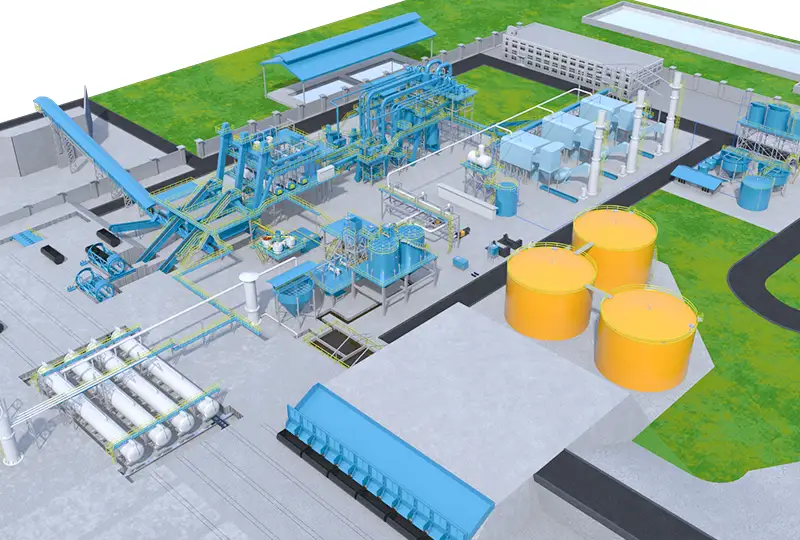
Main Process Flow of a Palm Oil Mill Plant
A standard palm oil mill plant converts fresh fruit bunches into crude palm oil and palm kernel. The process is usually:
FFB reception → sterilization → threshing → digestion → pressing → clarification → oil drying → storage → palm kernel recovery → wastewater and fiber treatment
| Process Section | Main Equipment | Function |
| FFB reception | Weighbridge, loading ramp, conveyor | Receive and feed palm fruit bunches |
| Sterilization | Vertical/horizontal sterilizer | Use steam to soften fruit and stop enzyme activity |
| Threshing | Drum thresher | Separate palm fruits from bunches |
| Digestion | Fruit digester | Mash fruit before pressing |
| Pressing | Screw press | Extract crude palm oil |
| Clarification | Vibrating screen, clarification tank, centrifuge | Remove water, sludge, and impurities |
| Drying & storage | Vacuum dryer, oil tank | Reduce moisture and store CPO |
| Kernel recovery | Nut/fiber separator, nut cracker, kernel separator | Recover palm kernel for PKO production |
| Waste treatment | EFB handling, fiber boiler, POME system | Reduce waste and improve energy efficiency |
For African projects, equipment should be selected based on local power stability, operator skill level, steam supply, maintenance capability, and spare parts availability.
Estimated Investment Cost
The cost of a palm oil mill plant in Africa depends on capacity, automation level, civil works, boiler system, power system, land condition, transport, import duties, and local installation costs.
| Plant Size | Equipment Scope | Estimated Investment Range |
| 0.5–1 ton/hour | Simple mini line | USD 20,000–80,000 |
| 2–5 tons/hour | Small complete line | USD 100,000–400,000 |
| 10–20 tons/hour | Medium industrial line | USD 800,000–2.5 million |
| 30–60 tons/hour | Large complete mill | USD 4 million–10+ million |
These are general planning ranges. A real quotation should include equipment, steel structure, boiler, generator, electrical control, installation, commissioning, operator training, spare parts, inland transport, and local taxes.
Land, Utilities, and Factory Layout
A palm oil mill needs enough space for fruit receiving, production, oil storage, boiler room, water treatment, workshop, warehouse, office, and truck movement.
| Capacity | Suggested Land Area | Power Demand | Steam Demand | Water Demand |
| 1 ton/hour | 500–1,500 m² | 20–50 kW | Low | Low |
| 5 tons/hour | 2,000–5,000 m² | 80–150 kW | Medium | Medium |
| 10 tons/hour | 5,000–10,000 m² | 200–350 kW | High | High |
| 30 tons/hour | 20,000 m²+ | 600 kW+ | Very high | Very high |
In many African locations, the power supply can be unstable. Investors often need a diesel generator, biomass boiler, or hybrid energy plan. Boiler fuel derived from palm fiber and shells can improve sustainability and reduce energy expenditures.
Key Factors for Profitability
Palm oil mill profit depends on more than selling CPO. The most important indicators are oil extraction rate, FFB cost, operating efficiency, downtime, labor cost, and by-product recovery.
| Profit Factor | Target or Focus | Why It Matters |
| Oil extraction rate | Usually 18–23%, depending on fruit quality | Higher OER increases CPO output |
| FFB freshness | Process within 24–48 hours | Reduces the increase in free fatty acids |
| Sterilization control | Stable temperature and time | Improves fruit loosening and oil recovery |
| Press efficiency | Low residual oil in fiber | Reduces oil loss |
| Clarification efficiency | Low oil in the sludge | Improves final CPO yield |
| Kernel recovery | Clean nut and kernel separation | Adds extra revenue |
| Maintenance | Preventive maintenance plan | Reduces downtime and repair cost |
For example, if a 5 tons/hour mill processes 14,000 tons of FFB per year, a 1% improvement in oil extraction can mean about 140 tons more crude palm oil annually. This is why efficient sterilizers, screw presses, clarification systems, and operator training are critical.
Environmental and Compliance Considerations
Palm oil production creates empty fruit bunches, fiber, shells, sludge, and palm oil mill effluent. A modern African palm oil mill should plan waste management from the beginning.
| Waste Type | Possible Use or Treatment |
| Empty fruit bunches | Mulch, compost, biomass fuel |
| Palm fiber | Boiler fuel |
| Palm shells | Boiler fuel, activated carbon material |
| Sludge | Oil recovery, controlled treatment |
| POME | Anaerobic treatment, biogas, and irrigation after treatment |
Environmental compliance is becoming more important for financing, export, and long-term operation. Investors should check local regulations for wastewater discharge, boiler emissions, land use, labor safety, and product quality standards before construction.
Project Setup Timeline
A palm oil mill plant usually takes several months to plan and build. Larger projects require longer engineering and approval time.
| Stage | Main Work | Estimated Time |
| Feasibility study | Market, FFB supply, site, capacity | 2–6 weeks |
| Design and quotation | Process design, layout, and budget | 2–4 weeks |
| Financing and permits | Land, registration, approvals | 1–3 months |
| Equipment production | Manufacturing and testing | 1–4 months |
| Shipping and customs | Export, import, and inland transport | 1–2 months |
| Installation | Civil works, mechanical, electrical | 1–3 months |
| Commissioning | Trial run, training, adjustment | 1–4 weeks |
For start-up investors, the best approach is to begin with a manageable capacity, build reliable farmer relationships, and upgrade capacity step by step.

Complete Setup Checklist
Before investing, prepare a checklist:
| Item | Key Question |
| Market demand | Who will buy the CPO, red oil, or refined oil? |
| Raw material | How many tons of FFB can be secured every month? |
| Capacity | Is the mill size matched with the real FFB supply? |
| Land | Is the site close to plantations and road access? |
| Utilities | Is there a stable water, power, and steam supply? |
| Equipment | Is the line easy to operate and maintain locally? |
| Labor | Are trained operators available? |
| Finance | Is working capital enough for FFB purchasing? |
| Compliance | Are environmental and business permits clear? |
| Expansion | Can the plant add refining, PKO, or soap production later? |
Setting up a palm oil mill plant in Africa can be a strong opportunity, but success depends on practical planning and reliable FFB supply.
Investors should match capacity with fruit availability, choose efficient equipment, control oil loss, manage waste properly, and leave room for future expansion into refining, palm kernel oil, soap, or other downstream products.