
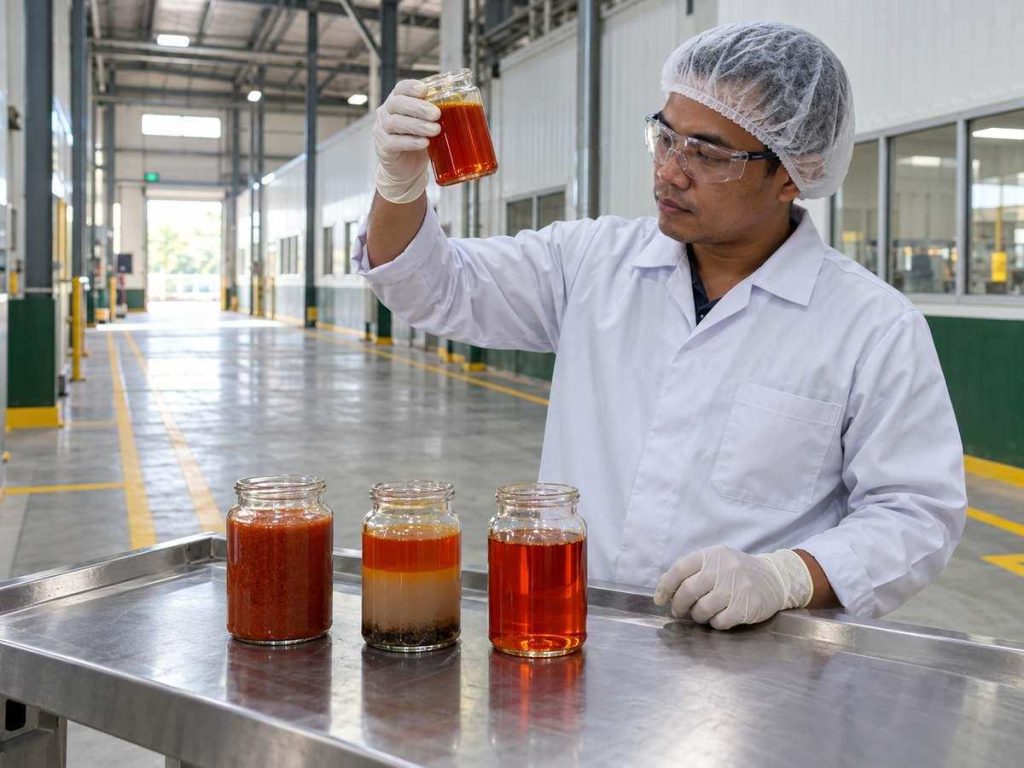
Choose a palm oil clarification system by its feed stream, separation duty, and required outlets. A settling tank can provide gravity separation within a conventional clarification route. A suitably configured decanter centrifuge can recover oil from tank underflow or perform a different duty in an engineered direct-clarification system.
For an existing mill, measure where oil is being lost before replacing equipment. For a new line, compare complete process arrangements, including feed preparation, downstream treatment, utilities, and maintenance. Similar capacity labels do not make a tank and a decanter interchangeable.
Define the Feed Stream Before Comparing Equipment
“Crude palm oil” is not a sufficient feed specification. Press liquor and settling-tank underflow can have very different proportions of oil, water, suspended solids, and coarse debris.
Identify the proposed installation point on the process drawing before requesting prices.
| Proposed Feed | What to Establish | Selection Question |
| Screened press liquor | Flow, temperature, composition, and existing water addition | Is the proposal for primary clarification or solids removal? |
| Settling-tank underflow | Oil remaining in the stream, solids loading, and discharge pattern | What recovery duty must the added machine perform? |
| Another recovery stream | Source, contaminants, variability, and downstream destination | Has the machine been evaluated for this particular feed? |
Collect measurements during representative operating periods, including higher-load conditions. Record whether flow is continuous or intermittent and whether samples were taken before or after dilution.
- Express machine feed capacity in the agreed mass or volume units.
- Keep fresh fruit bunch input separate from clarification-stream throughput.
- Include composition ranges, not only a single favourable sample.
- Identify coarse material that requires removal before separation.
For the wider process boundary, refer to Vortech’s palm oil production line overview.
How Settling Tanks and Decanters Work
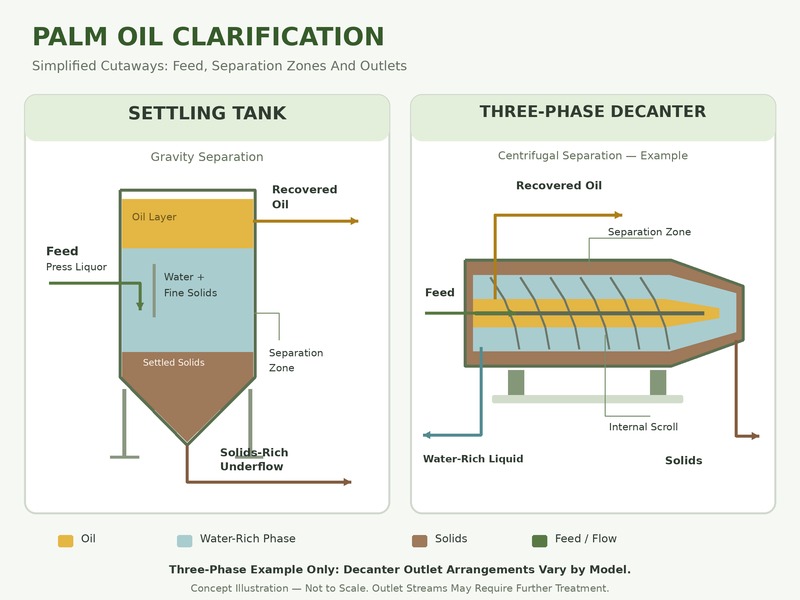
Both systems exploit differences between components, but they create separation in different ways. Their operating controls and maintenance demands also differ.
| Feature | Settling Tank | Decanter Centrifuge |
| Separation force | Gravity | Centrifugal force in a rotating bowl |
| Main operating considerations | Feed distribution, temperature, residence time, and withdrawal | Feed rate, bowl speed, differential speed, and liquid settings |
| Solids handling | Solids-rich material leaves through the designated discharge arrangement | An internal scroll conveys separated solids toward discharge |
| Sensitivity | Disturbed flow and changing feed can affect settling | Changing solids load and feed properties can affect separation and torque |
| Maintenance focus | Heating surfaces, deposits, valves, leaks, and access | Bearings, drive system, scroll, wear protection, and rotating assembly |
Gravity Separation in a Settling Tank
Within a conventional arrangement, the tank allows components to separate over time, with oil withdrawn and a solids-rich underflow sent onward. Heating and flow management must support the intended separation conditions.
Check for short-circuiting, uneven feed distribution, accumulated deposits, and unsuitable withdrawal practices before concluding that the tank itself is undersized. Enlarging a tank does not automatically correct those problems.
Centrifugal Separation in a Decanter
A decanter feeds material into a rotating bowl. The internal scroll rotates at a different speed to transport separated solids. Outlet design determines whether the selected configuration produces one liquid stream or separately discharged liquid phases.
Compare Separation Duty and Outlet Streams
Define where each outlet goes and what condition the next process requires. A clearer oil stream may still need further treatment before storage, while discharged liquid and solids still require management.
| Stream | Specify for the Proposed Route | Downstream Check |
| Recovered oil | Flow, moisture, impurities, and sampling method | Confirm polishing or drying requirements |
| Water-rich liquid | Flow and residual oil on an agreed basis | Confirm further recovery and effluent treatment |
| Solids or solids-rich underflow | Quantity, moisture, and residual oil | Confirm conveying, storage, recovery, or disposal |
| Recycled material | Source, destination, and return rate | Check the extra hydraulic and solids load |
Ask suppliers to distinguish concentration measurements from total losses. Low oil concentration in a large discharge stream can still represent substantial oil loss.
- Measure the outlet quantity over a defined operating period.
- Determine its oil content using the agreed analytical method.
- State whether the result uses wet mass, dry mass, or another basis.
- Calculate oil leaving that outlet over the same period.
- Account for feed, recycle, and changes in system inventory.
Clarification removes separable components; it does not replace refining or reverse oil deterioration. Stable emulsions can complicate separation, so questionable feed should be tested rather than assigned a recovery guarantee from appearance alone.
Compare Utilities, Footprint, and Operating Costs
Compare the installed system, not only the machine footprint or purchase price. A compact separator still needs access, foundations, piping, controls, and a route for removing major components.
| Cost or Site Item | Settling-Based Route | Decanter-Based Route |
| Civil work | Tank support, access, containment, and pipe elevations | Foundation, dynamic-load requirements, and service access |
| Heat and water | Heating and dilution requirements of the selected process | Feed conditioning and cleaning requirements of the selected package |
| Electricity | Pumps, transfer systems, and associated equipment | Main drive, differential drive where fitted, pumps, and auxiliaries |
| Maintenance | Cleaning, heating repairs, corrosion checks, and valves | Wear parts, lubrication, specialist service, and overhaul logistics |
| Outlet handling | Underflow and recovered-oil transfer | Liquid outlets plus solids collection and conveying |
| Availability | Shutdown and cleaning arrangements | Service interval, spare parts, and contingency arrangements |
Water savings belong to a defined process comparison. Adding a decanter to an unchanged diluted system does not automatically eliminate dilution water.
Build an annual estimate using productive hours, local utility prices, labour, consumables, expected repairs, and shutdown allowances. Keep assumptions visible so competing proposals can be recalculated on the same basis.
When a Combined System Makes Sense
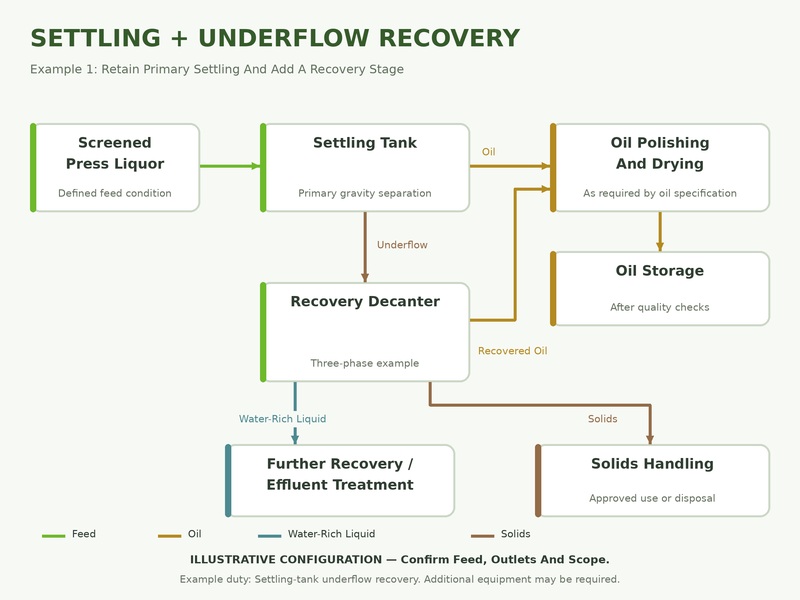
An existing tank may remain useful while its underflow becomes the target for additional oil recovery. This can justify a combined system when measurements identify a recoverable loss and the retrofit fits the downstream process.
| Project Situation | Route to Investigate |
| Tank performs adequately, but underflow retains oil | Retain primary settling and evaluate underflow recovery |
| Tank performance changes with feed interruptions | Review distribution, buffering, heating, and withdrawal first |
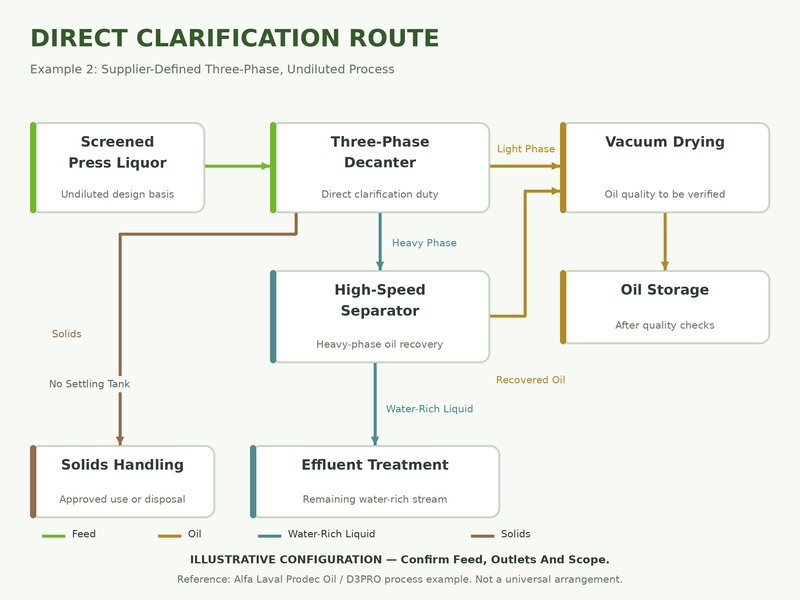
| New plant has restricted space or specific water objectives | Compare a complete direct-clarification package against the conventional route |
| Maintenance resources are limited | Assess service support and available alternatives before adding rotating equipment |
Map bypasses and temporary operating arrangements before installation. A recovery upgrade should not leave the mill without a defined route when the new machine is unavailable.
What to Ask Suppliers Before Selecting a System
Issue the same feed description and process objectives to each supplier. Require exceptions and unknown values to be listed alongside the quotation, where they can be reviewed before purchase.
Request a Comparable Technical Package
- Process drawing:Show the inlet location, screening, conditioning, outlets, recycle, and downstream equipment.
- Operating envelope:Define feed flow, composition, temperature, and variability covered by the proposal.
- Performance basis:State outlet targets, measurement methods, and conditions attached to guarantees.
- Supply boundary:Identify tanks, pumps, heaters, valves, piping, controls, and conveyors included or excluded.
- Site requirements:Provide utilities, foundation loads, elevations, lifting needs, and maintenance clearances.
- Service plan:List wear parts, inspection intervals, repair arrangements, and replacement lead times.
- Control behaviour:Explain start conditions, feed interruption, alarms, and coordination with other equipment.
A vibrating screen performs a different duty from gravity or centrifugal clarification. Specify how coarse screening supports the proposed route rather than treating a screen as a substitute for separating oil and water.
The Vortech 10 T/H CPO vibrating-screen project is a useful reference when discussing screening interfaces and upstream solids removal.
Verify Performance Before Approving the Change
A short demonstration with unusually clean feed may not represent mill operation. Agree a trial that covers the actual duty, including the operating variations that motivated the purchase.
| Trial Item | Evidence to Agree |
| Feed representativeness | Source, sampling points, composition, and operating conditions |
| Stable operation | Trial duration and treatment of start-up or interrupted periods |
| Separation results | Simultaneous outlet quantities and analytical results |
| Utility demand | Measured consumption at a declared package boundary |
| Operability | Operator actions, cleaning sequence, and outlet handling |
| Acceptance | Pass criteria, exclusions, unresolved items, and corrective work |
For retrofits, establish a baseline before modification. Compare equivalent production conditions and account for tank inventory, recycled streams, and other process changes.
Use the monitoring approach in Vortech’s oil-loss prevention guide to connect the separation trial with wider mill performance.
Choose the Route That Solves the Measured Problem
- Retain or improve settlingwhen operating faults can be corrected and the route meets the required duty.
- Evaluate underflow recoverywhen measured losses justify an additional separation stage.
- Evaluate direct clarificationwhen a complete engineered package fits the feed, site, and outlet requirements.
- Defer selectionwhen feed data, outlet destinations, or maintenance arrangements remain unresolved.
For a clarification-system enquiry, send Vortech your existing flow diagram, proposed feed stream, measured throughput, available analysis, and upgrade objective through the project enquiry page. These details establish the scope for reviewing equipment and integration requirements.