
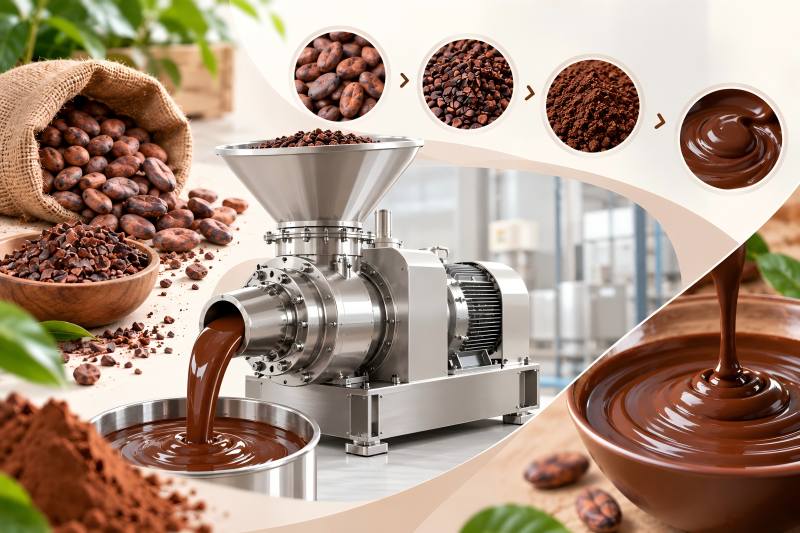
A cocoa paste grinder transforms roasted cocoa nibs into uniform, pumpable cocoa liquor by reducing particle size and releasing cocoa butter.
Effective grinding depends on particle size, temperature, viscosity, throughput, and feed consistency. The goal is consistent cocoa liquor production while controlling heat, wear, and energy consumption.
What Is a Cocoa Paste Grinder?
A cocoa paste grinder is designed to process roasted and usually winnowed cocoa nibs into cocoa liquor.
Cocoa nibs contain a high proportion of cocoa butter. During grinding, mechanical forces rupture the cellular structure of the nibs. As cocoa butter is released, the material gradually changes from dry, irregular particles into a thick brown paste.
A simplified process is:
Roasted Cocoa Beans → Winnowing → Cocoa Nibs → Pre-Grinding → Fine Grinding → Cocoa Paste/Liquor
The resulting liquor can then follow different processing routes.
For chocolate manufacturing, it may be mixed with sugar, additional cocoa butter, milk ingredients, or other components. For cocoa powder production, cocoa liquor is normally sent to a cocoa butter press, where part of the fat is removed, and cocoa press cake is produced.
So although the cocoa paste grinder occupies only one stage of the production line, its performance can influence several downstream processes.
Working Principle of a Cocoa Paste Grinder
The fundamental principle is mechanical size reduction combined with cocoa butter release.
When cocoa nibs enter the grinding chamber, they are exposed to forces such as impact, shear, compression, friction, or combinations of these mechanisms. The exact forces depend on the type of grinder being used.
There are four primary phases to the procedure.
| Stage | What Happens | Main Objective |
| Feeding | Cocoa nibs enter the grinder | Maintain stable material flow |
| Particle Breakdown | Mechanical forces reduce nib size | Rupture cocoa cell structure |
| Fat Release | Cocoa butter is released | Convert solids into flowing paste |
| Fine Grinding | Remaining particles are reduced | Produce uniform cocoa liquor |
The transition from nib to paste is especially important.
At the beginning, the material behaves like a dry granular solid. As grinding continues and more cocoa butter is released, the material becomes increasingly fluid. This change affects motor load, grinding efficiency, temperature, and discharge behavior.
Feeding Cocoa Nibs into the Grinder
Good grinding starts with consistent feed preparation.
The cocoa nibs should be reasonably uniform and largely free from shells, stones, metal fragments, and other foreign materials. Poor winnowing can increase wear and negatively affect final product quality.
Feed rate also matters.
If material enters the grinding chamber faster than the grinder can process it, the chamber may become overloaded. This can increase motor current, produce inconsistent liquor, and reduce grinding efficiency.
Too little feed, on the other hand, can reduce production efficiency and sometimes change the thermal conditions inside the grinder.
A controlled feeder therefore helps maintain stable operation.
Breaking the Cocoa Nib Structure
Inside the grinder, nibs are subjected to mechanical forces.
Depending on the equipment design, cocoa particles may pass between grinding surfaces, collide with high-speed components, or experience intense shear forces.
These forces progressively rupture the nib structure.
This is different from simply crushing a brittle mineral. Cocoa nibs contain significant fat, so their behavior changes quickly as grinding proceeds.
Initially:
Solid nib → Broken particles
Then:
Broken particles → Cocoa butter release
Finally:
Cocoa solids + released cocoa butter → Cocoa paste
The grinding equipment must therefore be capable of handling a product whose physical state changes during processing.
Cocoa Butter Release and Paste Formation
Cocoa nibs typically contain roughly half their weight as cocoa butter, although actual composition varies with cocoa origin and processing conditions.
As grinding destroys the cellular structure, this fat becomes available as the continuous phase surrounding the cocoa solids.
The material begins to flow.
This is why cocoa liquor can behave like a liquid even though it contains a large amount of solid cocoa material.
Temperature also contributes to this transition. Mechanical grinding generates heat, while cocoa butter becomes fully liquid above its melting range. Under typical processing conditions, the combination of released fat and elevated temperature allows cocoa mass to move through piping and pumps.
However, more heat is not necessarily desirable.
Excessive product temperature can affect flavor and create unnecessary thermal stress. The goal is controlled warming, not uncontrolled heating.
Fine Grinding
After the initial paste has formed, additional grinding can reduce the cocoa solid particles further.
The required fineness depends on what happens next.
Cocoa liquor intended for pressing may have different requirements from liquor that will enter a chocolate production process. Furthermore, a cocoa paste grinder is not always expected to produce the final chocolate particle size.
This distinction is important.
A primary cocoa grinder may produce liquor that is sufficiently fine for efficient downstream processing, while dedicated refiners perform additional particle-size reduction later.
Typical Grinding Objectives
| Application | Main Grinding Priority |
| Cocoa liquor production | Uniform, pumpable paste |
| Cocoa powder line | Consistent liquor for pressing |
| Chocolate production | Fine and homogeneous liquor |
| Compound products | Stable ingredient dispersion |
| Further refining | Controlled feed for downstream equipment |
Trying to achieve the entire required size reduction in a single machine may unnecessarily increase energy consumption and product temperature.
Common Types of Cocoa Paste Grinders
Several grinding technologies can be used depending on capacity, product requirements, and production configuration.
Colloid Mill
A colloid mill typically uses a high-speed rotor and stationary stator separated by a narrow adjustable gap.
Cocoa paste passes through this gap and experiences strong shear forces. The machine is particularly suitable once the cocoa material has already begun developing into a paste.
The rotor-stator gap is an important operating parameter. Reducing the gap generally increases grinding intensity but can also increase heat generation and machine load.
Disc Grinder
Disc grinding systems use opposing grinding surfaces to reduce cocoa nibs.
The material passes through a controlled space between the discs, where compression, friction, and shear reduce particle size and release cocoa butter.
Disc grinders can be useful for primary or intermediate grinding depending on their design.
Pin Mill
Pin mills use high-speed rotating and stationary pins to create intensive impact and shear.
They can achieve rapid size reduction but require careful consideration of heat generation and product characteristics.
Ball Mill
Ball mills are more commonly associated with fine refining rather than initial nib grinding.
Grinding media inside the chamber continuously act on the cocoa mass, reducing particle size over time. In chocolate and compound production, ball mills may process mixtures containing cocoa liquor along with other ingredients.
| Grinder Type | Grinding Mechanism | Typical Strength |
| Colloid Mill | Rotor-stator shear | Homogeneous paste production |
| Disc Grinder | Shear + compression | Primary/intermediate grinding |
| Pin Mill | Impact + shear | Intensive size reduction |
| Ball Mill | Grinding media impact/friction | Fine refining |
| Multi-stage System | Combined mechanisms | Better control of final liquor |
Why Multi-Stage Grinding Is Often Better
For larger cocoa processing plants, using one grinder for the entire size-reduction duty is not always the most efficient solution.
A better configuration may use:
Cocoa Nibs → Coarse Grinder → Intermediate Cocoa Paste → Fine Grinder → Cocoa Liquor
The first grinder performs the heavy work of breaking the nibs and releasing enough cocoa butter to form a paste.
The second stage operates on an already fluid material and focuses on improving fineness and uniformity.
This distributes the grinding load.
It can also make temperature control easier and provide more flexibility when different liquor specifications are required.
For industrial production, two well-matched grinding stages can be more practical than forcing one machine to perform both aggressive nib breakdown and fine finishing.
Key Parameters Affecting Cocoa Paste Grinding
Grinding quality is determined by the interaction of several operating variables.
| Parameter | If Too Low | If Too High |
| Feed Rate | Low productivity | Overloading, inconsistent grinding |
| Rotor Speed | Insufficient size reduction | Higher heat and wear |
| Grinding Gap | Coarse liquor | Excessive load/heat if too narrow |
| Product Temperature | Poor flow if fat is insufficiently fluid | Thermal stress/flavor impact |
| Residence Time | Coarse particles | Excessive energy input |
| Number of Grinding Stages | Inadequate fineness | Higher equipment complexity |
These parameters should not be adjusted independently.
For example, reducing the grinding gap may improve fineness, but it can simultaneously increase motor load and product temperature. Increasing throughput may improve production economics but reduce residence time and change final particle size.
The correct operating point is therefore a compromise between capacity, fineness, temperature, and energy consumption.
Temperature Control During Cocoa Grinding
Temperature deserves special attention because grinding converts mechanical energy into heat.
Some heating is useful. Once cocoa butter is released and melted, cocoa mass becomes easier to transport and process.
But uncontrolled temperature rise is undesirable.
Depending on equipment design, temperature may be managed through jacketed grinding chambers, cooling water, controlled feed temperature, intermediate holding tanks, or heat exchangers.
A useful operating philosophy is:
Generate only as much grinding energy as necessary to achieve the required liquor quality.
Increasing grinding intensity beyond that point usually means additional electricity is being converted into heat rather than useful particle-size reduction.
Particle Size and Cocoa Liquor Quality
Particle size directly influences the smoothness and processing behavior of cocoa liquor.
A very coarse liquor can create difficulties in downstream refining or pressing. At the same time, producing an unnecessarily fine liquor during primary grinding may waste energy.
Particle size should therefore be evaluated as a distribution rather than one isolated number.
| Parameter | Meaning |
| D10 | 10% of particles are smaller than this value |
| D50 | Median particle size |
| D90 | 90% of particles are smaller than this value |
| Maximum/Coarse Fraction | Indicates remaining large particles |
D90 can be particularly useful because a reasonable average size does not guarantee that troublesome coarse particles have been eliminated.
A cocoa liquor could have an acceptable D50 but still contain a coarse tail that creates problems downstream.
Main Applications of Cocoa Paste Grinders
Cocoa Liquor Production
The most direct application is producing cocoa liquor from roasted cocoa nibs.
The liquor can be stored temporarily in heated tanks and transferred to downstream processing equipment.
For dedicated cocoa processing plants, grinder capacity must match roasting, winnowing, pressing, and storage capacity to avoid bottlenecks.
Cocoa Butter and Cocoa Powder Production
Cocoa liquor is the feed material for cocoa pressing.
A hydraulic cocoa butter press separates part of the cocoa butter from the liquor, producing:
Cocoa Butter + Cocoa Press Cake
The cake is subsequently cooled, broken, milled, and classified to produce cocoa powder.
Grinding consistency is important here because stable cocoa liquor helps create more predictable press operation.
Chocolate Manufacturing
Cocoa liquor is one of the fundamental ingredients in chocolate.
After grinding, it can be mixed with ingredients such as sugar, cocoa butter, milk powder, and emulsifiers depending on the chocolate formulation.
The mixture then undergoes further refining and conching according to the production process.
The cocoa paste grinder therefore establishes an important starting condition for downstream chocolate refining.
Chocolate Spread and Filling Production
Cocoa paste can also be incorporated into chocolate spreads, bakery fillings, creams, and similar products.
In these applications, homogeneous grinding helps achieve consistent flavor distribution and texture.
However, the cocoa grinder should not be confused with the final product homogenizer. Other ingredients may require additional mixing, refining, or emulsification after cocoa liquor production.
Cocoa-Based Beverage Ingredients
Some beverage formulations use cocoa-derived ingredients requiring controlled grinding and downstream powder processing.
The cocoa paste may first be pressed into cake and subsequently milled into cocoa powder before being incorporated into beverage formulations.
For these applications, controlling upstream liquor grinding can contribute to more predictable downstream powder characteristics.
Common Cocoa Grinding Problems
A cocoa paste grinder can experience performance issues when feed conditions or machine settings are unstable.
| Problem | Likely Cause | Practical Direction |
| Paste too coarse | Grinding gap too large | Reduce gap gradually |
| Low capacity | Restricted feed or excessive grinding | Check feed and grinding settings |
| High motor current | Overfeeding or gap too narrow | Reduce load/check clearance |
| Excessive temperature | High grinding intensity | Improve cooling or reduce energy input |
| Inconsistent paste | Variable nib feed | Stabilize feeding |
| Poor flow | Insufficient fat release/low temperature | Review grinding and thermal conditions |
| Rapid wear | Foreign material or aggressive settings | Improve cleaning and inspect components |
The important point is to diagnose the process before changing the machine.
If motor current suddenly increases, for example, immediately increasing cooling may treat the symptom but not the cause. The real issue could be excessive feed, foreign material, reduced grinding clearance, or product buildup.
How to Select a Cocoa Paste Grinder
Machine selection should begin with the production requirement rather than motor power or advertised maximum fineness.
Before selecting equipment, manufacturers should define:
| Required Information | Example |
| Raw Material | Roasted cocoa nibs |
| Capacity | kg/h or t/h |
| Feed Temperature | Actual process condition |
| Target Fineness | Required PSD |
| Final Application | Pressing/chocolate/refining |
| Operating Hours | Batch or continuous |
| Cleaning Requirement | Standard or frequent changeover |
| Available Utilities | Electricity, cooling water, etc. |
| Downstream Equipment | Press, tank, refiner, mixer |
A pilot grinding test is valuable when the raw material or required product specification is unusual.
Different cocoa origins, roasting conditions, nib moisture, fat content, and upstream preparation can influence grinding behavior. A machine that performs well with one cocoa material should not automatically be assumed to deliver identical results with another.
A cocoa paste grinder does more than reduce particle size—it releases cocoa butter and transforms nibs into smooth, pumpable cocoa liquor.
Effective grinding requires balancing particle size, temperature, viscosity, throughput, and energy use. The right system delivers consistent cocoa liquor while controlling heat, wear, and operating costs.