
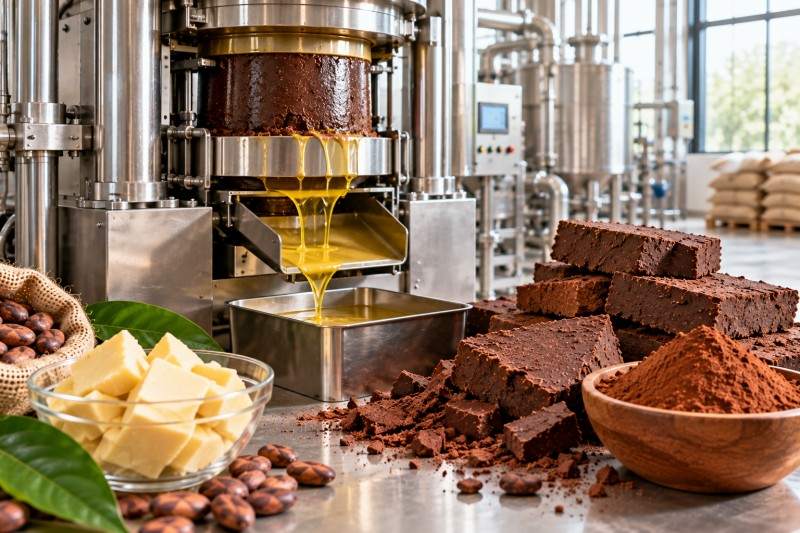
Cocoa press cake fat content is a key control point in cocoa powder production. After pressing, the remaining cake typically contains 8–24% fat, with 10–12% and 20–22% being common commercial grades.
Residual fat affects butter recovery, cake hardness, milling, handling, and production cost. The goal is to consistently achieve the fat level required by the final cocoa powder specification.
What Is Cocoa Press Cake?
Cocoa beans naturally contain a large proportion of cocoa butter. Cocoa nibs become cocoa liquid or cocoa mass after roasting, winnowing, and grinding.
Industrial cocoa mass commonly contains approximately 50–55% cocoa butter. The liquor is kept warm enough to remain fluid and is pumped into a hydraulic cocoa press.
Cocoa solids stay inside the press pots while liquid cocoa butter is forced through filter screens by pressure inside the press.
The basic separation is:
Cocoa Liquor → Hydraulic Pressing → Cocoa Butter + Cocoa Press Cake
The cake is then discharged, cooled if necessary, broken into smaller pieces, and milled into cocoa powder.
The residual fat content of the finished powder is determined by how much cocoa butter was left in that cake.
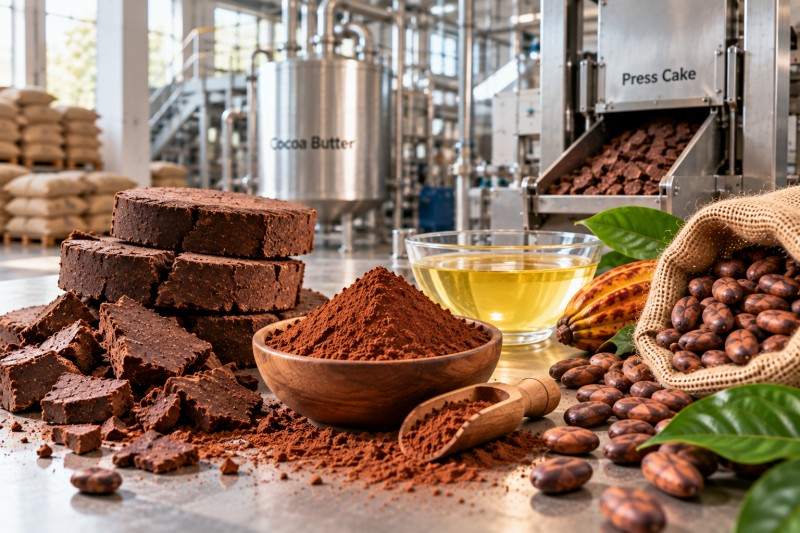
Typical Cocoa Press Cake Fat Levels
The press does not remove all cocoa butter, nor should it necessarily do so.
Different final products require different residual-fat specifications.
| Press Cake Fat | Typical Classification | Processing Character |
| 8–10% | Very low fat | Intensive pressing |
| 10–12% | Low-fat/standard grade | Common commercial target |
| 14–16% | Medium-fat | Intermediate pressing |
| 20–22% | High-fat grade | More butter retained |
| 22–24%+ | Very high fat | Limited butter extraction |
The exact terminology varies by supplier and market, so purchasing specifications should always state the actual percentage.
Industry references identify 10/12 and 20/22 as two principal cocoa powder trade qualities, with 10/12 being particularly common.
This means that a processor planning to manufacture 10–12% cocoa powder must already control the cake close to that range before milling.
A powder mill cannot remove excess cocoa butter.
Fat Content Is Mainly Controlled During Pressing
A common misunderstanding is that cocoa powder fat content can be adjusted during final grinding.
Normally, it cannot.
The important separation occurs in the cocoa press.
Several variables influence residual cake fat:
- Initial cocoa liquor fat content
- Liquor temperature
- Particle-size distribution
- Press pressure
- Pressing time
- Press filling consistency
- Filter condition
- Hydraulic pressure profile
Industrial research has demonstrated cocoa liquor pressing at approximately 90°C and pressures up to 550 bar to manufacture powders containing 12% and 16% fat.
The relationship is straightforward in principle:
More butter removed → Lower cake fat
But achieving the final few percentage points becomes progressively more difficult.
Lower Fat Requires More Pressing Effort
Reducing a cake from 22% fat to 20% is not equivalent to reducing it from 12% to 10%.
As pressing continues, cocoa butter becomes increasingly difficult to remove from the compacted solids.
Older process literature notes that reducing residual cake fat from around 20% to approximately 10% can require roughly twice the pressing time compared with pressing only to around 20%, although actual cycle behavior depends heavily on equipment and liquor properties.
This creates an important production trade-off.
| Target Cake Fat | Pressing Intensity | Cycle Time | Butter Recovery |
| 20–22% | Lower | Shorter | Lower |
| 14–16% | Medium | Medium | Medium |
| 10–12% | Higher | Longer | Higher |
| Below ~10% | Very high | Long | Maximum practical recovery |
Therefore, a press should not be evaluated only by maximum hydraulic pressure.
Pressing capacity at the required residual fat level is the more useful performance specification.
Why Residual Fat Changes Cocoa Butter Yield
Every kilogram of cocoa butter remaining in the press cake is butter that does not leave the press as a separate product.
Consider a simplified example.
Assume 1,000 kg of cocoa liquor containing 54% fat.
That means the feed contains:
- Cocoa butter: 540 kg
- Non-fat cocoa solids: 460 kg
Ignoring small process losses, we can estimate cake and butter output at different residual-fat targets.
At 20% Residual Cake Fat
If non-fat solids represent 80% of the cake:
Cake = 460 ÷ 0.80 = 575 kg
Residual butter:
575 × 20% = 115 kg
Separated cocoa butter:
540 − 115 = 425 kg
At 10% Residual Cake Fat
Non-fat solids represent 90% of the cake:
Cake = 460 ÷ 0.90 ≈ 511 kg
Residual butter:
511 × 10% ≈ 51 kg
Separated cocoa butter:
540 − 51 ≈ 489 kg
The simplified comparison becomes:
| From 1,000 kg Liquor at 54% Fat | 20% Cake Fat | 10% Cake Fat |
| Non-fat cocoa solids | 460 kg | 460 kg |
| Press cake | 575 kg | 511 kg |
| Fat remaining in cake | 115 kg | 51 kg |
| Butter separated | 425 kg | 489 kg |
| Additional butter recovered | — | ~64 kg |
These are theoretical mass-balance values rather than guaranteed plant yields, but they demonstrate the economics clearly.
Moving from 20% to 10% residual fat could recover roughly 64 kg more cocoa butter from every 1,000 kg of this example liquor.
However, the plant also produces less powder mass because more fat has been removed.
More Cocoa Butter Recovery Is Not Automatically Better
At first glance, maximizing butter extraction sounds economically attractive.
But cocoa processing produces two valuable product streams:
Cocoa butter + cocoa powder
The optimum pressing target depends on the market value of both.
Suppose customers specifically require 20–22% high-fat cocoa powder. Pressing the cake down to 10–12% would produce the wrong product even though more cocoa butter was recovered.
Conversely, if the market requires low-fat powder, stopping the press at 20% creates an off-specification cake.
The processor therefore needs to optimize:
Butter revenue + Powder revenue − Processing cost
rather than simply:
Maximum cocoa butter extraction
This distinction is important when selecting press capacity.
How Fat Content Affects Press Cake Structure
Residual cocoa butter changes the physical behavior of the cake.
A heavily pressed low-fat cake tends to be relatively dense, hard and brittle after cooling. Higher-fat cake retains more cocoa butter and can behave differently during breaking and grinding.
| Cake Property | Lower Fat Cake | Higher Fat Cake |
| Cocoa butter remaining | Lower | Higher |
| Cake hardness | Generally higher | Generally softer |
| Temperature sensitivity | Lower | Higher |
| Smearing tendency | Lower | Higher |
| Grinding heat sensitivity | Moderate | Higher |
| Powder richness | Lower | Higher |
These are general processing tendencies rather than universal specifications.
Temperature is especially important because cocoa butter changes physical state with temperature.
A high-fat cake entering the mill too warm can become considerably more difficult to process.
Why Fat Content Matters During Cocoa Powder Milling
The powder mill does not simply reduce particle size. It must break the compact press cake into a stable, free-flowing powder without creating excessive heat.
Residual cocoa butter complicates this process.
Grinding converts mechanical energy into heat.
If product temperature rises too far, cocoa butter softens and the material can begin to behave less like a dry brittle solid and more like a sticky powder.
Possible symptoms include:
Smearing → Agglomeration → Screen blockage → Powder buildup → Reduced mill capacity
The risk becomes more significant as cake fat increases.
For this reason, cake cooling and temperature control should be considered part of the milling process—not just an optional accessory.
Cake Temperature Can Matter as Much as Fat Percentage
Consider two batches containing 20% residual fat.
One cake enters the grinder cool and brittle.
The second enters while still warm from pressing.
Although both meet the same chemical fat specification, their grinding behavior may be very different.
The warmer material may:
- Stick more easily
- Create larger agglomerates
- Reduce mill throughput
- Increase internal deposits
- Require more frequent cleaning
This explains why processors sometimes experience unstable powder milling even when laboratory fat results appear normal.
The fat proportion itself might not be the issue.
It may be the combination of:
Fat Content + Cake Temperature + Mill Temperature
Fat Content and Final Cocoa Powder Characteristics
Residual cocoa butter also changes how the finished powder behaves in food formulations.
Low-fat 10–12% powder and high-fat 20–22% powder are not interchangeable ingredients.
| Characteristic | 10–12% Powder | 20–22% Powder |
| Residual cocoa butter | Low | High |
| Mouthfeel | Drier/lighter | Richer/smoother |
| Fat contribution | Lower | Higher |
| Dry-mix suitability | Strong | Application-dependent |
| Grinding sensitivity | Lower | Higher |
| Product cost structure | Lower butter retained | More butter retained |
| Typical positioning | General industrial | Richer/high-fat applications |
Higher-fat powder can provide richer mouthfeel and greater fat contribution, while low-fat powder is widely used where additional fat is supplied elsewhere in the formulation.
But fat content should not be used alone to predict color or flavor.
Roasting, bean origin, and especially alkalization also have major effects.
Fat Content Is Not Always Uniform Inside the Cake
One of the more interesting practical problems is that a press cake may not have perfectly uniform residual fat.
An industrial study examining cakes produced at 12% and 16% target fat found significant fat variation between batches, between cakes and even within individual cakes. The researchers reported average deviations around 5 percentage points in their spatial measurements and developed a sampling method to improve measurement consistency.
This has an important implication for quality control.
Taking one small sample from one convenient location may not accurately represent the entire press batch.
A better sampling procedure should consider:
- Multiple cakes
- Defined sampling locations
- Center versus edge variation
- Batch-to-batch consistency
- Composite samples where appropriate
The laboratory method may be accurate while the sampling method is poor.
That distinction is often overlooked.
Upstream Liquor Grinding Also Matters
When press performance is poor, operators sometimes increase hydraulic pressure immediately.
That may not solve the real problem.
Cocoa liquor properties strongly affect butter release.
Important upstream variables include:
- Liquor particle size
- Particle-size distribution
- Moisture
- Temperature
- Fat content
- Viscosity
- Degree of alkalization
- Feed consistency
Industrial research has confirmed that pressing time depends not only on the target cake fat but also on the properties of the feed liquor.
A poorly prepared liquor can require longer pressing, reduce butter recovery or create uneven cakes even when the press itself is mechanically sound.
Therefore:
Grinding → Liquor Conditioning → Pressing
should be treated as one connected process.
Common Reasons for High or Unstable Cake Fat
If the target is 10–12% but laboratory results repeatedly show 14–16%, increasing pressure should not be the only response.
A systematic check is better.
| Problem | Possible Cause | What to Check |
| Cake fat too high | Press time too short | Cycle parameters |
| Cake fat too high | Insufficient pressure | Hydraulic system |
| Uneven cake fat | Poor press filling | Feed distribution |
| Variable results | Liquor temperature unstable | Conditioning tank |
| Poor butter release | Liquor properties unsuitable | Grinding/PSD |
| Slow pressing | Filter resistance | Filter screens |
| Milling becomes sticky | Cake too warm/high fat | Cooling + fat analysis |
| Batch variation | Poor sampling | QC procedure |
This approach prevents the press from becoming the default explanation for every production problem.
How to Select the Right Fat Target
There is no universally correct residual fat percentage.
The target should come from the final cocoa powder requirement.
For a typical industrial project:
Step 1 — Define the final powder specification.
Decide whether customers require 10–12%, 14–16%, 20–22% or another range.
Step 2 — Establish liquor characteristics.
Determine input fat, temperature, particle size and viscosity.
Step 3 — Perform a mass balance.
Calculate expected butter and cake output.
Step 4 — Determine pressing cycle requirements.
Do not assume maximum press capacity applies to every fat target.
Step 5 — Size downstream cake handling.
Cake breakers, cooling equipment and mills should match actual cake output and properties.
Step 6 — Validate powder behavior.
Check particle size, flowability, color, fat, moisture and customer-specific requirements.
A Better Way to Design the Cocoa Powder Line
Cocoa powder production is sometimes designed backward from the powder mill.
That is rarely the best approach.
A more logical sequence is:
Required Cocoa Powder → Target Fat → Required Press Cake → Pressing Conditions → Liquor Specification → Press Capacity → Cake Cooling → Milling → Classification
This makes residual fat a design parameter rather than merely a laboratory result.
It also prevents one of the most expensive mistakes in cocoa processing: purchasing a press based on nominal throughput and later discovering that the required capacity cannot be achieved at the customer’s target powder fat.
Cocoa press cake fat content directly affects butter recovery, press throughput, milling behavior, and production economics. Higher-fat cake requires less intensive pressing, while lower-fat cake increases butter recovery but may reduce throughput.
The goal is not the lowest possible fat content, but the fat level required by the finished cocoa powder, balanced with recovery, capacity, and processing efficiency.