
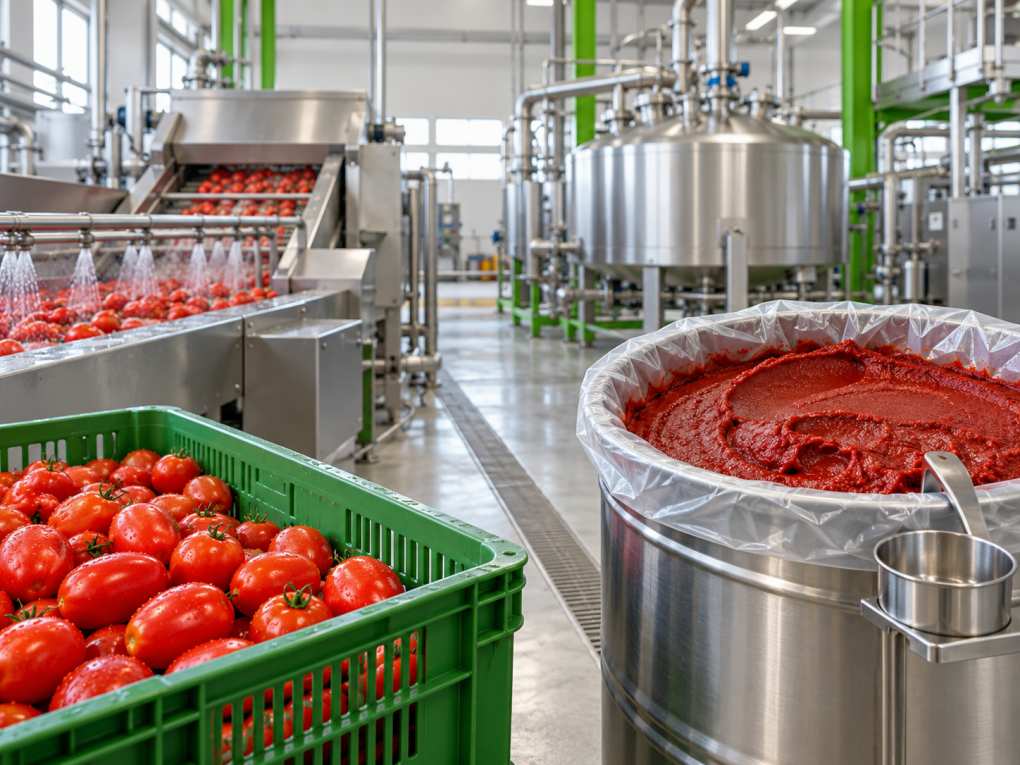
Fresh tomatoes suit a tomato sauce line with dependable crop supply, fruit-handling capacity, and enough operating time to justify upstream processing. Purchased bulk tomato paste suits factories that need scheduled sauce production, recipe flexibility, and fewer fresh-fruit preparation stages. Compare both routes against the same finished sauce specification and saleable output.
For tomato sauce production from tomato paste, the main work shifts to receiving paste, controlled opening, transfer, reconstitution, ingredient mixing, and the required preservation and filling process. Using fresh fruit adds washing, sorting, crushing, and pulp extraction before formulation.
Start with the Finished Sauce Specification
“Tomato sauce” can describe a smooth cooking sauce, a thicker condiment, or a product containing visible ingredients. These differences affect the line regardless of where the tomato component comes from.
| Specification Item | Define Before Selecting Equipment |
| Product and recipe | Tomato contribution, water, oil, seasonings, and other ingredients |
| Texture | Smooth or particulate; acceptable particle size and flow behaviour |
| Quality targets | Colour, flavour, consistency, acidity, and agreed analytical methods |
| Production duty | Saleable sauce per hour or batch, operating days, and product changes |
| Packaging | Container, fill weight, closure, and filling requirements |
| Distribution | Intended storage conditions, shelf life, and preservation requirements |
Use a reference product and a controlled recipe when comparing trials. If each route is allowed to produce a different sauce, the cost comparison will not answer the purchasing question.
For the distinction between making concentrate and making a formulated sauce, see Vortech’s tomato paste and tomato sauce line comparison.
Processing Sauce Directly from Fresh Tomatoes
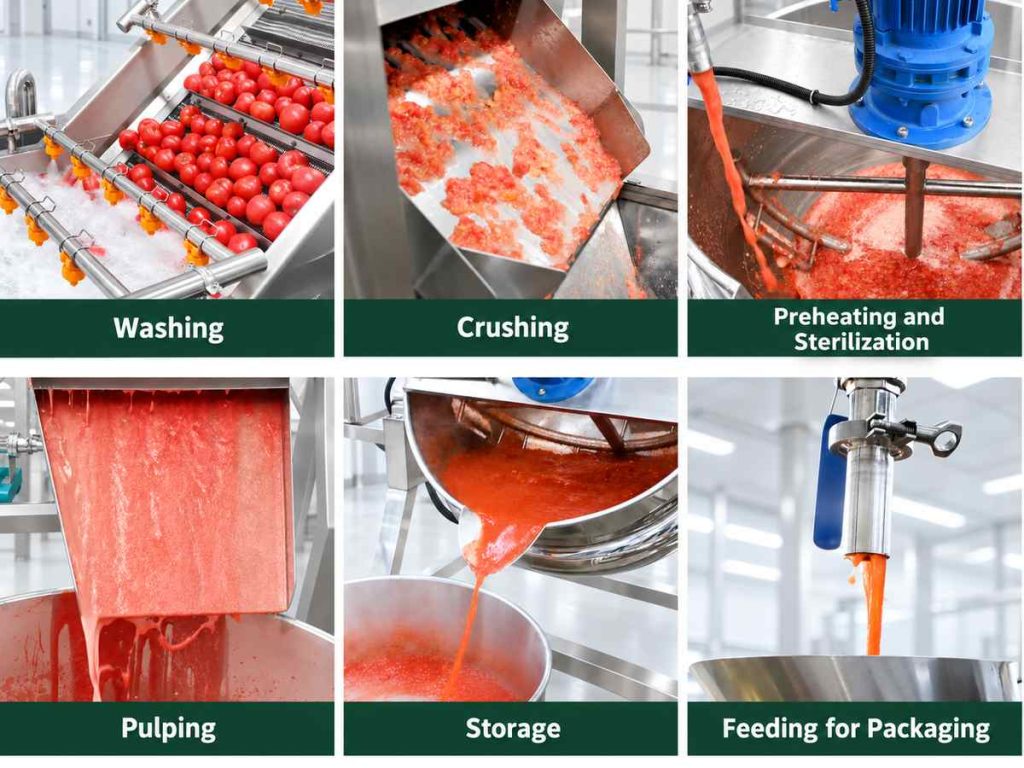
A fresh-fruit route converts incoming tomatoes into a usable pulp before the sauce is formulated. Its design must account for rejected fruit, skins, seeds, wash water, and changes in crop condition.
| Stage | Main Task | Planning Requirement |
| Receiving and sorting | Inspect fruit and remove unsuitable material | Arrival pattern, rejection allowance, and handling space |
| Washing | Remove soil and foreign material | Water supply, cleaning access, and drainage |
| Crushing and transfer | Prepare fruit for subsequent processing | Controlled feeding and pump compatibility |
| Preheating and pulping | Follow the selected process and remove skins and seeds | Product texture, pulp recovery, and screen selection |
| Concentration, where required | Adjust the tomato base for the recipe | Evaporation duty based on actual composition |
| Formulation and finishing | Add ingredients, mix, and complete the selected process | Recipe control and downstream capacity |
Check the Fresh-Fruit Supply Against the Production Schedule
- Confirm harvest dates and the daily volume the factory can actually receive.
- Assess varieties and incoming quality using supplier samples.
- Include rejected fruit and processing residues in the material balance.
- Check whether peak arrivals exceed available processing hours.
- Plan the line’s use outside the tomato season.
A sauce line does not necessarily need to produce high-concentration paste as an intermediate. Specify only the concentration duty required by the intended product and operating plan.
Producing Sauce from Purchased Tomato Paste
A tomato paste reconstitution line starts with a processed ingredient. Check the paste’s specification and packaging before choosing an opening station, transfer pump, or mixer.
| Stage | Main Task | What to Confirm |
| Receipt and storage | Identify lots and check package condition | Supplier specifications and required storage conditions |
| Package opening | Access paste without introducing packaging debris | Drum or bag format and hygienic handling procedure |
| Transfer and dosing | Move and weigh a viscous ingredient | Feed temperature, consistency, and dosing accuracy |
| Reconstitution | Incorporate recipe water into the paste | Water quality, weighing, and mixing performance |
| Ingredient addition | Add the remaining recipe components | Addition sequence and dispersion requirements |
| Finishing and filling | Complete the specified product process | Preservation method, filler, closure, and package compatibility |
Purchase Paste for Its Function in the Sauce
Compare more than concentration and price:
- Soluble solids and the test method used to report them.
- Consistency measured under defined conditions.
- Colour, flavour, acidity, and relevant quality specifications.
- Break-process information where relevant to the target texture.
- Supplier traceability, packaging integrity, and storage instructions.
An unopened aseptic ingredient does not make the finished sauce aseptic after opening, dilution, and mixing. The finished recipe and packaging still need an appropriate, validated preservation process.
How the Two Routes Change Equipment Requirements
Both routes need formulation and downstream processing, but their receiving sections differ substantially. Compare the equipment required to achieve the same finished output.
| Equipment Group | Fresh-Tomato Route | Purchased-Paste Route |
| Raw-material reception | Fruit unloading, washing, sorting, and lifting | Packaged-paste handling, opening, and transfer |
| Tomato preparation | Crusher, preheater, pulper, and refining screens | Paste dosing and reconstitution equipment |
| Concentration | May be required for the selected formulation | Usually purchased within the paste; final adjustment remains recipe-dependent |
| Storage and buffering | Fruit-handling areas and pulp buffers | Packaged ingredient storage and paste buffers |
| Mixing | Blend pulp with other ingredients | Disperse paste, water, and other ingredients |
| Residue handling | Rejected fruit, skins, seeds, and wash-water streams | Empty packaging, retained paste, and cleaning streams |
| Final processing | Match the finished recipe and package | Match the finished recipe and package |
Size mixers by useful batch volume and cycle time, including loading, mixing, discharge, and cleaning. Size pumps against actual viscosity, temperature, suction conditions, and particles.
For a line intended to use both feedstocks, check the shared equipment against both operating cases:
- Can the receiving system supply the mixer without waiting for fruit preparation or paste opening?
- Can the same transfer arrangement handle the expected pulp and paste consistency ranges?
- Are changeover, cleaning, and batch identification defined for each route?
- Does the filling section limit output once the upstream route changes?
The Vortech tomato processing equipment page outlines equipment groups available for fruit preparation, concentration, and filling. A project quotation should identify which groups the chosen feedstock route requires.
Compare Tomato Contribution Before Comparing Prices
A tonne of fresh tomatoes and a tonne of concentrate deliver different amounts of usable tomato material. Compare ingredient costs using the recipe quantity needed for the same saleable sauce.
Use a Recipe-Based Material Balance
| Calculation Step | Fresh-Tomato Route | Purchased-Paste Route |
| Establish the ingredient basis | Measure incoming composition and usable pulp recovery | Confirm paste concentration and specification |
| Calculate recipe demand | Determine fruit needed after rejection and processing losses | Determine paste required per finished batch |
| Account for adjustment | Include any water removal or addition | Include recipe water and other additions |
| Include losses | Track residues, transfers, and retained product | Track package residue, transfers, and retained product |
| Compare output | Cost per saleable batch or tonne | Cost per saleable batch or tonne |
As a simplified example, 30 kg of paste with 30% soluble solids contributes approximately 9 kg of soluble solids. That calculation helps check an unformulated base; it does not establish the recipe or prove equivalence to a particular quantity of fresh fruit.
Sugar, salt, and other soluble ingredients also affect the finished sauce’s refractometer reading. Do not use final °Brix alone to compare tomato contribution or flavour.
Compare Seasonality, Logistics, and Total Cost
Fresh tomatoes may offer attractive local procurement economics, while paste can separate sauce production from the harvest calendar. Both routes need a cost model that reflects the factory’s actual purchasing and operating conditions.
| Cost Item | Fresh-Tomato Consideration | Purchased-Paste Consideration |
| Delivered ingredient | Seasonal price, transport, and rejected fruit | Paste price, freight, package size, and usable yield |
| Utilities | Washing, heating, and any concentration duty | Transfer, mixing, cleaning, and finishing duty |
| Labour | Fruit reception, sorting, and residue handling | Package opening, dosing, and ingredient handling |
| Inventory | Limited fresh-fruit holding and supply interruptions | Stock funding, storage space, and lot rotation |
| Equipment utilisation | Harvest-season loading and off-season use | Scheduled production and product changeovers |
| Waste and losses | Fruit rejects, skins, seeds, and wash streams | Packaging waste, retained paste, and cleaning losses |
Calculate costs per saleable tonne at realistic utilisation. Keep ingredient prices, recovery assumptions, utility rates, and working-capital needs visible so the comparison can be updated.
Vortech’s tomato factory business-plan guide provides related planning topics. Apply them to the sauce project’s own capacity and sourcing model.
What to Test Before Committing to a Production Route
Use representative fruit and paste lots in trials. Record the recipe, processing history, equipment settings, and test conditions so results can be repeated.
| Trial Area | Evidence to Compare |
| Product quality | Flavour, colour, consistency, and approved analytical results |
| Mixing | Uniformity, dispersion time, lumps, and batch repeatability |
| Transfer | Pumpability, retained product, and discharge performance |
| Filling | Fill-weight control, particles, leakage, and closure performance |
| Stability | Separation, texture changes, and quality over intended storage |
| Production cost | Usable yield, cycle time, cleaning demand, and measured consumption |
Define acceptance criteria before reviewing samples. Keep process validation and shelf-life evaluation tied to the finished formulation, container, closure, and distribution conditions.
Bulk-paste packaging and finished-sauce packaging are separate decisions. Vortech’s packaging comparison can support the ingredient-storage discussion; confirm the sauce package separately.
Select the Feedstock Route Before Finalising the Line
- Choose fresh tomatoeswhen supply, usable yield, upstream facilities, and seasonal utilisation support the project.
- Choose purchased pastewhen qualified suppliers, recipe trials, and total delivered cost support scheduled sauce production.
- Consider both routeswhen the business needs seasonal fruit processing and off-season paste use, with defined interfaces and changeover requirements.
For an equipment review, send Vortech your raw-material specification, reference sauce, recipe requirements, target output, and intended package through the project enquiry page. Include available utilities and operating days so the proposed line matches the production plan.