
A useful palm oil equipment spare-parts kit is built from the actual machines being installed and the consequences of waiting for a replacement. It should connect every stocked item to an equipment tag, a confirmed part specification, a supplier, and a replenishment plan. Buying a large collection of generic bearings and seals does not provide the same protection.
The first kit is necessarily based on incomplete operating experience. Use the supplier’s recommendations and the project’s expected duty to establish the initial list, then revise it using actual consumption and failure records. The aim is to make justified stocking decisions, not to claim that any fixed kit can prevent every shutdown.
Start with the Installed Equipment Register
List each machine and package with its equipment tag, manufacturer, model, serial identification where available, and location in the process. Include drives, pumps, transfer equipment, and other supporting items within the agreed maintenance scope. Small components can stop an important function even when the major process machine remains serviceable.
The palm oil equipment station overview can help organize the register by receiving, sterilization, threshing, pressing, and clarification duties. Replace general equipment names with the identifiers used on the delivered plant. A part ordered for the wrong revision of an otherwise similar machine may not fit.
Ask for the supplier’s parts information before finalizing the initial kit. The parts list should connect item descriptions and drawing references to the actual supplied configuration. Where a purchased component comes from another manufacturer, record the complete designation rather than only the machinery supplier’s informal description.
Separate Parts Identification from Interchangeability
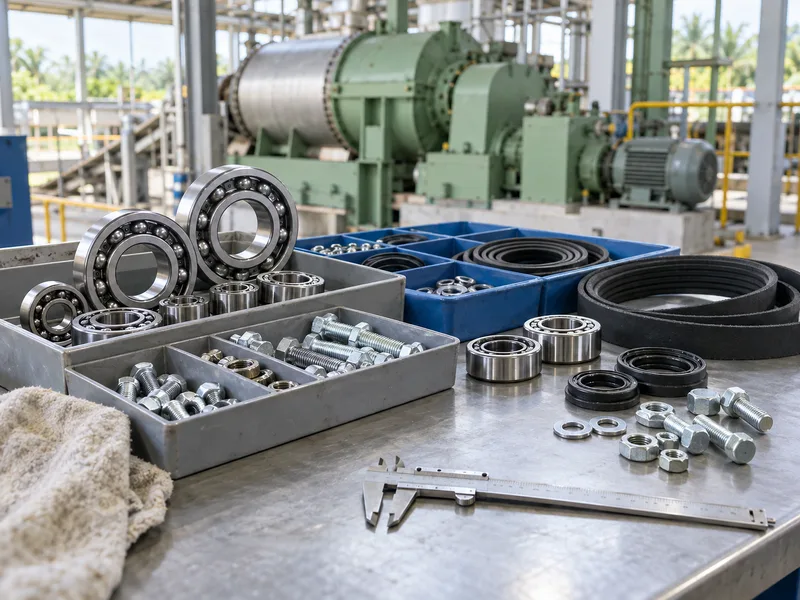
A description such as bearing for press motor is inadequate for purchasing. Record the full specified designation and the equipment reference, together with the supplier’s confirmation of suitability. Similar external dimensions do not establish identical construction, material, sealing, clearance, or duty capability.
SKF’s Bearing Assist documentation explains ways to find product information using a bearing designation or package barcode. That illustrates why complete identification matters. It does not establish that a particular SKF bearing is installed in a Vortech machine or approve a substitute for the manufacturer’s specified part.
Keep proposed alternatives in a separate field until the relevant supplier or responsible engineer approves them. Record the approval and its limitations. An emergency purchase should not silently become the permanent standard for every machine that appears similar.
Rank Parts by the Consequences of Being Unavailable
Consider what happens if an item fails and no replacement is on site. Does the failure stop a single nonessential function, interrupt the entire material route, or create a condition that requires the equipment to remain out of service? The answer helps establish stocking priority.
Next consider whether the plant has an approved alternative operating arrangement. A spare installed pump may reduce the urgency of one stocked component, but only if that standby arrangement can perform the required duty. Do not assume redundancy from the presence of a second machine without checking its intended use.
Include repair time and access requirements in the discussion. Holding a spare does not remove the need for competent personnel, tools, isolation arrangements, or lifting provisions. A stocking decision and a maintenance work plan solve related but different problems.
Use Replenishment Time Rather than Purchase Price Alone
A low-cost specialized part can deserve high priority if it takes a long time to obtain and stops a critical function. Conversely, a costly component with a reliable local repair route may require a different strategy. Compare operational consequences and realistic replacement lead time alongside the item price.
Ask the supplier what lead time includes. Manufacturing, order processing, transport, customs clearance, and delivery to the mill may be separate stages. The time until a part is available for use at the site matters more than the time until it leaves a supplier’s warehouse.
Record the date and basis of the lead-time estimate. A historical delivery or a general statement that a part is available should not be treated as a current commitment. Confirm the supply arrangement again when the project schedule or stocking decision depends on it.
Distinguish Consumables, Wear Parts, and Strategic Spares
Consumables are items expected to be used or replaced through routine work. Wear parts need replacement as their condition or service duty requires. Strategic spares are held mainly because an infrequent failure would have a serious operational consequence and replenishment would be difficult.
These categories help organize decisions but do not determine quantities automatically. The selected machine, feed conditions, operating hours, and supplier’s maintenance instructions affect what is needed. Have the supplier connect each proposed stock quantity to the selected equipment, expected duty, and replenishment assumptions.
For screw press equipment, discuss the components the manufacturer identifies as subject to wear and the criteria used to decide replacement. Avoid inventing a universal service life for screws, cages, or seals. Operating experience from another mill is useful context only when the equipment and duty are comparable.
Build a Parts Register That Purchasing Can Use
| Register field | Purpose |
| Equipment tag and model | Connect the part to the installed machine |
| Part number and drawing reference | Identify the required item accurately |
| Approved specification or alternative | Prevent unsupported substitution |
| Stock quantity and location | Show what is actually available |
| Lead time and supplier contact | Support replenishment planning |
| Storage and shelf-life information | Preserve the part until use |
| Issue and reorder record | Connect consumption to future orders |
Use one item code for a confirmed common part shared by several machines, with the approved applications listed. Do not merge similar-looking items merely to simplify the inventory. If commonality is uncertain, keep them separate until it is verified.
The register should distinguish ordered, received, inspected, reserved, and available stock where those distinctions matter. A part promised by a supplier is not available stock. Likewise, a component reserved for an upcoming overhaul may not be available for an unrelated breakdown.

Set Initial Quantities Using Explicit Assumptions
For regularly consumed items, a simple planning starting point is expected demand during replenishment time plus an agreed buffer. The assumptions need evidence and should be reviewed as actual consumption becomes known. This approach is less suitable for rare, high-consequence failures where criticality and replacement strategy dominate.
For an arithmetic example, an assumed usage of two identical items per month and a three-month replenishment time implies six items of lead-time demand. Adding an illustrative two-item buffer produces a reorder reference of eight. This is not a recommendation for any palm oil machine; it demonstrates how a quantity should be traceable to stated inputs.
Check units and the definition of usage before applying the formula. A maintenance event may replace a matched set rather than a single piece. The parts register should reflect the quantity needed to complete the intended job, not merely the number printed on a purchase line.
Plan Storage Before the Shipment Arrives
Request storage instructions for the supplied parts, including any packaging, preservation, environmental, or shelf-life requirements. Different materials and assemblies can need different treatment. Follow the relevant manufacturer’s instructions rather than assuming that every spare can sit on an open shelf indefinitely.
Keep identification with the item and protect it from being lost when packaging is opened. Record receipt date and condition, then inspect discrepancies before accepting the delivery into usable stock. A damaged or unidentified spare can create a false impression that the mill is prepared for a repair.
The SKF bearing maintenance handbook includes storage guidance for bearings and related products. Use the applicable product instructions for the actual stocked item. Those instructions should be linked from the register so the stores team can find them without searching through unrelated manuals.
Include the Information and Tools Needed to Use the Spare
A replacement component is only part of a repair. Determine whether the job needs special tools, alignment equipment, lifting arrangements, or specialist assistance. The supplier should identify those needs for the delivered equipment and explain which items are included in the supply.
Ask for the relevant drawings and maintenance instructions in the agreed language and format. Keep the supplier’s installation instructions with the identified spare so the maintenance team can plan the replacement task. Keep the task-specific work procedure and authorization arrangements with the responsible maintenance organization.
The existing palm oil mill maintenance guide addresses the broader maintenance program. Use the spare-parts plan to support that program with identified materials and supply arrangements. Avoid turning the parts list into a substitute for planned inspections or competent maintenance work.
Check the Kit During Equipment Handover
Reconcile the delivered kit against the purchase list before the installation team disperses. Verify quantities, identification, condition, and the machine applications recorded by the supplier. Photograph labels where useful and attach discrepancies to the project’s open-item list.
If a part number has changed during manufacture, ask the supplier to update the parts documents and explain the relationship between old and new references. The stores record should match what was supplied. Keeping two unexplained identifiers can lead to duplicate purchasing or an incorrect future order.
Confirm how warranty replacements and routine spare orders are handled, including the information required to identify a machine. Those arrangements depend on the agreement and should not be inferred from general marketing statements. The equipment cost guide can help keep initial spares and ongoing maintenance allowances visible in the budget.
Improve the Kit After Real Operation Begins
Record each issue from stores against an equipment tag and a reason. Distinguish planned replacement, damage during installation, verified wear, and an item used while investigating a fault. Otherwise a short period of unusual startup activity can distort the expected long-term consumption rate.
Review items that repeatedly run short and items that remain unused. Before raising stock, ask whether the consumption reflects an unresolved operating or maintenance problem. More spare parts can support recovery while leaving the underlying cause untouched.
For a future mill expansion, review whether the added equipment truly shares parts with the existing plant. The mill expansion article discusses the larger project decision; the parts register should track the actual changes to models and configurations. Standardization is useful when technically justified and documented.
Send Vortech Global the planned equipment list and the site’s access to local service when requesting a start-up spare-parts proposal. Ask for recommended quantities, complete identifiers, storage instructions, and replenishment assumptions. That produces a kit the stores and maintenance teams can use from the first day of operation.