
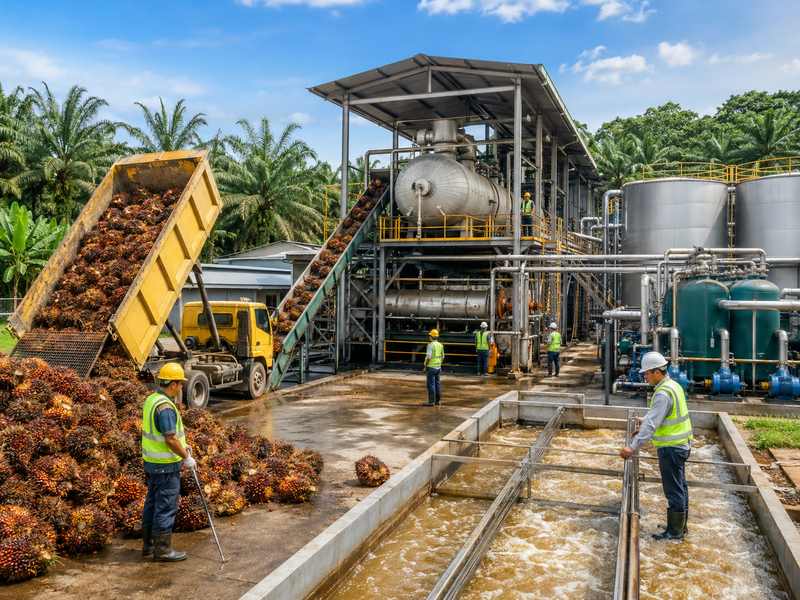
How to Prevent Oil Loss in Palm Oil Production: Practical Guide for Palm Oil Mills
Oil loss is a key profit-control issue in palm oil production. Even small losses can reduce annual revenue, affect CPO output, increase costs, and raise wastewater load. In a modern palm oil mill, oil loss may occur during sterilization, threshing, pressing, clarification, sludge treatment, kernel recovery, and POME treatment. AOCS identifies major loss points such as sterilizer condensate, empty bunches, press cake fiber, nuts, and sludge, with sterilizer condensate loss typically around 0.1% of FFB. Why Oil Loss Control Matters Palm oil production line is a volume business. A mill may look profitable when the crude palm oil price is high, but poor oil recovery can silently reduce profit every day. Large-scale palm oil mills generally process 3–60 tons of FFB per hour, and well-managed large mills can achieve 23–24% palm oil extraction from good-quality Tenera fruit. For example, if a 30 t/h mill runs 20 hours per day and 300 days per year, it processes about 180,000 tons of FFB annually. If oil loss is reduced by only 0.5% of FFB, the mill can recover: Item Calculation Result Annual FFB processed 30 t/h × 20 h/day × 300 days 180,000 tons Oil saved 180,000 × 0.5% 900 tons CPO CPO price assumption USD 900/ton Planning estimate Extra revenue 900 × 900 USD 810,000/year This is why oil loss prevention should be treated as a management system, not only a machine adjustment. Main Oil Loss Points in Palm Oil Production Oil loss usually comes from both raw material issues and processing problems. Some losses are unavoidable, but many can be reduced through better fruit grading, correct sterilization, efficient pressing, stable clarification, and regular testing. Process Stage Common Oil Loss Form Main Cause Control Focus FFB reception Loose fruit and poor-quality bunches Overripe, underripe, delayed delivery Strict FFB grading Sterilization Oil in condensate Over-sterilization, overripe fruit Steam cycle control Threshing Oil in empty fruit bunches Poor fruit detachment Correct sterilizing and threshing Pressing Oil in fiber and nuts Poor digestion, worn screw press Press setting and maintenance Clarification Oil in sludge Poor separation, wrong temperature Stable dilution and separation POME Residual oil in wastewater Fine oil droplets, solids absorption Oil trap and sludge recovery Kernel recovery Oil or kernel loss in the shell/fiber Poor cracking or separation Kernel plant adjustment Start with Fresh Fruit Bunch Quality The first step to reducing oil loss is controlling FFB quality. If the fruit is underripe, the oil content may be low, and fruitlets may not detach easily. If the fruit is overripe, oil loss may increase during handling and sterilization. Long transport time can also increase free fatty acids and reduce final oil quality. A palm oil mill should build a clear FFB grading standard at the reception ramp. FFB Condition Effect on Oil Loss Recommended Action Underripe bunches Low oil content, difficult fruit detachment Reject or apply price penalty Overripe bunches More loose fruit, higher sterilizer oil loss Process quickly, shorten holding time Dirty bunches More sand and solids in process Clean reception control Delayed delivery Higher FFA, lower quality Process within shortest practical time High loose fruit loss Direct oil loss before processing Improve collection and loading A good rule is simple: do not rely on machines to solve fruit-quality problems. Equipment can improve extraction efficiency, but it cannot fully recover value lost before the fruit enters the mill. Control Sterilization Carefully Sterilization is one of the most important steps in palm oil production. It softens the fruit, stops enzyme activity, supports fruit detachment, and prepares the fruit for digestion and pressing. However, poor sterilization can increase oil loss. Over-sterilization can increase oil in condensate. Under-sterilization can cause poor threshing and high oil loss in empty fruit bunches. AOCS notes that overripe bunches may lose more oil during sterilization, and better ripeness control or shorter sterilizer cycles can reduce waste. Sterilization Problem Possible Result Prevention Method Too long a cycle More oil in condensate Optimize steam time Insufficient steam pressure Poor fruit loosening Check the steam supply Uneven loading Uneven sterilization Control cage loading Poor condensate drainage Higher oil carryover Maintain the drainage system Overripe FFB input Higher oil loss Improve FFB grading For a new palm oil mill, the sterilizer should be selected according to capacity, steam supply, labor level, and automation requirements. For an existing mill, the focus should be on cycle optimization, steam valve control, condensate monitoring, and operator training. Improve Threshing Efficiency After sterilization, the thresher separates fruitlets from empty fruit bunches. If many fruitlets remain attached to the bunch, the mill loses oil directly. This problem often comes from poor sterilization, overloaded thresher feeding, incorrect drum speed, or worn internal parts. The mill should regularly check the percentage of unstripped bunches and oil content in empty fruit bunches. A stable sampling system is important because one-time inspection may not represent the real daily loss. Control Point Good Practice Feeding rate Keep feeding stable, avoid overload Drum speed Match fruit condition and equipment design Sterilization quality Ensure fruitlets loosen properly EFB sampling Test oil loss and unstripped bunches Maintenance Inspect drum bars, lifters, and discharge points Optimize Digestion and Pressing The digester breaks down the fruit mash and prepares it for mechanical pressing. After the fruit has been broken down, crude palm oil is extracted using a screw press. If digestion is insufficient, oil cells may not be opened properly. If the screw press pressure is too low, oil remains in the fiber. If pressure is too high, kernel breakage may increase, and downstream separation becomes more difficult. Press cake fiber is one of the most common oil loss points. Pressing harder is not the only objective. The goal is to press efficiently while protecting kernel quality and maintaining stable throughput. Pressing Factor Impact on Oil Loss Control Method Digester temperature Affects oil release Maintain proper heating Digester filling level Affects mixing Avoid underfilling or overfilling Press screw wear Reduces extraction efficiency Inspect and replace worn parts Cone pressure Affects residual oil in fiber Adjust according to lab