
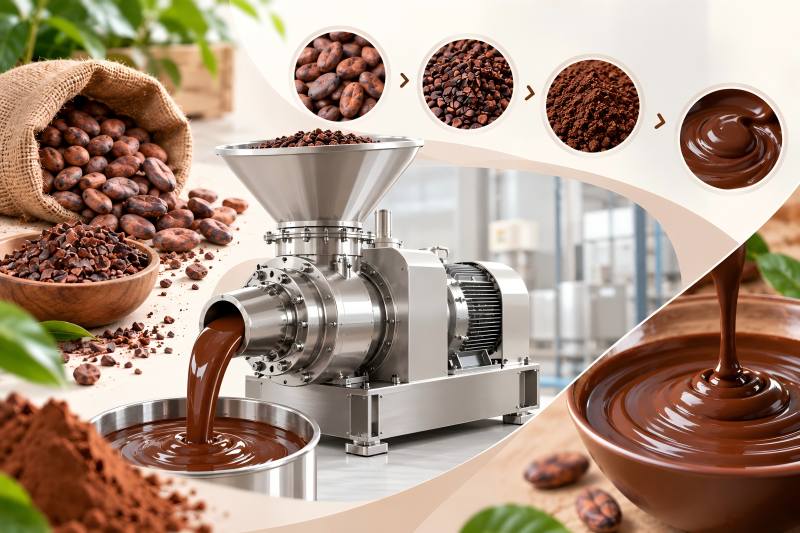
Cocoa Paste Grinder: Working Principle and Applications
A cocoa paste grinder transforms roasted cocoa nibs into uniform, pumpable cocoa liquor by reducing particle size and releasing cocoa butter. Effective grinding depends on particle size, temperature, viscosity, throughput, and feed consistency. The goal is consistent cocoa liquor production while controlling heat, wear, and energy consumption. What Is a Cocoa Paste Grinder? A cocoa paste grinder is designed to process roasted and usually winnowed cocoa nibs into cocoa liquor. Cocoa nibs contain a high proportion of cocoa butter. During grinding, mechanical forces rupture the cellular structure of the nibs. As cocoa butter is released, the material gradually changes from dry, irregular particles into a thick brown paste. A simplified process is: Roasted Cocoa Beans → Winnowing → Cocoa Nibs → Pre-Grinding → Fine Grinding → Cocoa Paste/Liquor The resulting liquor can then follow different processing routes. For chocolate manufacturing, it may be mixed with sugar, additional cocoa butter, milk ingredients, or other components. For cocoa powder production, cocoa liquor is normally sent to a cocoa butter press, where part of the fat is removed, and cocoa press cake is produced. So although the cocoa paste grinder occupies only one stage of the production line, its performance can influence several downstream processes. Working Principle of a Cocoa Paste Grinder The fundamental principle is mechanical size reduction combined with cocoa butter release. When cocoa nibs enter the grinding chamber, they are exposed to forces such as impact, shear, compression, friction, or combinations of these mechanisms. The exact forces depend on the type of grinder being used. There are four primary phases to the procedure. Stage What Happens Main Objective Feeding Cocoa nibs enter the grinder Maintain stable material flow Particle Breakdown Mechanical forces reduce nib size Rupture cocoa cell structure Fat Release Cocoa butter is released Convert solids into flowing paste Fine Grinding Remaining particles are reduced Produce uniform cocoa liquor The transition from nib to paste is especially important. At the beginning, the material behaves like a dry granular solid. As grinding continues and more cocoa butter is released, the material becomes increasingly fluid. This change affects motor load, grinding efficiency, temperature, and discharge behavior. Feeding Cocoa Nibs into the Grinder Good grinding starts with consistent feed preparation. The cocoa nibs should be reasonably uniform and largely free from shells, stones, metal fragments, and other foreign materials. Poor winnowing can increase wear and negatively affect final product quality. Feed rate also matters. If material enters the grinding chamber faster than the grinder can process it, the chamber may become overloaded. This can increase motor current, produce inconsistent liquor, and reduce grinding efficiency. Too little feed, on the other hand, can reduce production efficiency and sometimes change the thermal conditions inside the grinder. A controlled feeder therefore helps maintain stable operation. Breaking the Cocoa Nib Structure Inside the grinder, nibs are subjected to mechanical forces. Depending on the equipment design, cocoa particles may pass between grinding surfaces, collide with high-speed components, or experience intense shear forces. These forces progressively rupture the nib structure. This is different from simply crushing a brittle mineral. Cocoa nibs contain significant fat, so their behavior changes quickly as grinding proceeds. Initially: Solid nib → Broken particles Then: Broken particles → Cocoa butter release Finally: Cocoa solids + released cocoa butter → Cocoa paste The grinding equipment must therefore be capable of handling a product whose physical state changes during processing. Cocoa Butter Release and Paste Formation Cocoa nibs typically contain roughly half their weight as cocoa butter, although actual composition varies with cocoa origin and processing conditions. As grinding destroys the cellular structure, this fat becomes available as the continuous phase surrounding the cocoa solids. The material begins to flow. This is why cocoa liquor can behave like a liquid even though it contains a large amount of solid cocoa material. Temperature also contributes to this transition. Mechanical grinding generates heat, while cocoa butter becomes fully liquid above its melting range. Under typical processing conditions, the combination of released fat and elevated temperature allows cocoa mass to move through piping and pumps. However, more heat is not necessarily desirable. Excessive product temperature can affect flavor and create unnecessary thermal stress. The goal is controlled warming, not uncontrolled heating. Fine Grinding After the initial paste has formed, additional grinding can reduce the cocoa solid particles further. The required fineness depends on what happens next. Cocoa liquor intended for pressing may have different requirements from liquor that will enter a chocolate production process. Furthermore, a cocoa paste grinder is not always expected to produce the final chocolate particle size. This distinction is important. A primary cocoa grinder may produce liquor that is sufficiently fine for efficient downstream processing, while dedicated refiners perform additional particle-size reduction later. Typical Grinding Objectives Application Main Grinding Priority Cocoa liquor production Uniform, pumpable paste Cocoa powder line Consistent liquor for pressing Chocolate production Fine and homogeneous liquor Compound products Stable ingredient dispersion Further refining Controlled feed for downstream equipment Trying to achieve the entire required size reduction in a single machine may unnecessarily increase energy consumption and product temperature. Common Types of Cocoa Paste Grinders Several grinding technologies can be used depending on capacity, product requirements, and production configuration. Colloid Mill A colloid mill typically uses a high-speed rotor and stationary stator separated by a narrow adjustable gap. Cocoa paste passes through this gap and experiences strong shear forces. The machine is particularly suitable once the cocoa material has already begun developing into a paste. The rotor-stator gap is an important operating parameter. Reducing the gap generally increases grinding intensity but can also increase heat generation and machine load. Disc Grinder Disc grinding systems use opposing grinding surfaces to reduce cocoa nibs. The material passes through a controlled space between the discs, where compression, friction, and shear reduce particle size and release cocoa butter. Disc grinders can be useful for primary or intermediate grinding depending on their design. Pin Mill Pin mills use high-speed rotating and stationary pins to create intensive impact