
Indonesia is a major palm oil investment market, supported by large plantations, mature exports, rising biodiesel demand, and strong FFB supply. USDA/FAS forecasts 2026/27 production at 48 million metric tons, while GAPKI reported 51.66 million tons of CPO in 2025.
For investors, a palm oil mill is a supply-chain business. Success depends on stable FFB supply, proper capacity planning, reliable equipment, compliance, and clear sales channels.
Understand the Palm Oil Mill Business Model
A palm oil mill converts fresh fruit bunches into crude palm oil, palm kernel, fiber, shell, empty fruit bunches, and palm oil mill effluent. The main profit comes from CPO, but by-products can also improve overall revenue.
There are three common business models in Indonesia:
| Business Model | Suitable For | Key Advantage | Main Challenge |
| Estate-owned mill | Plantation companies | Stable FFB supply | High land and management cost |
| Independent mill | Investors buying FFB from farmers | Flexible market entry | FFB price and supply competition |
| Cooperative/smallholder mill | Farmer groups or local partners | Strong local supply relationship | Financing and management capability |
| Mini palm oil mill | Start-up or remote FFB areas | Lower investment, faster setup | Lower automation and limited output |
For a “zero to one” business, the most practical model is often an independent mill near smallholder plantations or a medium-capacity mill connected with long-term FFB supply contracts.
Market Drivers in Indonesia
Indonesia’s palm oil market is supported by both export demand and domestic consumption. GAPKI reported that total palm oil exports in 2025 increased from 29.535 million tons in 2024 to 32.343 million tons in 2025, while export value reached about IDR 590 trillion.
Another important driver is biodiesel. Indonesia has implemented the B40 biodiesel mandate, requiring a 40% palm-based biodiesel blend. Reuters reported that Indonesia consumed 14.2 million kilolitres of palm-based biodiesel in 2025 and allocated 15.65 million kilolitres for 2026. This supports domestic palm oil demand and may reduce the risk of depending only on export markets.
Select the Appropriate Location
One of the most crucial choices is location. A palm oil mill should be close to the FFB supply because fresh fruit bunches must be processed quickly after harvesting. Long-distance transport can increase free fatty acid levels, reduce oil quality, and raise logistics costs.
Key palm oil regions include Sumatra, Kalimantan, and parts of Sulawesi. BPS publishes annual estate crop statistics covering oil palm area and production by province, which can be used for regional feasibility studies.
| Location Factor | Why It Matters | Practical Requirement |
| FFB supply radius | Reduces transport time and FFA increase | Preferably within 30–80 km |
| Road access | Supports year-round FFB delivery | Suitable for trucks in the rainy season |
| Water source | Needed for sterilization, boiler, and clarification | Stable industrial water supply |
| Power and fuel | Supports continuous mill operation | Grid power or biomass boiler system |
| Land zoning | Affects permit approval | Industrial or plantation-processing compatible land |
| Labor availability | Supports operation and maintenance | Local skilled and semi-skilled workers |
Select the Right Processing Capacity
Capacity should be based on available FFB, not only investment ambition. Oversized mills often face low utilization, while undersized mills lose opportunity during peak harvest.
A simple calculation:
Daily FFB demand = Mill capacity × operating hours per day
For example, a 30 t/h palm oil mill running 20 hours per day needs about 600 tons of FFB per day.
| Mill Capacity | FFB Needed Per Day | Annual FFB Needed | Suitable Business Stage |
| 1–5 t/h | 20–100 tons | 6,000–30,000 tons | Mini mill/pilot project |
| 10 t/h | 200 tons | 60,000 tons | Small commercial mill |
| 30 t/h | 600 tons | 180,000 tons | Medium independent mill |
| 45 t/h | 900 tons | 270,000 tons | Regional commercial mill |
| 60 t/h | 1,200 tons | 360,000 tons | Large plantation or industrial mill |
Assumption: 20 operating hours per day and 300 operating days per year.
For a start-up investor, 10–30 t/h is usually more realistic than immediately building a 60 t/h plant. It reduces initial risk while leaving room for expansion.
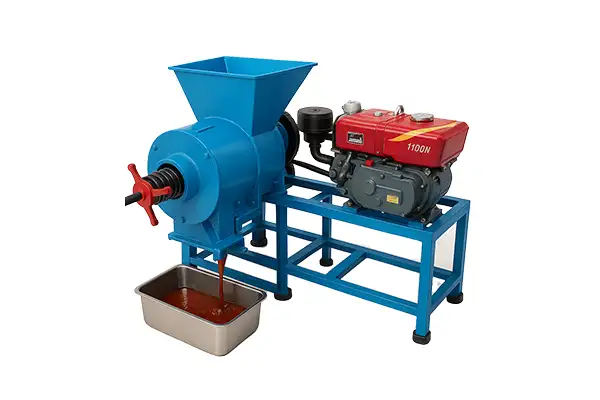
Main Equipment Configuration
A complete palm oil mill plant includes FFB reception, sterilization, threshing, pressing, clarification, kernel recovery, boiler system, water treatment, and wastewater treatment.
| Section | Main Equipment | Function |
| FFB reception | Weighbridge, loading ramp, conveyor | Receive and feed FFB |
| Sterilization | Horizontal or vertical sterilizer | Soften fruit and reduce enzyme activity |
| Threshing | Drum thresher | Separate fruitlets from bunches |
| Pressing | Digester, screw press | Extract crude palm oil |
| Clarification | Vibrating screen, clarifier tank, purifier, vacuum dryer | Remove solids, water, and impurities |
| Kernel recovery | Nut/fiber separator, nut cracker, kernel separator | Recover palm kernel |
| Boiler system | Fiber/shell boiler, steam system | Provide steam and energy |
| Effluent treatment | POME ponds or treatment system | Meet environmental discharge requirements |
For Indonesia, the boiler and wastewater system should be designed carefully. Many mills use fiber and shell as boiler fuel, which reduces diesel or grid power dependence. However, POME treatment must be properly planned to avoid environmental and licensing problems.
Estimated Investment Cost
The cost of a palm oil mill plant varies by capacity, automation level, civil works, boiler design, wastewater treatment, local construction cost, and imported equipment ratio.
| Capacity | Estimated Investment Range | Typical Configuration |
| 1–5 t/h | USD 500,000–2 million | Mini line, basic automation |
| 10 t/h | USD 2–5 million | Small commercial plant |
| 30 t/h | USD 6–15 million | Medium plant with full process sections |
| 45–60 t/h | USD 15–35 million+ | Large mill with higher automation |
These are planning estimates only. They usually exclude plantation acquisition, land, financing cost, taxes, long-term working capital, and unexpected local construction costs.
Basic Output and Revenue Estimation
The most important technical indicator is the oil extraction rate. In many feasibility studies, investors may calculate based on 20–23% CPO extraction, but actual performance depends on fruit quality, ripeness, processing speed, sterilization control, press efficiency, and operator management.
Example for a 30 t/h mill:
| Item | Assumption | Result |
| Mill capacity | 30 t/h | — |
| Operating hours | 20 h/day | 600 tons FFB/day |
| Operating days | 300 days/year | 180,000 tons FFB/year |
| CPO extraction rate | 21% | 37,800 tons CPO/year |
| Palm kernel recovery | 4% | 7,200 tons of kernel/year |
If the CPO selling price is USD 900 per ton, annual CPO revenue can be estimated as:
37,800 tons × USD 900 = USD 34.02 million
This is not net profit. FFB purchase cost, labor, power, maintenance, chemicals, financing, logistics, tax, and depreciation must be deducted.
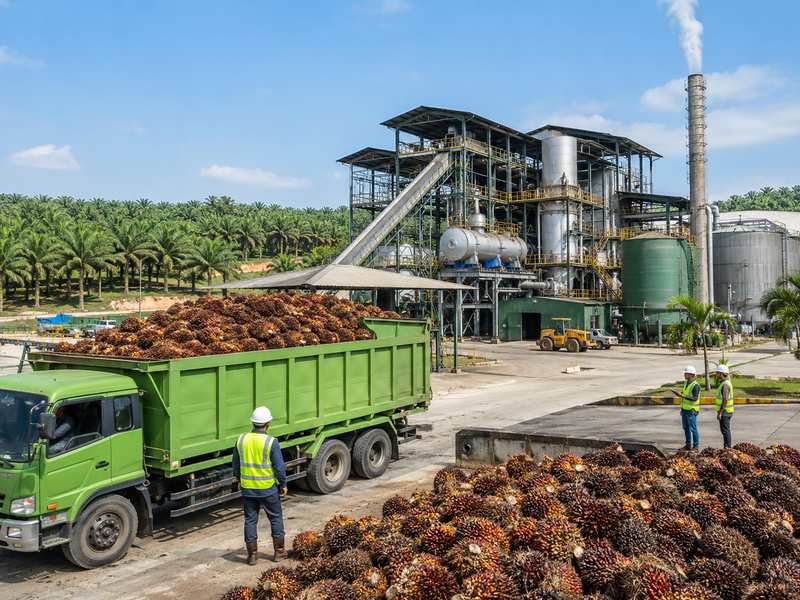
Licensing and Compliance in Indonesia
Palm oil mill investors must plan licensing early. Indonesia uses the OSS-RBA system, a risk-based online licensing platform. Under OSS-RBA, businesses obtain a Business Identification Number and may need additional permits depending on risk level and sector.
Environmental approval is also critical. Depending on project size and environmental impact, businesses may need AMDAL, UKL-UPL, or SPPL before moving forward with industrial licensing. AMDAL is generally for large or high-impact projects, UKL-UPL for medium-impact businesses, and SPPL for lower-risk activities.
ISPO certification should also be considered from the beginning. Indonesia’s national palm oil certification system, ISPO, addresses environmental management, labor responsibility, social responsibility, legal compliance, good farming practices, transparency, and continual improvement.
Project Setup Timeline
A palm oil mill plant is usually built in phases. Costly delays may result from rushing the project without verifying FFB supplies or approvals.
| Phase | Main Work | Estimated Time |
| Feasibility study | FFB survey, location, and financial model | 1–3 months |
| Company and permits | Business setup, OSS, and environmental documents | 3–9 months |
| Engineering design | Layout, process design, utility design | 1–3 months |
| Equipment manufacturing | Main machinery and boiler preparation | 4–8 months |
| Civil construction | Foundation, building, ponds, roads | 4–10 months |
| Installation | Mechanical and electrical installation | 2–4 months |
| Commissioning | Trial run, training, performance testing | 1–2 months |
A realistic total timeline is often 12–24 months, depending on capacity, permit complexity, weather, contractor quality, and import schedule.
Key Risks and Control Measures
| Risk | Impact | Control Method |
| Unstable FFB supply | Low plant utilization | Secure long-term farmer or estate contracts |
| Poor FFB quality | Lower oil extraction rate | Set grading standards and buying rules |
| Wrong capacity selection | High cost or lost opportunity | Match capacity with verified FFB supply |
| Weak sterilization control | Poor oil quality and low yield | Use reliable sterilizer and steam control |
| Poor wastewater planning | Permit and environmental risk | Build proper POME treatment system |
| Lack of maintenance | Downtime and repair cost | Prepare spare parts and maintenance schedule |
| Price fluctuation | Profit instability | Combine CPO, kernel, shell, and local sales strategy |
Practical Setup Strategy for New Investors
For a zero-to-one palm oil mill business in Indonesia, investors should follow a step-by-step approach.
First, confirm FFB supply. Do not buy equipment before checking daily FFB availability, harvest seasonality, farmer relationships, road conditions, and local competition.
Second, choose a scalable capacity. A 10 t/h or 30 t/h mill can be a safer starting point than a very large plant, especially if the investor is new to the industry.
Third, design the plant around efficiency. A modern palm oil mill should focus on high oil extraction, low residual oil loss, stable steam supply, efficient clarification, and proper kernel recovery.
Fourth, prepare for compliance early. Licensing, environmental approval, wastewater treatment, and ISPO-related documentation should be included in the project budget.
Finally, work with experienced palm oil mill equipment suppliers. Process design, equipment selection, layout planning, installation advice, operator training, and post-purchase assistance should all be provided by the supplier.
Setting up a palm oil mill plant in Indonesia offers strong potential, supported by large production, exports, and biodiesel demand. Success depends on verified FFB supply, suitable capacity, reliable equipment, compliance, and realistic financial planning.
New investors should start with a feasibility study, control oil loss early, and build a scalable plant that can expand with FFB supply.