
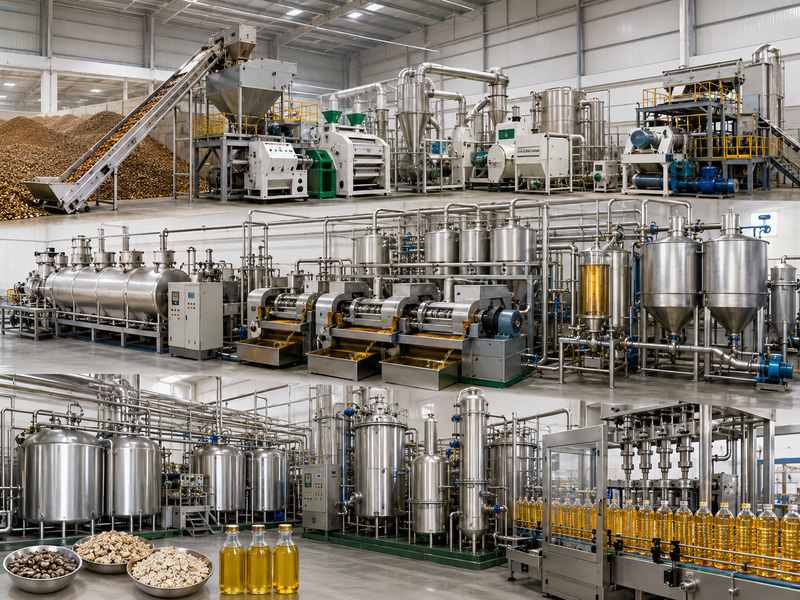
Cottonseed oil production turns cottonseed into crude oil, refined edible oil, meal, hulls, and other by-products through a connected processing system. Because cottonseed contains lint, hulls, kernels, oil, protein, fiber, pigments, and gossypol, proper cleaning, delinting, dehulling, extraction, and refining are essential. A complete line usually includes seed receiving, cleaning, delinting, dehulling, crushing, flaking, cooking, pressing or solvent extraction, filtration, refining, storage, and packaging. Small plants often use mechanical pressing, while medium and large plants commonly use pre-pressing plus solvent extraction for higher oil recovery.
Basic Flow of a Cottonseed Oil Production Line
| Production Stage | Main Machines | Main Function |
| Raw seed receiving | Silo, conveyor, elevator, weighing system | Store and transfer cottonseed continuously |
| Cleaning | Vibrating screen, magnetic separator, destoner | Remove dust, stones, metal, stems, and impurities |
| Delinting | Cottonseed delinter | Remove short fibers from seed surface |
| Dehulling | Cottonseed dehuller, hull-kernel separator | Break seed hulls and separate kernels |
| Size reduction | Crusher, grinder | Reduce kernel size for better flaking |
| Flaking | Flaking mill | Press kernels into thin flakes |
| Cooking/conditioning | Steam cooker, conditioner | Adjust moisture and temperature |
| Oil extraction | Screw oil press or solvent extractor | Extract crude cottonseed oil |
| Oil cleaning | Oil filter, settling tank, centrifuge | Remove cake particles and solid impurities |
| Refining | Degumming, neutralizing, bleaching, and deodorizing equipment | Remove gums, free fatty acids, color, odor, and gossypol |
| Packing | Filling machine, capping machine, labeling machine | Pack refined cottonseed oil for sale |
Cottonseed Receiving and Storage System
The first part of the cottonseed oil line is raw material handling. Cottonseed is usually delivered by truck, bulk bags, or conveyor from a cotton gin. Before entering production, the seed needs to be weighed, sampled, and stored properly.
The main machines include bucket elevators, belt conveyors, screw conveyors, raw seed silos, and weighing systems. Their function is to keep the cottonseed moving smoothly while reducing manual labor. Good storage design is very important because high moisture cottonseed can easily cause mold, heating, and oil quality problems.
For larger plants, raw seed silos should be equipped with ventilation, level sensors, temperature monitoring, and dust control systems. These systems help maintain stable production and prevent material blockage.
Cleaning Section
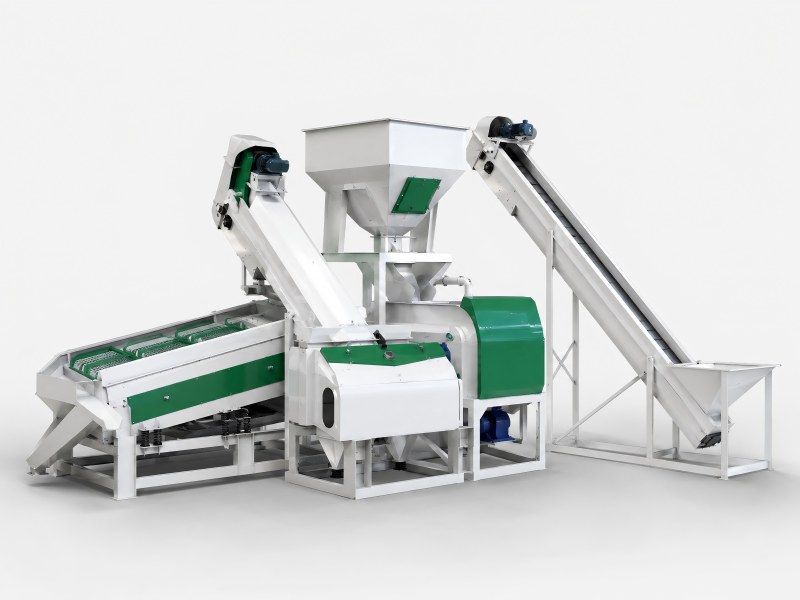
Cottonseed often contains dust, stones, stems, metal pieces, broken seeds, sand, and other impurities. If these materials enter the oil press or extractor, they can reduce oil quality, damage equipment, and increase maintenance costs.
The cleaning section usually includes a vibrating screen, magnetic separator, destoner, and air separator. Both big and small contaminants are eliminated by the vibrating screen. The magnetic separator removes iron and metal particles. The destoner removes heavy impurities such as stones and sand. The air separator removes light impurities such as dust and fibers.
Clean cottonseed improves the performance of downstream machines. It also reduces wear on dehullers, flaking mills, oil presses, and conveyors.
Delinting Machine
Cottonseed may still have short cotton fibers, called linters, attached to its surface. A delinting machine removes these short fibers before dehulling. This step is important because excessive lint can affect seed flow, reduce dehulling efficiency, and create dust problems in the workshop.
The delinting machine uses mechanical cutting or friction to remove lint from the seed surface. The removed linters can be collected as a by-product. In some plants, cotton linters are used for cellulose, paper, or other industrial applications.
For a commercial cottonseed oil plant, the delinting section helps improve material uniformity and makes the following dehulling process more stable.
Dehulling and Hull-Kernel Separation
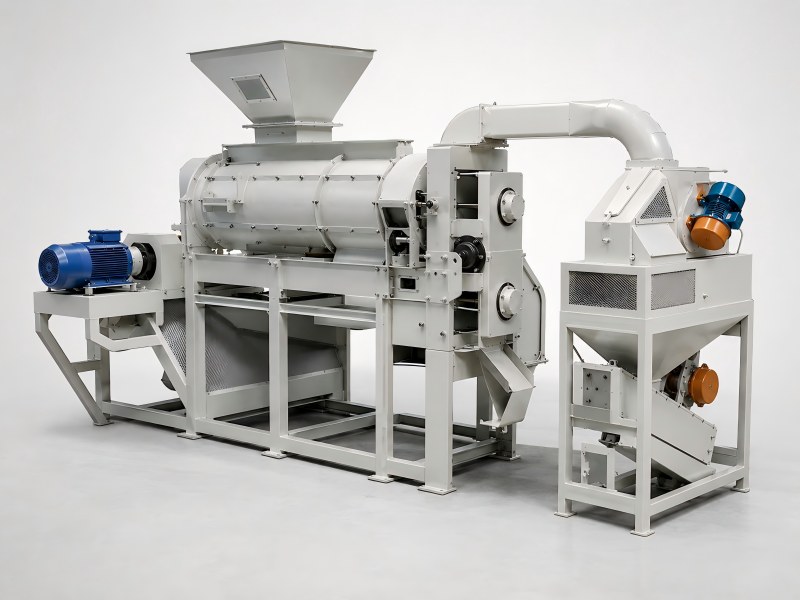
Dehulling is one of the most important steps in cottonseed oil production. Cottonseed hulls contain little oil, so removing them before extraction helps improve oil yield and meal quality. Oklahoma State University Extension notes that hulls and shells of oilseeds generally contain very little oil, and many oilseeds need dehulling before efficient oil extraction.
The main machine is the cottonseed dehuller. It breaks the outer hull without excessively crushing the kernel. After dehulling, a hull-kernel separator separates kernels from hulls by screening and airflow.
The separated cottonseed hulls can be utilised as fuel, biomass, or components in animal feed. The kernels go to the next step for crushing, flaking, and oil extraction.
Section for Crushing and Flaking
The cottonseed kernels are crushed into smaller pieces after dehulling. The crusher reduces kernel size and helps the flaking mill work more evenly.
The flaking mill then presses the kernel particles into thin flakes. Flaking splits oil cells, increases the material’s surface area, and facilitates more even heat and moisture penetration during cooking. Good flaking improves oil release during pressing or solvent extraction.
| Machine | Key Function | Why It Matters |
| Kernel crusher | Reduces kernel size | Makes the material easier to flake |
| Flaking mill | Turns kernels into thin flakes | Improves oil cell rupture and extraction efficiency |
| Thickness control system | Controls flake thickness | Helps maintain stable oil yield |
| Conveyor | Transfers flakes continuously | Reduces manual handling and contamination |
In most cottonseed oil plants, flake thickness must be controlled carefully. Oil extraction is not complete if flakes are very thick. If they are too thin, they may break into powder and affect solvent extraction or filtration.
Cooking and Conditioning System
Cooking is not mainly for flavor. In oilseed processing, cooking means using steam and heat to adjust the moisture, temperature, and structure of the flakes. This prepares the material for pressing or extraction.
The main machine is a steam cooker or conditioner. It usually has several layers or compartments. Steam heats the flakes gradually, softens the material, coagulates proteins, reduces oil viscosity, and improves oil release.
For mechanical pressing, proper cooking can significantly improve oil yield. For solvent extraction, conditioning helps create a stable material structure that allows solvent to penetrate and drain effectively.
Temperature, moisture, and retention time should be adjusted according to seed quality, oil content, and extraction method. Overcooking may darken the oil color and damage the meal quality. Undercooking may reduce oil yield.
Cottonseed Oil Pressing Section
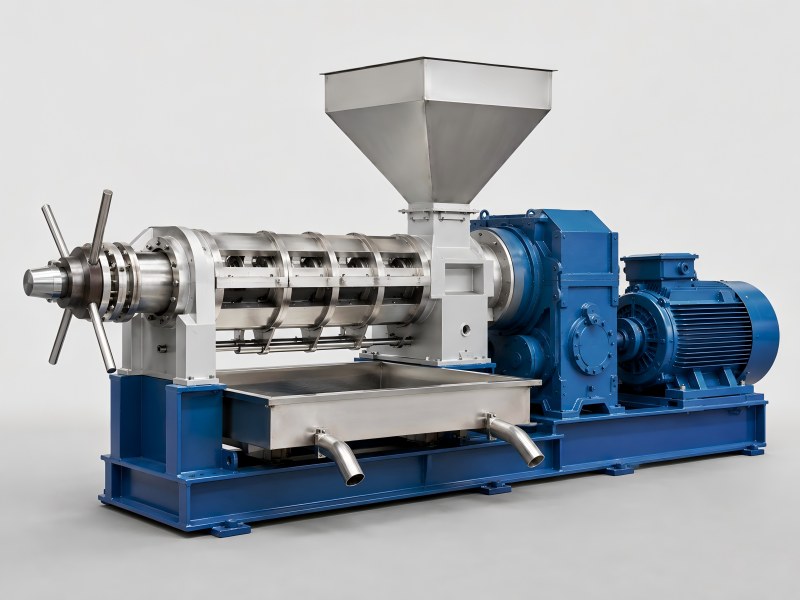
Mechanical pressing uses a screw oil press, also called an expeller, to squeeze oil out of cooked cottonseed flakes. AOCS explains that an expeller is used for mechanical oil separation, while an expander is mainly used for seed or material preparation.
In a screw press, the cooked material enters a pressing chamber. The material is pushed forward by a revolving screw as pressure progressively rises. Crude oil flows out through small gaps, while the remaining solid material is discharged as cottonseed cake.
Mechanical pressing is suitable for small and medium plants because the process is simple, investment is lower, and operation is easier. However, oil remaining in the cake is usually higher than in solvent extraction.
| Extraction Method | Suitable Plant Type | Advantages | Limitations |
| Single pressing | Small plants | Simple process, lower investment, easy operation | Higher residual oil in cake |
| Pre-pressing + solvent extraction | Medium and large plants | Higher oil recovery, better for continuous production | Higher investment and stricter safety requirements |
| Direct solvent extraction | Large industrial plants | High extraction efficiency | Requires good preparation and solvent recovery system |
Solvent Extraction Section
For large cottonseed oil production lines, solvent extraction is often used after pre-pressing. The pressed cake still contains residual oil. Solvent extraction uses food-grade solvent, commonly hexane, to dissolve and recover the remaining oil.
Oklahoma State University Extension explains that oilseed extraction commonly uses mechanical extraction with a screw press or solvent extraction, and that hexane solvent extraction is standard in modern large oilseed-processing facilities.
The main machines in this section include solvent extractor, desolventizer-toaster, evaporator, condenser, solvent recovery system, and meal cooler. The solvent extractor mixes cottonseed cake with solvent to dissolve oil. The oil-solvent mixture is called miscella. The miscella then goes through evaporation and stripping to separate crude oil from solvent. The solvent vapor is condensed and reused.
The meal also needs to be desolventized to remove remaining solvent before it can be safely stored or used as feed material.
Crude Oil Filtration and Storage
Crude cottonseed oil from pressing or extraction contains solid particles, gums, pigments, free fatty acids, moisture, and other impurities. Before refining, it should be filtered and temporarily stored.
Common equipment includes settling tanks, plate filters, leaf filters, bag filters, and centrifuges. Filtration removes cake fines and suspended solids. Clean crude oil reduces refining losses and improves the performance of pumps, heat exchangers, and refining equipment.
Crude oil tanks should be designed with heating coils, level indicators, sampling ports, and proper sealing. Good storage helps reduce oxidation and contamination.
Cottonseed Oil Refining Section
Crude cottonseed oil is not usually ready for direct edible use. It must be refined to improve color, odor, taste, stability, and safety. Edible oil refining commonly includes degumming, deacidification or neutralization, bleaching, deodorization, and sometimes winterization.
Cottonseed oil refining is especially important because gossypol contributes to dark color and must be removed during processing to produce edible oil and usable meal.
Main Refining Steps
| Refining Step | Main Equipment | Function |
| Degumming | Degumming tank, mixer, centrifuge | Removes phospholipids and gums |
| Neutralization | Alkali tank, mixer, centrifuge | Removes free fatty acids and soapstock |
| Washing and drying | Washing tank, vacuum dryer | Removes soap residue and moisture |
| Bleaching | Bleaching tank, vacuum system, leaf filter | Removes pigments, color bodies, and trace impurities |
| Deodorization | Deodorizer, vacuum system, steam system | Removes odor, flavor compounds, and volatile impurities |
| Winterization, optional | Crystallizer, filter | Improves clarity at low temperature |
Degumming removes phospholipids that can cause sediment, poor color, and processing problems. Neutralization reduces free fatty acids. Bleaching improves oil color by using bleaching earth or activated clay. Deodorization uses high temperature, vacuum, and steam to remove unwanted odor and flavor compounds.
For cottonseed oil, winterization may be used when the final product needs good clarity in cooler conditions.
Filling and Packaging Section
After refining, the cottonseed oil is cooled, filtered, and stored in finished oil tanks. Then it can be packed into bottles, drums, barrels, or bulk containers.
The packaging section may include bottle unscrambler, filling machine, capping machine, labeling machine, inkjet printer, carton packing machine, and palletizing system. For edible oil, packaging machines should be made with food-grade contact parts and easy-to-clean structures.
Small plants may use semi-automatic filling machines. Large plants usually use automatic filling lines with accurate metering, anti-drip nozzles, cap feeding, labeling, coding, and carton packing.
By-Product Handling
A complete cottonseed oil production line should also consider by-products. Cottonseed processing does not only produce oil. It also produces linters, hulls, cottonseed cake, cottonseed meal, soapstock, and spent bleaching earth.
| By-Product | Source | Possible Use |
| Cotton linters | Delinting | Cellulose, paper, industrial material |
| Cottonseed hulls | Dehulling | Feed ingredient, biomass fuel |
| Cottonseed cake | Mechanical pressing | Feed material after proper processing |
| Cottonseed meal | Solvent extraction | Animal feed ingredient |
| Soapstock | Neutralization | Soap, acid oil, industrial use |
| Spent bleaching earth | Bleaching | Disposal or controlled industrial recovery |
By-product utilization can improve the total profitability of a cottonseed oil plant. For many investors, the value of meal and hulls is an important part of the business model.
How to Choose Machines for a Cottonseed Oil Plant
The right machine configuration depends on production capacity, raw seed quality, final oil standard, investment budget, local labor cost, and target market.
| Plant Scale | Suggested Process | Typical Features |
| Small plant | Cleaning + cooking + pressing + filtration | Lower investment, simple operation |
| Medium plant | Cleaning + dehulling + flaking + cooking + pressing + refining | Better oil quality and higher efficiency |
| Large plant | Full pretreatment + pre-pressing + solvent extraction + refining + packing | High oil recovery, continuous production |
| Edible oil plant | Full refining and food-grade packing | Suitable for retail and food industry markets |
| Industrial oil plant | Basic filtration or partial refining | Suitable for non-food applications |
For investors who want to sell refined edible cottonseed oil, refining equipment is necessary. For investors who only sell crude oil to refineries, a pretreatment and pressing line may be enough. For large-scale operations, solvent extraction can improve oil recovery and reduce residual oil in meal.
A complete cottonseed oil production line connects cleaning, delinting, dehulling, crushing, flaking, cooking, pressing or extraction, filtration, refining, filling, and packaging into one efficient system. For investors, the key is to design a balanced plant that matches capacity, raw material quality, product standards, safety needs, by-product use, and future expansion, helping improve oil yield, product quality, operating cost, and long-term profit.