
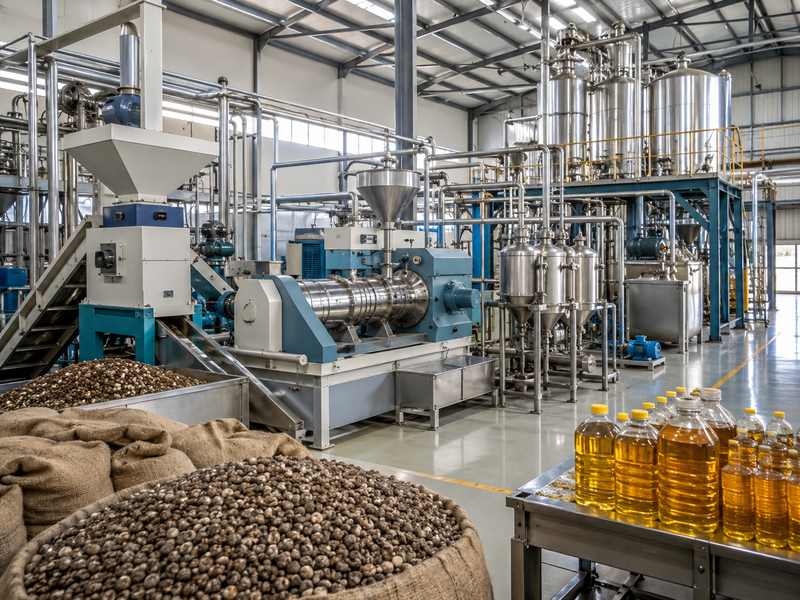
A cottonseed oil mill plant can be profitable in cotton-producing regions. It turns cottonseed into crude oil, refined oil, meal, hulls, and linters. Cost depends on capacity, technology, automation, refining needs, labor, utilities, and raw material supply. Small pressing plants cost less, while larger extraction and refining lines need higher investment.
The material is pushed forward by a revolving screw as pressure progressively rises.
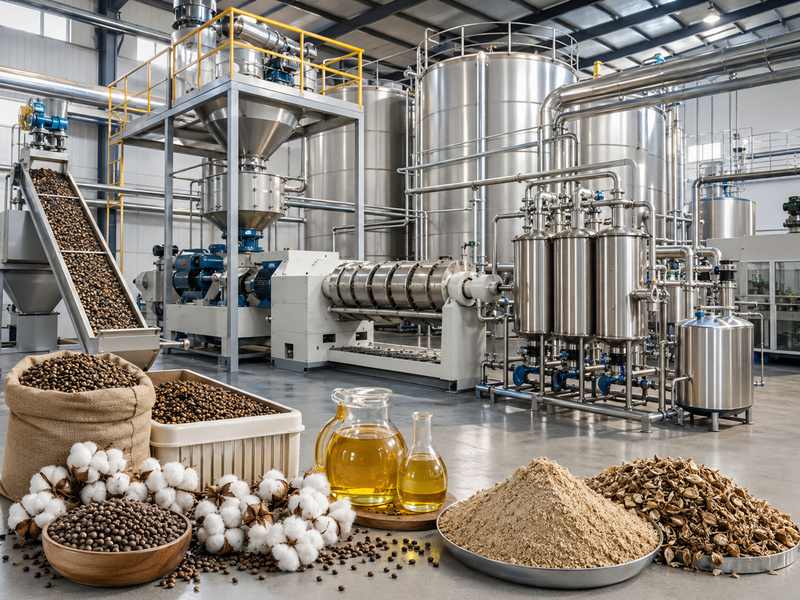
A complete cottonseed oil mill plant is not just one oil press machine. It is a full processing system that turns cottonseed into oil and by-products. A basic plant may only include cleaning, crushing, cooking, pressing, and filtration. A more complete plant may include delinting, dehulling, kernel separation, solvent extraction, refining, filling, packaging, and storage.
Cottonseed usually contains oil, protein, fiber, hulls, lint, and natural pigment compounds. One ton of crushed cottonseed can typically produce about 16% crude oil, 45% meal, 27% hulls, and 8% linters, although the exact result depends on seed quality and processing method.
| Product from 1 Ton Cottonseed | Approx. Yield | Commercial Use |
| Crude cottonseed oil | 150–170 kg | Edible oil refining, industrial oil |
| Cottonseed meal | 430–460 kg | Animal feed, protein ingredient |
| Cottonseed hulls | 250–280 kg | Cattle feed, fiber material |
| Linters | 60–90 kg | Cellulose, paper, industrial use |
| Loss and moisture | 30–60 kg | Processing loss |
Main Factors Affecting Cottonseed Oil Mill Plant Cost
The first factor is capacity. A 5–10 tons/day workshop has a much lower investment than a 100 tons/day industrial plant. Small plants often use mechanical pressing, while larger plants may use pre-pressing plus solvent extraction to improve oil recovery.
The second factor is whether the investor wants to sell crude oil or refined edible oil. Crude cottonseed oil can be sold to refineries, but refined cottonseed oil has a wider market and higher value. However, edible oil refining requires degumming, neutralization, bleaching, deodorization, filtration, storage, and sometimes winterization.
The third factor is raw material preparation. Cottonseed has lint and hulls, so cleaning, delinting, dehulling, and kernel separation are important for higher oil yield and better meal quality. A plant that skips proper pretreatment may save money at the beginning but lose profit every day through lower oil recovery.
The fourth factor is automation. Manual feeding and bagging reduce initial investment, but they increase labor cost and make production less stable. Automatic conveyors, temperature control, PLC control, oil tanks, and packaging systems increase cost but improve long-term efficiency.
Estimated Cottonseed Oil Mill Plant Cost by Capacity
The following table gives a practical investment reference. Actual prices vary by country, steel cost, supplier, shipping distance, installation standard, and project scope. The cost ranges below are planning estimates in USD and usually exclude land purchase.
| Plant Scale | Capacity | Suggested Process | Estimated Equipment Cost | Estimated Total Project Cost |
| Mini workshop | 1–5 TPD | Cleaning + cooking + pressing + filtration | $8,000–$35,000 | $20,000–$80,000 |
| Small plant | 5–20 TPD | Pretreatment + screw pressing + crude oil filter | $35,000–$120,000 | $80,000–$250,000 |
| Medium plant | 20–50 TPD | Delinting + dehulling + pressing + small refinery | $120,000–$400,000 | $250,000–$800,000 |
| Industrial plant | 50–150 TPD | Pre-pressing + solvent extraction + refining | $500,000–$2,500,000 | $1,000,000–$5,000,000 |
| Large turnkey plant | 150+ TPD | Full automatic extraction + refining + packing | $2,000,000+ | $5,000,000+ |
Some equipment suppliers publish small-scale references, such as around $8,000 for a 5-ton/day small cottonseed oil workshop, but this type of figure usually refers mainly to basic equipment, not a full turnkey factory with civil works, utilities, installation, storage, refining, and working capital.
Equipment Cost Breakdown
The cost of a cottonseed oil mill plant should be calculated by production section. This helps investors understand where money is spent and which parts should not be over-simplified.
| Production Section | Main Machines | Cost Share | Investment Notes |
| Seed receiving and storage | Weighing, bins, silos, conveyors | 5%–10% | Important for continuous production |
| Cleaning and delinting | Vibrating screen, magnetic separator, delinter | 10%–15% | Removes impurities and lint |
| Dehulling and kernel separation | Dehuller, separator, hull conveyor | 10%–18% | Improves oil yield and meal quality |
| Crushing, flaking, cooking | Crusher, flaker, cooker | 12%–20% | Prepares kernels for efficient oil release |
| Pressing or extraction | Screw press, pre-press, extractor | 20%–35% | Core oil recovery system |
| Filtration and crude oil tank | Filter press, pumps, oil tanks | 5%–10% | Improves crude oil cleanliness |
| Refining section | Degumming, neutralization, bleaching, deodorization | 20%–35% | Needed for edible oil |
| Filling and packing | Filling machine, capping, labeling, cartons | 5%–15% | Needed for retail oil sales |
| Boiler and utilities | Steam boiler, air compressor, water system | 8%–15% | Often underestimated |
| Installation and commissioning | Engineers, wiring, testing, training | 5%–12% | Depends on country and site |
Pressing vs Solvent Extraction Cost
Mechanical pressing is simpler and suitable for small to medium plants. It requires lower investment and is easier to operate. However, more oil remains in the cake compared with solvent extraction.
In order to extract additional oil from cottonseed flakes or pre-pressed cake, a solvent—typically hexane—is used. It increases oil recovery but also requires higher investment, stronger safety design, solvent recovery, explosion-proof equipment, skilled operators, and stricter environmental control. Oklahoma State University Extension notes that solvent extraction is widely used because more oil can be extracted.
| Process | Best Capacity Range | Advantages | Disadvantages |
| Mechanical pressing | 1–50 TPD | Lower investment, simple operation, suitable for startups | Lower oil recovery, higher residual oil in cake |
| Pre-pressing | 30–150 TPD | Good balance between cost and yield | Requires more machines and better control |
| Solvent extraction | 50+ TPD | Higher oil recovery, better for large plants | High investment, safety and environmental requirements |
| Pressing + refining | 5–50 TPD | Can sell edible oil directly | Refining adds cost and technical requirements |
| Extraction + refining | 50+ TPD | Best for industrial production | Requires larger capital and management ability |
Refinery Cost: Crude Oil or Edible Oil?
If the investor only sells crude cottonseed oil, the plant cost is lower. However, the buyer group is limited to oil refineries, industrial users, or traders. If the goal is to sell bottled edible cottonseed oil, a refinery is necessary.
Cottonseed contains gossypol, a natural compound found in cottonseed products. Proper processing and refining are important for edible oil quality and safety. Oklahoma State University Extension explains that different extraction techniques affect the amount of free gossypol in cottonseed meal, and gossypol control is an important issue in cottonseed processing.
A common cottonseed oil refining line includes:
| Refining Step | Function |
| Degumming | Removes phospholipids and gums |
| Neutralization | Reduces free fatty acids and soapstock |
| Washing and drying | Removes soap and moisture |
| Bleaching | Improves color and removes pigments |
| Deodorization | Removes odor and volatile compounds |
| Filtration | Improves clarity |
| Filling | Packs oil for sale |
For small refineries, investors may start with 1–10 TPD refining capacity. For a 20–50 TPD pressing plant, the refinery does not always need to match the full seed capacity. It only needs to match the crude oil output. For example, a 50 TPD cottonseed pressing plant may produce about 8 TPD crude oil, so a 5–10 TPD refinery may be enough.
Building, Utilities, and Installation Cost
Many beginners only ask for machine prices, but a real cottonseed oil mill plant also needs buildings, foundation, electricity, steam, water, storage, drainage, fire safety, and installation. These costs can be significant.
| Item | Small Plant | Medium Plant | Large Plant |
| Workshop building | $20,000–$80,000 | $80,000–$300,000 | $300,000+ |
| Electrical system | $5,000–$30,000 | $30,000–$120,000 | $120,000+ |
| Boiler and steam system | $10,000–$60,000 | $60,000–$200,000 | $200,000+ |
| Storage tanks and silos | $5,000–$50,000 | $50,000–$200,000 | $200,000+ |
| Installation labor | $5,000–$40,000 | $40,000–$150,000 | $150,000+ |
| Testing and training | $2,000–$15,000 | $15,000–$50,000 | $50,000+ |
Working Capital Requirement
Working capital is the money needed to buy cottonseed, pay workers, run utilities, maintain equipment, and cover daily operations before sales income returns. In many projects, working capital is more important than the machine price.
Whole cottonseed prices vary greatly by region and season. One current U.S. marketplace listed whole cottonseed average prices at about $309/ton in Alabama and $438/ton in California’s San Joaquin Valley as of June 1, 2026, using USDA as the stated source.
| Cost Item | Example for 20 TPD Plant | Notes |
| Cottonseed stock for 15 days | 300 tons × $250–$350 = $75,000–$105,000 | Biggest working capital item |
| Labor for 1 month | $5,000–$25,000 | Depends on country |
| Electricity and fuel | $4,000–$20,000 | Higher if using boiler/refinery |
| Packaging materials | $3,000–$20,000 | Needed for bottled oil |
| Maintenance reserve | $2,000–$10,000 | Spare parts and wear parts |
| Sales and logistics | $3,000–$15,000 | Transport, dealer margin |
| Suggested working capital | $100,000–$200,000 | For stable operation |
Sample Revenue Calculation for a 20 TPD Plant
The following example is only for investment planning. Actual profit depends on seed price, oil price, meal price, local demand, energy cost, yield, labor, taxes, and financing cost.
Assumptions:
| Item | Value |
| Cottonseed input | 20 tons/day |
| Working days | 300 days/year |
| Annual cottonseed processed | 6,000 tons/year |
| Crude oil yield | 16% |
| Meal yield | 45% |
| Hull yield | 27% |
| Linters yield | 8% |
Estimated annual output:
| Product | Annual Quantity | Assumed Selling Price | Annual Revenue |
| Crude/refined oil | 960 tons | $900/ton | $864,000 |
| Cottonseed meal | 2,700 tons | $260/ton | $702,000 |
| Hulls | 1,620 tons | $120/ton | $194,400 |
| Linters | 480 tons | $300/ton | $144,000 |
| Total revenue | — | — | $1,904,400 |
Estimated annual raw material cost:
| Item | Calculation | Cost |
| Cottonseed | 6,000 tons × $280/ton | $1,680,000 |
| Utilities, labor, maintenance, packaging | Estimated | $180,000–$350,000 |
| Total operating cost | Estimated | $1,860,000–$2,030,000 |
This simple example shows why cottonseed price, oil recovery, and by-product sales are critical. If the cottonseed purchase price is too high or meal and hull sales are weak, profit can quickly disappear. A good investment plan should not rely only on oil sales. It should calculate total value from oil, meal, hulls, and linters.
How to Reduce Cottonseed Oil Mill Plant Cost
Selecting the appropriate capacity is the first step. If a factory is too small, fixed costs might not be met. An excessively large plant could have a scarcity of raw materials. Investors should calculate available cottonseed within a reasonable transport radius before choosing capacity.
The second way is to start with pressing and add refining later. For beginners, a small pressing line can produce crude oil and cake first. After the market is stable, the investor can add a refinery and packing line.
The third way is to design the plant for expansion. Leave enough space for extra presses, larger storage tanks, a refinery, or solvent extraction equipment. This reduces future reconstruction cost.
The fourth way is to control energy consumption. Cottonseed oil processing uses power and steam. Efficient cookers, insulated steam pipes, stable motors, and good maintenance can reduce long-term operating cost.
The fifth way is to secure by-product buyers before production starts. Cottonseed meal and hulls can be valuable feed materials, but they require stable buyers, storage, and quality control.
Investment Checklist Before Buying Equipment
Before placing an order, investors should confirm the following points:
| Question | Why It Matters |
| How many tons of cottonseed are available per day? | Determines plant capacity |
| Is the cottonseed fuzzy or delinted? | Affects cleaning and delinting equipment |
| Will the plant sell crude oil or refined edible oil? | Determines refinery investment |
| Is the target market bulk oil or bottled oil? | Determines filling and packaging system |
| Are meal and hull buyers available? | Improves total profit |
| Is steam available? | Affects cooker and refinery design |
| Are local permits required? | Affects project timeline |
| Is solvent extraction allowed? | Important for large plants |
| What is the local electricity cost? | Affects operating cost |
| Is installation support included? | Prevents startup delays |
Cottonseed oil mill plant cost can range from under $100,000 for a small workshop to several million dollars for a full industrial plant. Beginners can start with a 5–20 TPD pressing plant, while larger investors may choose a 50 TPD or bigger plant with refining. A successful project depends not only on machine price, but also on the right capacity, stable cottonseed supply, efficient pretreatment, oil recovery, by-product sales, and working capital. A well-planned plant can turn cottonseed into multiple revenue streams in cotton-producing regions.