
Choosing the right machine means building an efficient and profitable production system, not just buying equipment. Unlike crude palm oil from fruit pulp, palm kernel oil comes from the kernel and is widely used in food, cosmetics, cleaning products, candles, and oleochemicals. Buyers should consider required machines, capacity, pressing or solvent extraction, automation level, and long-term production needs.
What Is a Machine for Processing Palm Kernel Oil?
A palm kernel oil processing machine refers to a set of equipment used to clean, crush, cook, press, filter, and sometimes refine palm kernels into palm kernel oil. In a small plant, it may only include a crusher, cooker, screw oil press, and filter. In a larger plant, it may include kernel cleaning, cracking, separation, drying, flaking, cooking, mechanical pressing, solvent extraction, oil clarification, refining, and packaging.
The final products usually include:
| Product | Description | Main Use |
| Crude Palm Kernel Oil | Oil extracted from palm kernels | Refining, soap, cosmetics, oleochemicals |
| Palm Kernel Cake | Solid cake after oil extraction | Animal feed, biomass fuel, fertilizer |
| Palm Kernel Shell | Hard shell separated from kernel | Boiler fuel, activated carbon, biomass energy |
| Refined Palm Kernel Oil | Processed edible or industrial oil | Food, personal care, chemical industry |
Palm kernel oil processing is attractive because it creates value from palm kernel, which is often a by-product of palm oil production. FAO data on oil palm fruit bunch composition shows kernel can account for about 5–7% of the bunch weight under ideal composition. This makes kernel recovery and oil extraction an important profit point for palm oil mills.
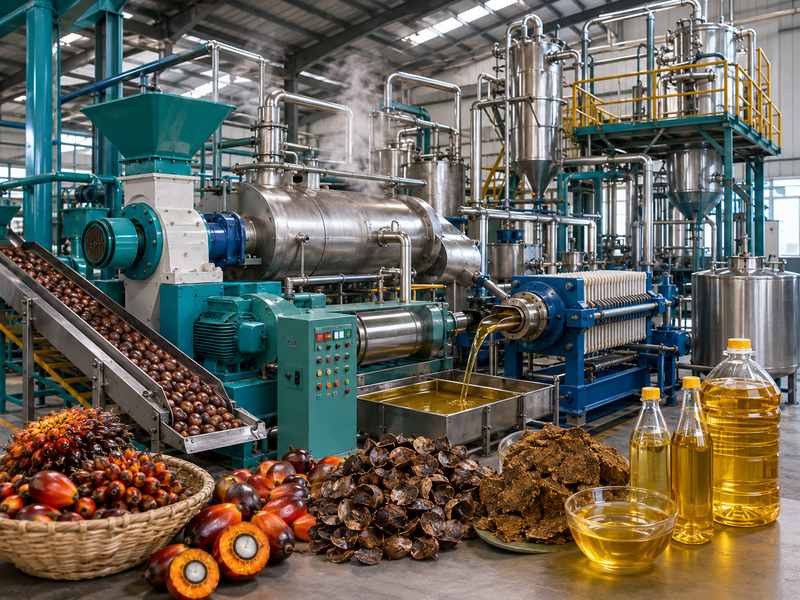
Complete Palm Kernel Oil Processing Flow
A complete palm kernel oil production line usually follows this process:
Palm kernel cleaning → crushing → cooking/conditioning → pressing → oil filtering → crude oil storage → refining or packaging
For larger plants, additional steps may include cracking, shell-kernel separation, drying, flaking, solvent extraction, and oil refining.
Main Process and Required Machines
| Processing Step | Main Machine | Function |
| Raw Material Cleaning | Vibrating screen, magnetic separator, destoner | Removes dust, stones, metal, and impurities |
| Kernel Crushing | Palm kernel crusher | Breaks kernels into smaller particles for better oil release |
| Cooking / Conditioning | Steam cooker or conditioning kettle | Adjusts moisture and temperature before pressing |
| Oil Pressing | Screw oil press / palm kernel oil expeller | Extracts crude palm kernel oil mechanically |
| Oil Filtering | Plate filter, leaf filter, oil filter press | Removes cake powder and solid impurities |
| Cake Handling | Cake conveyor, crusher, storage bin | Collects and processes palm kernel cake |
| Oil Storage | Crude oil tank | Stores crude palm kernel oil before refining |
| Refining | Degumming, neutralization, bleaching, deodorization equipment | Produces higher-quality refined oil |
| Packing | Filling and sealing machine | Packs oil into bottles, drums, or bulk tanks |
Key Machines in a Palm Kernel Oil Processing Line
Palm Kernel Cleaning Machine
Cleaning is the first step. Palm kernels may contain sand, stones, metal pieces, fiber, shell fragments, and dust. If these impurities enter the oil press, they can damage the screw shaft, reduce oil quality, and increase machine wear.
A destoner, magnetic separator, and vibrating screen could all be part of a good cleaning system. For small plants, simple screening equipment may be enough. For larger plants, continuous cleaning systems are recommended.
Palm Kernel Crusher
Palm kernels are hard and compact. Before pressing, they need to be crushed into smaller pieces. This increases the contact area and improves oil extraction efficiency.
The crusher should be selected based on kernel hardness, moisture level, and production capacity. A stable crusher reduces load pressure on the oil press and helps achieve more consistent oil yield.
Cooker or Conditioning Kettle
Cooking is one of the most important steps before pressing. Proper heating softens the kernel structure, adjusts moisture, improves oil flow, and reduces residual oil in the cake.
For buyers, steam cooking is usually more stable than direct heating. The cooker should provide even heating, good temperature control, and continuous discharge if used in a medium or large production line.
Screw Oil Press / Palm Kernel Oil Expeller
The screw oil press is the core palm kernel oil processing machine. It uses mechanical pressure to squeeze oil from cooked palm kernel material. For small and medium plants, mechanical pressing is often the most practical choice because it is simple, cost-effective, and easier to operate.
When selecting a palm kernel oil expeller, buyers should check:
| Selection Factor | Why It Matters |
| Capacity | Must match raw material supply |
| Screw Material | Affects wear resistance and service life |
| Motor Power | Influences energy consumption and pressing force |
| Residual Oil Rate | Lower residual oil means higher profit |
| Automation Level | Reduces labor and improves stable operation |
| Maintenance Access | Makes cleaning and repair easier |
Oil Filtering Machine
Crude palm kernel oil from the press contains fine cake particles and impurities. Oil filtering improves oil clarity and prepares it for storage, sale, or refining.
Common filter options include plate filters, frame filters, and leaf filters. Small plants often use a plate filter press. Larger plants may use continuous filtering systems.
Palm Kernel Oil Refining Machine
If buyers want to sell edible palm kernel oil or supply higher-grade industrial users, refining equipment is needed. Refining usually includes degumming, deacidification, bleaching, deodorization, and sometimes fractionation.
Refining improves color, odor, taste, stability, and impurity control. However, it also increases investment, steam consumption, electricity usage, and technical requirements.
Mechanical Pressing vs Solvent Extraction
Solvent extraction, mechanical pressing, or a combination of the two can be used to extract palm kernel oil. For most small and medium buyers, mechanical pressing is the first choice. For large industrial plants, solvent extraction may be added to recover more oil from palm kernel cake.
Mechanical Pressing vs Solvent Extraction
| Item | Mechanical Pressing | Solvent Extraction |
| Suitable Capacity | Small to medium plants | Large industrial plants |
| Investment | Lower | Higher |
| Operation Difficulty | Easier | More complex |
| Oil Recovery | Good | Higher |
| Residual Oil in Cake | Higher than solvent extraction | Lower |
| Safety Requirements | Normal mechanical safety | Explosion-proof and solvent safety |
| Best For | Start-ups, regional oil mills | Large-scale oil producers |
For buyers new to the industry, mechanical pressing is usually safer and easier to manage. Solvent extraction is better when raw material supply is stable, plant capacity is large, and the buyer has technical staff and safety management experience.
How to Select the Appropriate Capacity
One of the most crucial choices is capacity selection. Buying a machine that is too small limits production and increases labor cost per ton. Purchasing an overly large machine results in idle capacity and needless expenditure.
Palm Kernel Oil Processing Plant Capacity Guide
| Plant Scale | Typical Capacity | Suitable Buyer | Recommended Configuration |
| Small Plant | 0.5–5 tons/day | Start-ups, local processors | Crusher, cooker, screw press, filter |
| Medium Plant | 10–50 tons/day | Regional oil mills, palm kernel traders | Cleaning, crushing, cooking, pressing, filtering, tanks |
| Large Plant | 50–200+ tons/day | Industrial oil producers | Full automatic line, multiple presses, refining, and possible solvent extraction |
| Turnkey Plant | Customized | Investors are building a complete oil factory | Complete design, installation, training, and after-sales service |
The best capacity should be based on daily kernel supply, working hours, labor availability, electricity, steam supply, market demand, and budget.
Estimated Oil Yield and Output Planning
Palm kernel oil yield depends on kernel quality, moisture, storage conditions, machine performance, cooking temperature, and pressing technology. In practical production, palm kernels are often considered a high-oil raw material compared with many other oilseeds, but actual results vary by region and kernel quality.
Example Output Planning for Mechanical Pressing
| Raw Palm Kernel Input | Estimated Crude Oil Output | Estimated Palm Kernel Cake | Suitable Plant Type |
| 1 ton/day | 400–480 kg/day | 500–580 kg/day | Small workshop |
| 5 tons/day | 2.0–2.4 tons/day | 2.5–2.9 tons/day | Small commercial plant |
| 20 tons/day | 8–9.6 tons/day | 10–11.6 tons/day | Medium plant |
| 50 tons/day | 20–24 tons/day | 25–29 tons/day | Industrial plant |
Note: The above data is for planning reference only. Actual oil output depends on kernel oil content, machine condition, pressing method, and process management.
Investment Factors Buyers Should Consider
The price of a palm kernel oil processing machine can vary greatly. A small oil press line may require a modest investment, while a fully automatic palm kernel oil processing plant with refining and packaging can require much higher capital.
Main Factors Affecting Machine Cost
| Cost Factor | Impact on Investment |
| Capacity | Higher capacity requires larger machines, stronger motors, and more steel structure |
| Automation Level | Automatic feeding, temperature control, conveyors, and PLC systems increase cost |
| Process Design | Cleaning, crushing, cooking, pressing, filtering, refining, and packing all affect the price |
| Material Quality | Stainless steel parts and wear-resistant components increase durability and cost |
| Refining Requirement | Edible oil refining adds tanks, a vacuum system, a heating system, and a deodorization unit |
| Installation Conditions | Foundation, workshop layout, power supply, boiler, and piping affect the total project cost |
| After-Sales Service | Installation, training, spare parts, and technical support may affect long-term value |
Typical Equipment Configuration by Budget Level
| Budget Level | Equipment Configuration | Advantages | Limitations |
| Basic | Crusher + cooker + screw press + filter | Low investment, easy operation | More manual labor, limited efficiency |
| Standard | Cleaning + crusher + cooker + press + filter + tanks | Better stability and oil quality | Requires more space and power |
| Advanced | Full automatic pressing line + oil storage + refining | Higher oil quality, less labor | Higher investment |
| Industrial | Pressing + solvent extraction + refining + packaging | Maximum oil recovery and commercial scale | Complex operation and safety management |
Quality Requirements for Buyers
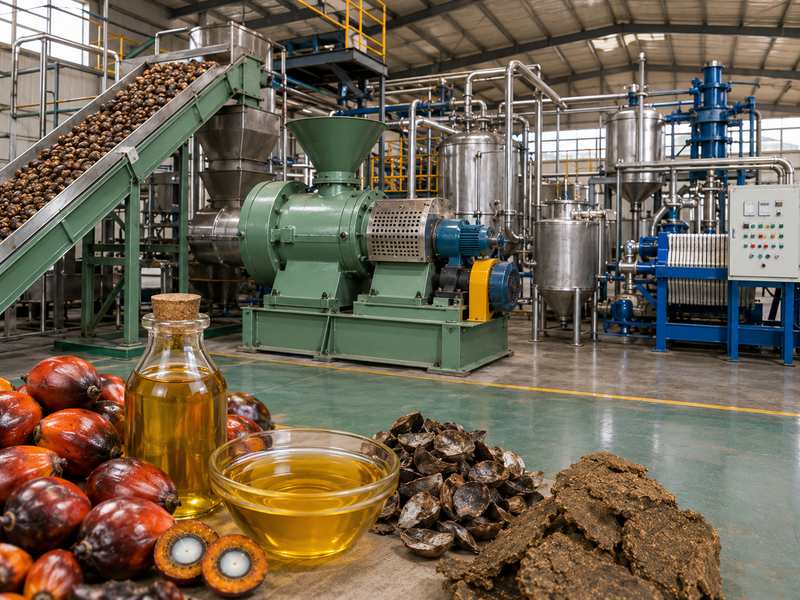
A good palm kernel oil processing machine should not only produce oil but also produce stable oil quality. The following aspects of quality should be considered by buyers:
Prior to pressing, the equipment should eliminate contaminants. Clean raw material protects the oil press and improves crude oil quality.
Second, cooking temperature should be controllable. Overheating may darken the oil, while underheating may reduce oil yield.
Third, the screw press should be strong and wear-resistant. Palm kernel is harder than many soft oilseeds, so the pressing chamber, screw shaft, and wear parts must be durable.
Fourth, oil filtration should be efficient. Clearer crude oil is easier to store, transport, refine, and sell.
Fifth, the supplier should provide technical guidance. Many production problems come from incorrect moisture control, poor feeding, insufficient heating, or wrong machine adjustment.
Common Buying Mistakes
Many buyers focus only on the machine price. This is risky. A cheap machine may have lower steel quality, weak motors, poor screw design, high residual oil, and short service life.
Another mistake is buying equipment without confirming the raw material supply. Palm kernel oil processing requires stable kernel availability. If the factory only runs a few days per month, return on investment will be slow.
Some buyers also ignore power and steam requirements. A palm kernel oil production line needs stable electricity, and cooking equipment may require steam. Before purchasing, buyers should confirm local voltage, transformer capacity, boiler options, and workshop layout.
Finally, buyers should not ignore spare parts. Screw shafts, press cages, bearings, belts, and filters may need replacement after long-term operation. A reliable supplier should provide spare parts support and maintenance guidance.
Buyer Checklist Before Ordering
| Checklist Item | Questions to Confirm |
| Raw Material | How many tons of palm kernels are available per day? |
| Final Product | Do you sell crude oil or refined oil? |
| Capacity | How many working hours per day? |
| Power Supply | Is the local voltage stable? Is the transformer capacity enough? |
| Steam Source | Is a boiler required for cooking or refining? |
| Workshop | Is there enough space for equipment, storage, and maintenance? |
| Labor | Do you prefer manual, semi-automatic, or automatic operation? |
| Budget | Do you need basic pressing or a complete turnkey project? |
| Supplier Support | Can the supplier provide installation, training, and spare parts? |
Buying a palm kernel oil processing machine is a long-term investment. The right choice depends on raw material supply, oil quality, capacity, budget, automation, and market demand. Beginners often choose small or medium pressing lines, while industrial buyers may need refining or solvent extraction for higher recovery. Buyers should compare price, process design, material quality, energy use, spare parts, and after-sales service. With the right equipment and supplier support, palm kernel oil processing can turn kernels into crude oil, refined oil, cake, and biomass by-products.