
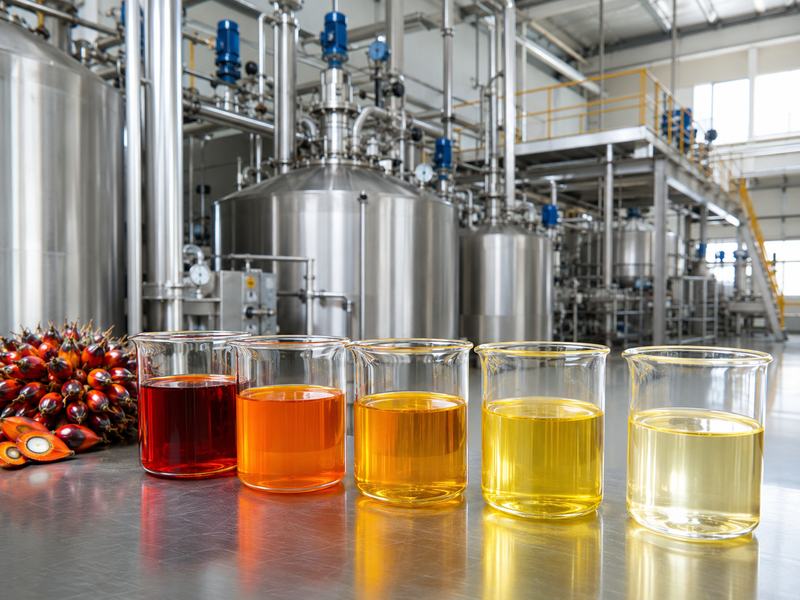
Why Palm Oil Color Is Too Dark After Refining
Palm oil color is a key quality indicator. After refining, oil should look bright yellow, golden yellow, or light red-yellow, but some refineries still face dark oil problems. This may reduce product value and affect uses such as cooking oil, margarine, shortening, soap, and food processing. Common causes include poor crude oil quality, weak degumming or bleaching, improper deodorization, unstable temperature or vacuum, low-quality bleaching earth, and poor storage. Poor Quality of Crude Palm Oil The final color of refined palm oil is strongly affected by the quality of crude palm oil. If the crude palm oil is already very dark, highly oxidized, or has high free fatty acid content, it becomes more difficult to obtain a bright final product. Fresh crude palm oil naturally contains carotenoids, which give palm oil its reddish-orange color. These pigments can be reduced during bleaching and deodorization. However, if the crude oil is produced from overripe fruit, rotten fruit, poor sterilization, or long storage, the color may become much darker. Common crude oil problems High free fatty acid content High moisture and impurities Oxidized oil Overheated crude oil Oil from poor-quality fruit bunches Long storage before refining Contamination with dirt, sludge, or metal particles Crude Palm Oil Problem Effect on Final Oil Color Common Cause High FFA content Darker refined oil Delayed processing or poor fruit quality High moisture Promotes hydrolysis and oxidation Poor clarification or storage High impurities Difficult bleaching and filtration Incomplete crude oil cleaning Oxidized oil Brown or dull color Long storage or air exposure Overheated crude oil Deep red or brown color Improper heating during extraction If the raw oil quality is poor, even a complete palm oil refining line may not achieve the desired color. Therefore, quality control should begin before refining. Incomplete Degumming Degumming is used to remove phospholipids, gums, proteins, and some metal ions from crude palm oil. Although palm oil has fewer gums than soybean oil or rapeseed oil, degumming is still important in many refining processes. If gums are not removed properly, they may interfere with bleaching. Gums can cover pigment particles or react during heating, making the oil color darker. Incomplete degumming may also cause poor filtration, higher oil loss, and unstable refining performance. Signs of poor degumming Oil becomes cloudy after heating Bleaching earth consumption increases Filter blockage happens frequently Refined oil color is dull Deodorized oil has poor brightness Degumming Factor Possible Problem Suggested Action Too little acid Gums not fully hydrated Adjust phosphoric acid or citric acid dosage Poor mixing Uneven gum reaction Improve mixing time and intensity Wrong temperature Low reaction efficiency Control proper degumming temperature Short retention time Incomplete gum removal Extend reaction time High moisture residue Dark color during heating Improve drying before bleaching Good degumming helps reduce the burden on the bleaching section and improves final oil clarity. Incorrect Bleaching Process Bleaching is the key step for removing pigments from palm oil. During bleaching, activated bleaching earth, activated carbon, or other adsorbents are used to remove carotenoids, oxidation products, trace metals, soaps, and other color-causing substances. If the bleaching process is not properly controlled, palm oil may remain dark after refining. Main bleaching problems Insufficient bleaching earth dosage If the dosage is too low, pigments cannot be fully absorbed. Poor bleaching earth quality Low-quality bleaching earth has weak adsorption ability. Wrong bleaching temperature If the temperature is too low, adsorption is not effective. The oil may discolour or oxidise if it is too high. Short bleaching time Pigments need enough contact time with bleaching earth. Poor vacuum condition Bleaching under poor vacuum may cause oxidation and color reversion. Incomplete filtration Residual bleaching earth in oil can make the oil appear dull or cloudy. Bleaching Parameter Typical Control Range Problem If Improper Bleaching temperature About 90–110°C Poor adsorption or oil darkening Bleaching time About 20–40 minutes Incomplete pigment removal Vacuum level High vacuum recommended Oxidation and dark color Bleaching earth dosage Depends on crude oil quality Too low causes dark oil; too high increases oil loss Filtration Clear oil after filter Residual earth affects color The bleaching section should be adjusted according to the quality of crude palm oil. Darker crude oil usually needs stronger bleaching conditions or higher-quality adsorbent. Poor Bleaching Earth Selection Not all bleaching earth is suitable for palm oil refining. Some bleaching earth is designed for light vegetable oils, while palm oil contains a high level of natural carotenoids. Therefore, palm oil usually requires bleaching earth with strong pigment adsorption capacity. Poor bleaching earth may cause high consumption but poor color improvement. In some cases, the oil still appears dark even after adding more bleaching earth. How to choose bleaching earth for palm oil Select bleaching earth suitable for high-carotene oils Test adsorption capacity before bulk purchase Check moisture content Avoid bleaching earth with unstable quality Store it in a dry place Do small laboratory trials before production adjustment Bleaching Earth Issue Result Solution Low activity Poor color removal Use activated bleaching earth High moisture Foaming and poor adsorption Store in dry conditions Wrong particle size Poor filtration Choose refinery-grade material Unstable batch quality Color fluctuation Use reliable suppliers Too much dosage High oil loss Optimize by lab test Using more bleaching earth is not always the best solution. The correct approach is to select the right adsorbent and optimize temperature, vacuum, time, and dosage together. High Oxidation During Refining Oxidation is another major reason for dark palm oil color. When palm oil contacts oxygen at high temperature, oxidation reactions may occur. These reactions produce dark-colored compounds and unpleasant odors. Oxidation may happen during crude oil storage, preheating, degumming, bleaching, deodorization, or final oil storage. Causes of oxidation Air leakage in the refining system Poor vacuum during bleaching or deodorization Long heating time Too high processing temperature Oil exposed to air in storage tanks Lack of nitrogen protection Dirty tanks or old oil residue Oxidized oil is more difficult to bleach. It may also suffer from color reversion, meaning the oil becomes darker