
A palm oil equipment acceptance plan should define what will be checked at the supplier’s factory, what must be checked after installation, and what evidence will demonstrate the agreed production duty. Use a factory acceptance test (FAT) to document the agreed checks before dispatch, and a site acceptance test (SAT) to examine the installation against its defined requirements. Neither label is useful unless the test scope, conditions, responsibilities, and acceptance criteria are written down.
The buyer should develop this plan while reviewing the technical proposal. Waiting until shipment to decide what acceptance means creates avoidable uncertainty. This article offers a purchasing and documentation framework; the supplier and competent project specialists must develop the actual procedures for the equipment and installation.
Separate Construction Checks from Process Performance
A machine can match its approved drawings and still require further testing to demonstrate performance in the installed process. Construction inspection, control-function testing, and production trials provide different evidence. List them separately so a successful check in one category is not mistaken for completion of another.
For a palm oil mill, production performance depends on the feed condition, upstream preparation, connected equipment, utilities, and measurement boundary. A factory without the intended fruit supply and surrounding process may not reproduce those conditions. Identify such limitations before agreeing what the factory trial will prove.
Siemens describes simulation as a way to test automation functions before plant operation. That can be useful for checking defined sequences and responses, but a simulated input does not demonstrate the physical performance of a complete fruit-processing line. Record whether each test uses actual equipment and material, simulated signals, or a combination.
Create an Acceptance Matrix from the Purchase Scope
Take the agreed equipment schedule and assign a verification method to each important requirement. A document may verify a specified component identity, a measurement may verify a dimension, and a functional trial may verify an operating sequence. Avoid asking one generic test to cover unrelated requirements.
The matrix should identify the requirement, test stage, procedure reference, evidence, and responsible reviewer. Include the intended witness where witnessing is required by the purchase agreement. Keep optional checks distinct from the activities necessary to release equipment or accept the installed system.
Use the palm oil equipment overview to establish the process packages under discussion, then work from the project’s actual scope. A receiving conveyor, sterilizer package, press, and clarification section will not all need identical checks. Their interfaces also require attention because successful individual tests do not automatically establish successful integration.
| Verification area | Typical factory evidence | Typical site evidence |
| Equipment identity | Schedule, labels, and approved component records | Delivered item reconciliation |
| Mechanical arrangement | Agreed dimensions and construction checks | Installed position and interface checks |
| Controls | Approved sequence tests with stated simulation limits | Field-signal and integrated-function checks |
| Documentation | Manual and drawing review | Final revisions and handover records |
| Production duty | Only the duty reproducible at the factory | Agreed trial with site feed and utilities |
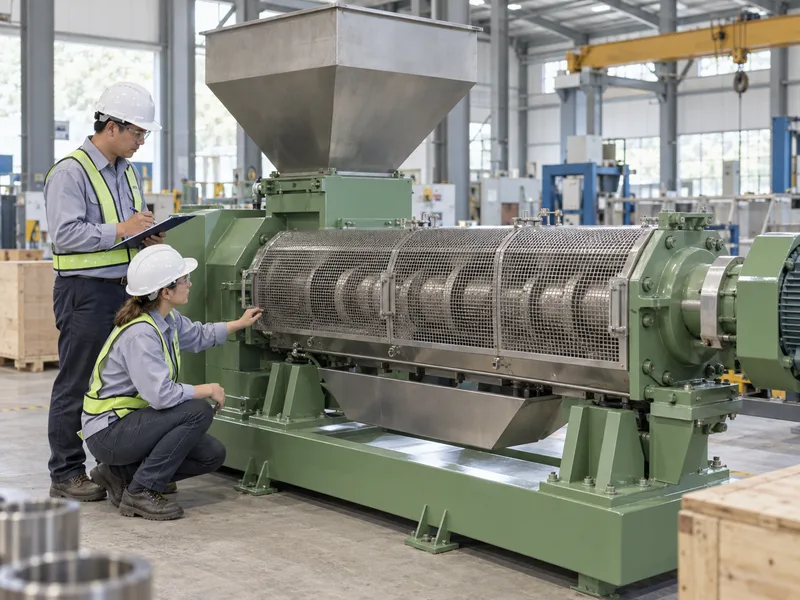
Agree the Documents Before Arranging a Witness Visit
Ask for the test procedure early enough for the project team to review it. The document should state prerequisites, test steps, expected results, recording forms, and the treatment of exceptions. The witness needs written steps and pass criteria, not merely an itinerary naming the machines on display.
Confirm which drawing and specification revisions the test will use. If the equipment has changed during fabrication, reconcile those changes before the inspection. Otherwise a witness may approve an item against an obsolete requirement without realizing it.
Organize the handover files around the equipment tags and the tasks the mill staff will perform after the supplier leaves. Equipment identification should match the parts lists, manuals, and test records. This consistency makes the acceptance file a useful maintenance reference rather than a disconnected collection of signed pages.
Make Prerequisites Visible
Before a test begins, confirm that the conditions needed for a meaningful and safe trial are in place. The responsible specialists should define the applicable installation, guarding, utility, instrumentation, and operating prerequisites. The buyer’s role is to ensure those prerequisites are documented and their status is visible.
For a site trial, record whether all connected equipment is available and whether temporary arrangements remain. A temporary feed method or utility connection can change what the trial demonstrates. If temporary conditions are accepted for a limited test, document the limitation and the further work needed.
The mill layout and installation team should confirm the physical interfaces before the trial schedule is fixed. Delays caused by incomplete supporting work cannot be resolved by relabeling a factory test as site acceptance. The acceptance plan should identify dependencies so the project schedule reflects them.
Describe the Trial Feed in Measurable Terms
For a press trial, define the material entering the press and the relevant upstream preparation conditions. For a complete mill trial, define the incoming FFB and the process boundary. Do not compare a prepared-fruit machine test with a whole-mill production requirement without an agreed conversion and measurement method.
Record the source and condition of the trial material using the characteristics specified by the procedure. If the trial material differs materially from the agreed basis, the parties should decide how to interpret or repeat the test. They should not change the performance definition after seeing the result.
Vortech Global’s screw press equipment information can support the initial technical discussion. Have the supplier attach the ordered model’s agreed duty, trial conditions, and acceptance values to the purchase specification. General catalogue ranges cannot establish the acceptance result of a particular delivered machine.
Choose a Clear Time and Inventory Boundary
State when measurement begins and ends, how startup is treated, and how interruptions are recorded. Material already held inside the process at the start can affect output measured during a short trial. The same applies to material remaining in equipment or tanks at the end.
An illustrative boundary might record 50 tonnes of FFB fed during a defined period and separately record the changes in process inventory. Without that inventory information, oil leaving during the period may not all correspond to fruit fed during the same period. The numbers are an example of a measurement issue, not a proposed acceptance duration or yield.
Report running rate and total-period production separately when both are relevant. A machine processing effectively while running may still lose time because of integrated system interruptions. Present the interruption log beside the running-rate calculation so reviewers can assess both the active machinery and the connected system.

Define How Quality and Recovery Will Be Measured
If the agreement includes oil quality or recovery requirements, specify sample points, sampling frequency, handling, and the analytical methods to be used. The appropriate laboratory and process specialists should establish those details. The report must identify what was sampled and what the percentage is calculated against before a reviewer can judge compliance.
Keep oil recovery, residual oil in a sampled stream, and oil obtained per mass of FFB as separate measures. Give each measure its own calculation and reporting field. Use the same definitions in the quotation, procedure, report, and any corrective-action discussion.
The article on preventing oil loss explains why multiple process locations matter. An acceptance trial should apply agreed measurements at the relevant boundaries rather than attribute every system loss to one machine. This makes the resulting discussion more useful for both the buyer and supplier.
Test Control Behavior Without Treating It as a Complete Safety Validation
An agreed function test may check that displayed equipment states, operator commands, alarms, and process sequences behave as specified. For every test step, provide adjacent entries for the specified behavior, the witnessed behavior, and any discrepancy. Where signals are simulated, the report should identify that fact.
Safety-related functions require the applicable engineering assessment and validation by competent specialists. A general demonstration that a motor starts and stops does not establish the adequacy of the safety system. The project plan should identify the responsible party and the required evidence for that separate scope.
UK HSE maintenance guidance discusses competent personnel, planning, and isolation in machinery work. It provides useful background for organizing work around equipment, but it is not a substitute for the site’s applicable requirements or an equipment-specific commissioning procedure. Keep commissioning responsibilities clear.
Use an Open-Item List That Can Actually Be Closed
For every discrepancy, record the affected requirement, observed condition, evidence, responsible party, and proposed resolution. Assign a unique reference so photographs, emails, and revised documents can be connected to the same issue. Avoid entries such as improve performance that do not identify a measurable problem.
Distinguish items that prevent shipment, items that prevent startup, and items that can be completed during a separately agreed period. The parties should make those decisions through the purchase and project arrangements. A long list of minor issues should not obscure one unresolved item that blocks safe or meaningful operation.
Closure needs evidence. A promise to supply a revised drawing is not the revised drawing, and an assertion that a fault is fixed is not the agreed repeat-test record. Define who can accept closure and keep the final record with the handover documents.
Make Training Part of the Handover Evidence
Specify who should receive training and what tasks the training covers. Operators, maintenance personnel, and supervisors need different information. A demonstration during a factory visit may help, but it may not cover the installed system and local operating arrangements.
Record the material used, participants, equipment configuration, and any remaining training needs. Include access to the final operating instructions and parts information. The palm oil mill maintenance guide provides a broader maintenance context; the handover should deliver the specific information needed for the equipment supplied.
Do not make unsupported claims that attendance alone proves competence. The employer and relevant specialists should determine the assessment and supervision needed for the actual tasks. The acceptance file should accurately describe what training was delivered.
Finish with a Usable Acceptance Record
The final record should connect the approved requirements to completed checks, test results, deviations, and remaining obligations. Keep the equipment serial or identification information with the relevant records. State clearly whether the evidence covers a machine, a package, or the complete line.
If a site trial is deferred because fruit or utilities are unavailable, record the actual status and the plan for completing it. Delivery, mechanical completion, startup, and accepted performance are different milestones. Clear language prevents later disagreement about what has been demonstrated.
For a new project, send the proposed acceptance matrix with the technical inquiry to Vortech Global. Buyers comparing equipment costs should include the scope of testing and commissioning support in that comparison. A well-defined acceptance plan gives both parties a practical route from a quotation to documented operating results.