
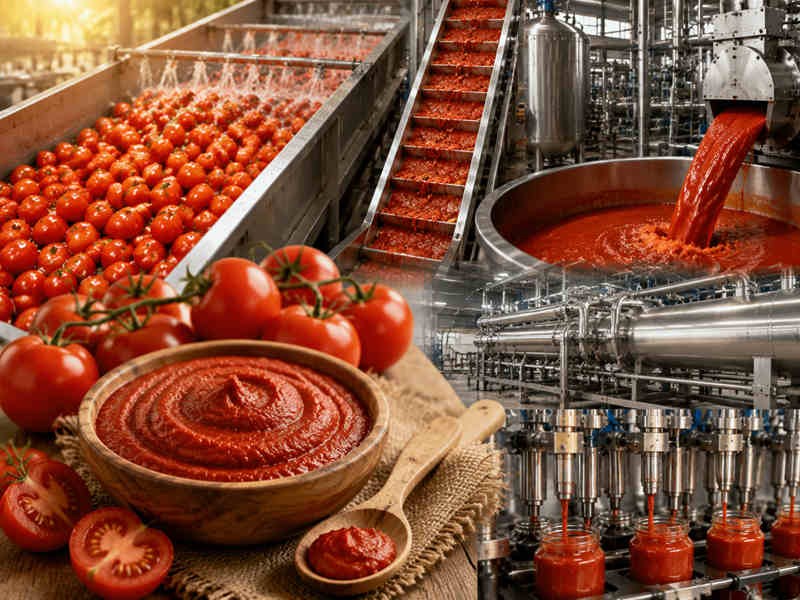
Tomato paste natural colour depends on the whole processing chain. Variety and ripeness establish basic tone, yet production processes largely decide the final visual quality.
Consistent colour calls for integrated process control to limit oxidation and mechanical damage. Custom lines reconcile production scale, tomato types and target product quality.
Tomato Variety and Raw Material Condition
Tomato paste colour originates from fresh raw materials. Varieties vary in pigment, moisture and soluble solids, defining the base tone of concentrated tomato products.
Numerous processing steps risk colour degradation. Sophisticated production lines minimise mechanical harm to retain the natural colour attributes of tomatoes.
Raw Tomato Receiving and Preparation
Tomato paste manufacturing starts with consistent raw material reception and preparation. Controlled feeding prevents fruit deterioration ahead of washing and classification.
Tailored hoppers, combined washing equipment and platforms optimise conveying, minimise mechanical injury and ensure uniform production performance.
Tomato Preparation Equipment Reference
| Equipment | Main Function | Application Value |
| Fruit Receiving Hopper | Receives and feeds fresh tomatoes | Creates stable material input and reduces impact during unloading |
| Fruit Washing Sorting Lifting Monobloc | Washing, sorting, and lifting transportation | Protects tomato quality before crushing |
| Tomato Operation Platform | Inspection and operation support | Improves production management and process control |
A customized tomato preparation section should consider raw tomato condition, factory space, and production speed. Proper equipment arrangement helps reduce waiting time and creates a more stable foundation for later color control.
Crushing and Refining Process
Significant structural transformation occurs to tomatoes in crushing and refining processes. Proper treatment extracts pulp and limits over-processing damage.
All-in-one conveying devices and tailor-made refiners eliminate skins and seeds for uniform pulp, coordinating pulp recovery and required product characteristics.
Thermal Processing Control
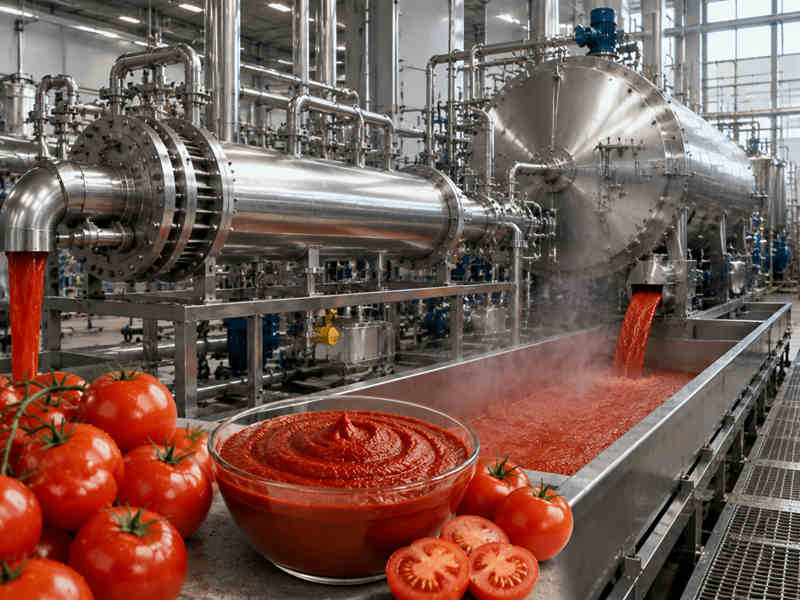
Thermal treatment exerts a vital influence on tomato paste colour. Precise heating safeguards stability, yet overheating damages tomatoes’ inherent colour features.
Tubular preheaters and scraped vacuum evaporators enable mild concentration, acquiring target thickness while protecting natural pigment components.
Thermal Processing Equipment Selection
| Equipment | Processing Stage | Key Function |
| Tomato Tubular Preheater | Preheating before concentration | Provides continuous and controlled heating |
| Scrape Type Vacuum Evaporator | Tomato paste concentration | Supports efficient evaporation with controlled thermal exposure |
The combination of preheating and evaporation equipment should be selected according to final product requirements.
For example, tomato paste intended for higher concentration levels may require stronger evaporation performance, while products emphasizing natural color retention may require more careful thermal management.
A custom thermal processing solution allows equipment parameters, product flow, and production capacity to be matched more accurately.
Concentration Process
After preheating, tomato pulp enters the concentration stage where excess water is removed to achieve the required tomato paste solids content.
Concentration cannot be regarded merely as speedy water evaporation. Thermal conditions, dwell time, pulp viscosity and heat exchange performance affect the preservation of native tomato qualities.
Equipment layouts can be tailored to suit varied production throughputs and tomato paste specifications based on the following factors:
- Target concentration level
- Processing capacity
- Product viscosity
- Heating method
- Continuous production requirements
Rational design of the evaporation unit helps manufacturers coordinate operational efficiency and the sensory appearance of end tomato paste products.
Storage and Mixing Before Filling
Post-evaporation tomato paste requires temporary treatment ahead of packing. Improper storage and transportation may undermine consistency during filling.
Tailored storage vessels bridge concentration and packaging. They allow stable operation for facilities producing multiple tomato paste specifications.
Stainless steel blending and sterilising tanks enable pre-packaging processes. This material delivers hygienic, durable and easily maintained food-grade conditions.
Storage and Mixing Equipment Reference
| Equipment | Application Stage | Processing Value |
| Raw Tomato Paste Storage Tank | Buffer storage after concentration | Maintains stable product flow before filling |
| Stainless Steel Mixing Tank Sterilization Tank | Mixing and sterilization | Supports final product adjustment before packaging |
Storage and blending facilities ought to be synchronised with evaporation and filling sections for tailor-made tomato paste lines. Smoothly arranged workflows avoid lengthy material transfer and sustain uniform product status all the time.
Packaging Process
The packaging phase fails to generate tomato paste colour but sustains its visual traits after processing. Viscous paste requires steady and precise filling technology.
Specialised viscous fillers reduce inter-pack deviation. All-in-one units complete forming, filling, sealing and coding for flexible pouch packaging.
Semi-automatic cappers ensure reliable sealing for bottles. Handheld inkjet printers print batch details to realise traceable product marking.
Tomato Paste Packaging Equipment Configuration
| Equipment | Suitable Application | Main Function |
| Viscous Product Filling Machine | Tomato paste in containers | Accurate filling of high-viscosity products |
| Pouch Forming Filling Seaming Coding Monoblock | Flexible pouch packaging | Integrated forming, filling, sealing, and coding |
| Semi-Auto Capping Machine | Bottle or container products | Stable closing and sealing |
| Handheld Inkjet Printer | Product identification | Batch and production marking |
Choosing suitable packaging equipment depends on packaging styles, production capacity and market standards. Integrated tomato paste manufacturing systems combine processing and packaging instead of isolating these procedures.
Custom Tomato Paste Processing Line Design Based on Color Requirements
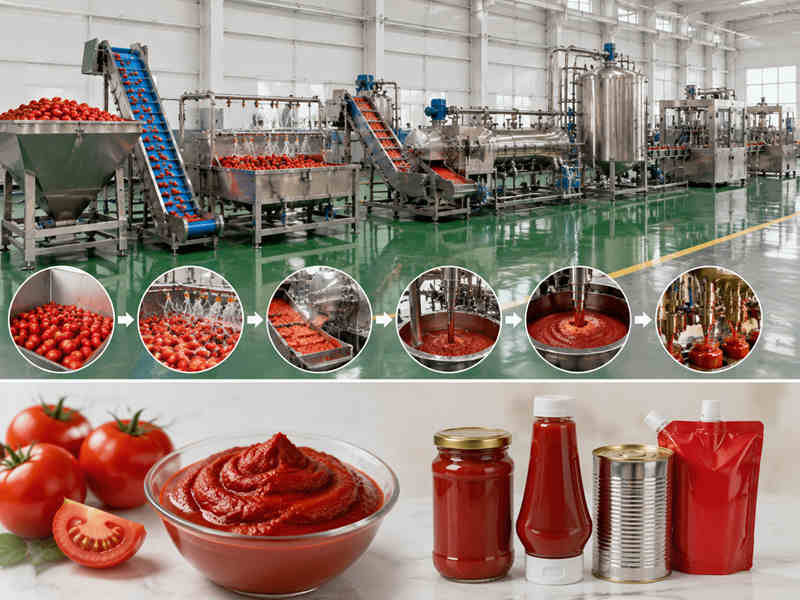
Objectives vary among tomato paste manufacturers. Priorities range from retaining bright natural pigment to elevated concentration, expanded output or multi-type packaging.
Generic equipment assemblies cannot meet these diverse needs. Customised production lines combine all processing units in accordance with individual factory requirements.
The integrated system can consist of:
- Fresh tomato receiving system
- Washing and sorting section
- Crushing and refining section
- Thermal treatment section
- Vacuum concentration section
- Storage and sterilization section
- Filling and packaging section
Custom Tomato Paste Line Configuration Reference
| Production Requirement | Recommended Equipment Combination | Design Focus |
| Natural color preservation | Gentle receiving + controlled crushing + optimized heating | Reduce unnecessary oxidation and thermal impact |
| High-capacity production | Continuous transfer + efficient evaporation system | Maintain stable production speed |
| High-viscosity tomato paste | Refining + scraper evaporation + viscous filling | Ensure smooth product flow |
| Multiple package formats | Flexible filling and sealing equipment | Adapt to different market requirements |
The natural color of finished tomato paste is therefore the result of the entire processing system rather than a single production step.
From the moment tomatoes enter the fruit receiving hopper to the final sealing process, each equipment section contributes to product consistency.
A reliable tomato paste processing line should protect the original tomato characteristics while improving efficiency, stability, and production flexibility.
Through customized equipment selection and process integration, manufacturers can achieve stable tomato paste quality with consistent color, texture, and packaging performance.