
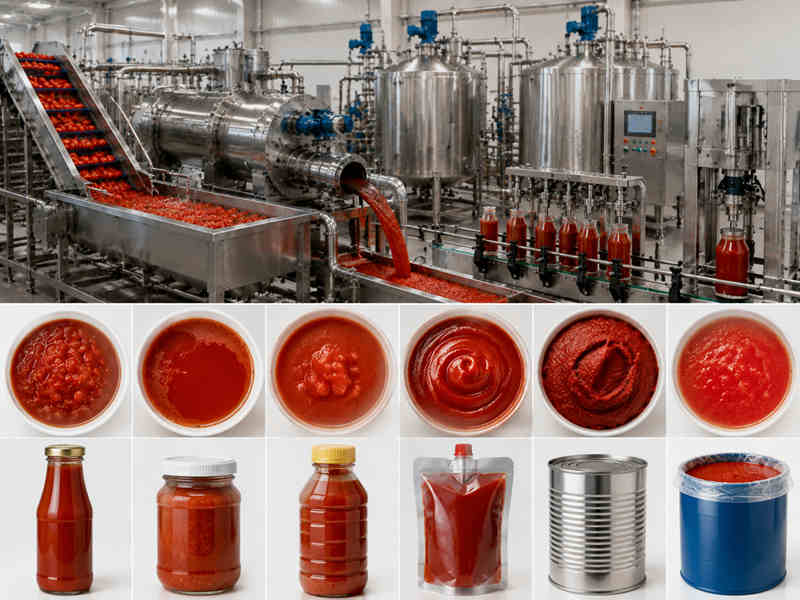
Steady texture is vital to the market performance of tomato products. Large manufacturers control viscosity and smoothness through standardized crushing, refining, heat processing, concentration and filling procedures.
Top-grade raw materials still lead to uneven texture on flawed production lines. Comprehensive tailored systems rather than single equipment help eliminate fiber particles and stabilize viscosity during high-volume output.
Main Factors Affecting Industrial Tomato Texture
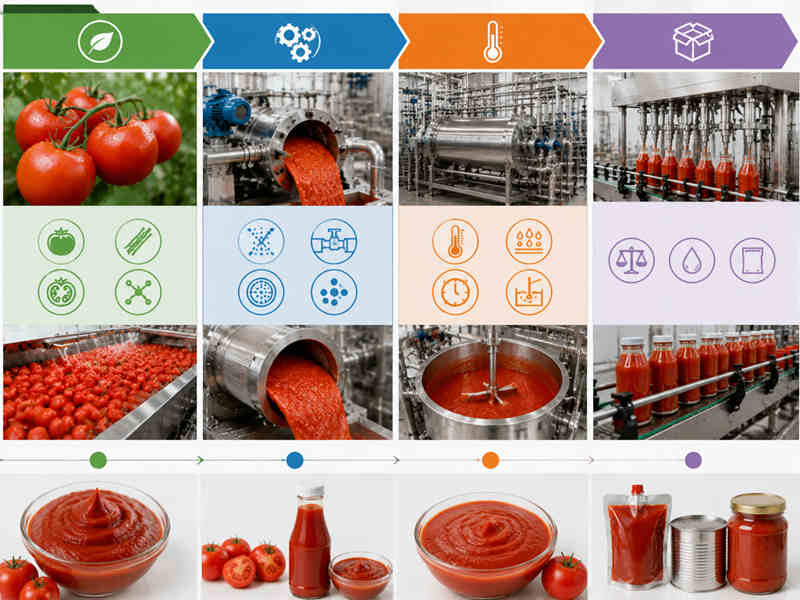
Manufacturers ought to evaluate multiple vital process variables before examining frequent texture-related flaws.
Raw Material Characteristics
- Tomato variety
- Fiber content
- Ripeness level
- Soluble solid content
Mechanical Processing
- Crushing intensity
- Pulp transfer stability
- Refining efficiency
- Particle size distribution
Thermal & Concentration Control
- Heating method
- Evaporation efficiency
- Residence time
- Mixing performance
Packaging Compatibility
- Filling accuracy
- Product flow behavior
- Package format
Tomato goods possess divergent texture requirements. Although paste and ketchup production may share similar equipment types, their system configurations need to be differentiated.
Excessive Fiber Residue and Rough Mouthfeel
Undesired surplus fiber stands among the most frequent texture-related issues for mass-produced tomato food items.
It usually appears as:
- Rough mouthfeel
- Visible particles
- Uneven product appearance
- Reduced smoothness
Tomato skins, seeds and coarse fibers need to be separated during processing while maintaining enough pulp structure.
Achieving optimal equilibrium poses a major challenge. Excessive separation weakens the natural traits of tomato, and incomplete refining will exert negative impacts on end-product quality.
Processing Points
- Raw Tomato Preparation
Consistent feed flow enables steady running of subsequent processing equipment. Acting as a buffered feeder ahead of washing procedures, the Fruit Receiving Hopper supports structural customization based on throughput, layout constraints and raw material handling needs.
- Washing and Sorting
The Fruit Washing Sorting Lifting Monobloc consolidates multiple pre-treatment stages, removing contaminants and enhancing raw tomato uniformity ahead of crushing operations.
- Crushing and Refining
Tomato material efficiency for subsequent refining hinges on the crushing phase. Equipped with thrusters, the crushing transfer pump realizes continuous comminution and delivery, stabilizing the flow of tomato pulp.
After crushing, the Peeling Pulping and Refining Machine separates skins, seeds and unwanted fiber particles.
For different products:
| Product | Texture Requirement | Refining Focus |
| Tomato Paste | Dense and smooth structure | Higher separation efficiency |
| Ketchup | Fine and uniform texture | Smaller particle control |
| Tomato Puree | Natural pulp feeling | Balanced refining |
Phase Separation During Storage
If tomato solid and liquid fractions lose structural stability as time passes, phase separation will emerge. The concern is particularly prominent for goods stored prior to filling or delivery. Its frequent symptoms include:
- Liquid accumulation
- Uneven consistency
- Different viscosity between batches
Manufacturers often underestimate storage procedures. Proper holding conditions are necessary for tomato products after refining and before further processing. The Raw Tomato Paste Storage Tank offers regulated storage space for treated tomato raw materials.
Important design factors include:
- Tank capacity
- Internal mixing structure
- Product inlet and outlet design
- Cleaning requirements
Rationally designed storage facilities sustain consistent product quality before thermal treatment, evaporation or filling operations.
Uneven Particle Distribution
For mass-produced tomato products, controlled particle size distribution matters more than reducing particles to the smallest extent. Each type of tomato product has unique texture standards.
For example:
- Tomato sauce requires smooth flow.
- Tomato puree may retain more natural pulp.
- Tomato paste requires concentrated and stable structure.
Uneven particle distribution usually results from:
- Unstable crushing conditions
- Incorrect refining settings
- Poor coordination between processing stages
Equipment Selection for Texture Control
| Processing Stage | Equipment | Main Function |
| Raw material handling | Fruit Receiving Hopper | Stable feeding |
| Washing and preparation | Fruit Washing Sorting Lifting Monobloc | Cleaning and sorting |
| Crushing | Crushing Transferring Pump with Thruster | Pulp production |
| Refining | Peeling Pulping and Refining Machine | Texture adjustment |
| Storage | Raw Tomato Paste Storage Tank | Product stability |
Texture Reduction After Thermal Processing
Industrial tomato foods require thermal processing, though excessive heat will alter viscosity and product microstructure. Heating triggers structural transformations in tomato components; temperature management needs to satisfy safety standards while protecting texture.
The Tomato Tubular Preheater delivers continuous preheating prior to sterilization or evaporation.
Its design supports:
- Stable heat transfer
- Continuous production
- Integration with automatic processing lines
For combined mixing and sterilization processes, the Stainless Steel Mixing Tank & Sterilization Tank provides a flexible solution.
It can be configured according to:
- Production volume
- Heating requirements
- Automation level
- Product viscosity
Excessive Thickening During Concentration
For tomato paste and high-viscosity tomato products, concentration is an indispensable procedure. Instead of only elevating consistency, the process needs to guarantee appropriate flow characteristics throughout storage, transportation and filling.
Excessive thickening may cause:
- Difficult pumping
- Uneven filling
- Reduced production efficiency
The Scrape Type Vacuum Evaporator helps control concentration by adjusting evaporation conditions.
Compared with uncontrolled concentration methods, vacuum evaporation provides better flexibility for manufacturers producing different tomato products.
Concentration Control Factors
- Target solids content
- Evaporation speed
- Product temperature
- Mixing performance
For factories producing multiple products, Custom evaporation solutions can be designed according to different viscosity requirements.
Filling Problems Caused by Incorrect Texture
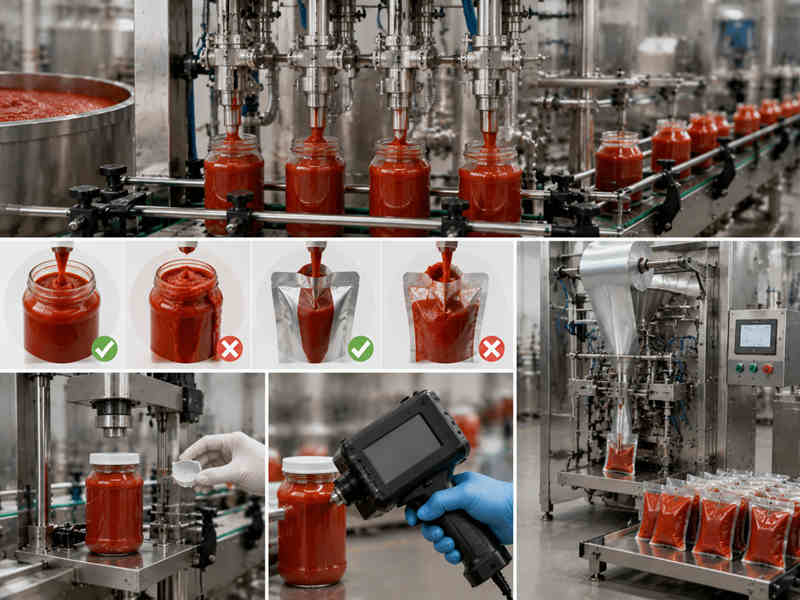
A product that cannot flow consistently may create:
- Uneven filling volume
- Product residue
- Packaging efficiency problems
Thick tomato paste and viscous sauces require stronger filling capability compared with thinner tomato products.
The Viscous Product Filling Machine is designed for high-viscosity products, helping manufacturers achieve stable filling performance.
For flexible packaging, the Pouch Forming Filling Seaming Coding Monoblock integrates:
- Pouch forming
- Product filling
- Sealing
- Coding
For bottle packaging, the Semi-auto Capping Machine provides flexible closing operations.
The Handheld Inkjet Printer supports production identification, including batch numbers and manufacturing information.
| Packaging Type | Equipment Solution | Application |
| Bottle container | Semi-auto Capping Machine | Bottle sealing |
| Thick sauce filling | Viscous Product Filling Machine | High viscosity products |
| Flexible pouch | Pouch Forming Filling Seaming Coding Monoblock | Integrated pouch production |
| Product marking | Handheld Inkjet Printer | Batch and date coding |
Custom Tomato Processing Equipment Configuration
Industrial tomato processing lines ought to be engineered based on product specifications instead of adopting standardized equipment configurations.
Key customization factors include:
Product Characteristics
- Tomato variety
- Viscosity range
- Texture preference
- Soluble solid target
Production Requirements
- Processing capacity
- Automation level
- Factory layout
- Cleaning requirements
Packaging Requirements
- Bottle
- Can
- Pouch
- Bulk container
A complete Custom tomato processing line may include:
Receiving → Washing → Sorting → Crushing → Refining → Storage → Heating → Evaporation → Sterilization → Filling → Coding
For example, a tomato paste manufacturer may combine:
- Fruit Receiving Hopper
- Fruit Washing Sorting Lifting Monobloc
- Crushing Transferring Pump with Thruster
- Peeling Pulping and Refining Machine
- Raw Tomato Paste Storage Tank
- Scrape Type Vacuum Evaporator
- Viscous Product Filling Machine
Texture imperfections within industrial tomato goods often arise from disjointed processing phases. All equipment choices spanning raw tomato pretreatment to packaging exert impacts on the uniformity of end products.
Customized processing installations maintain stable viscosity and texture. Matching crushing, thermal treatment and filling equipment allows factories to establish efficient lines suited for varied markets and packaging styles.